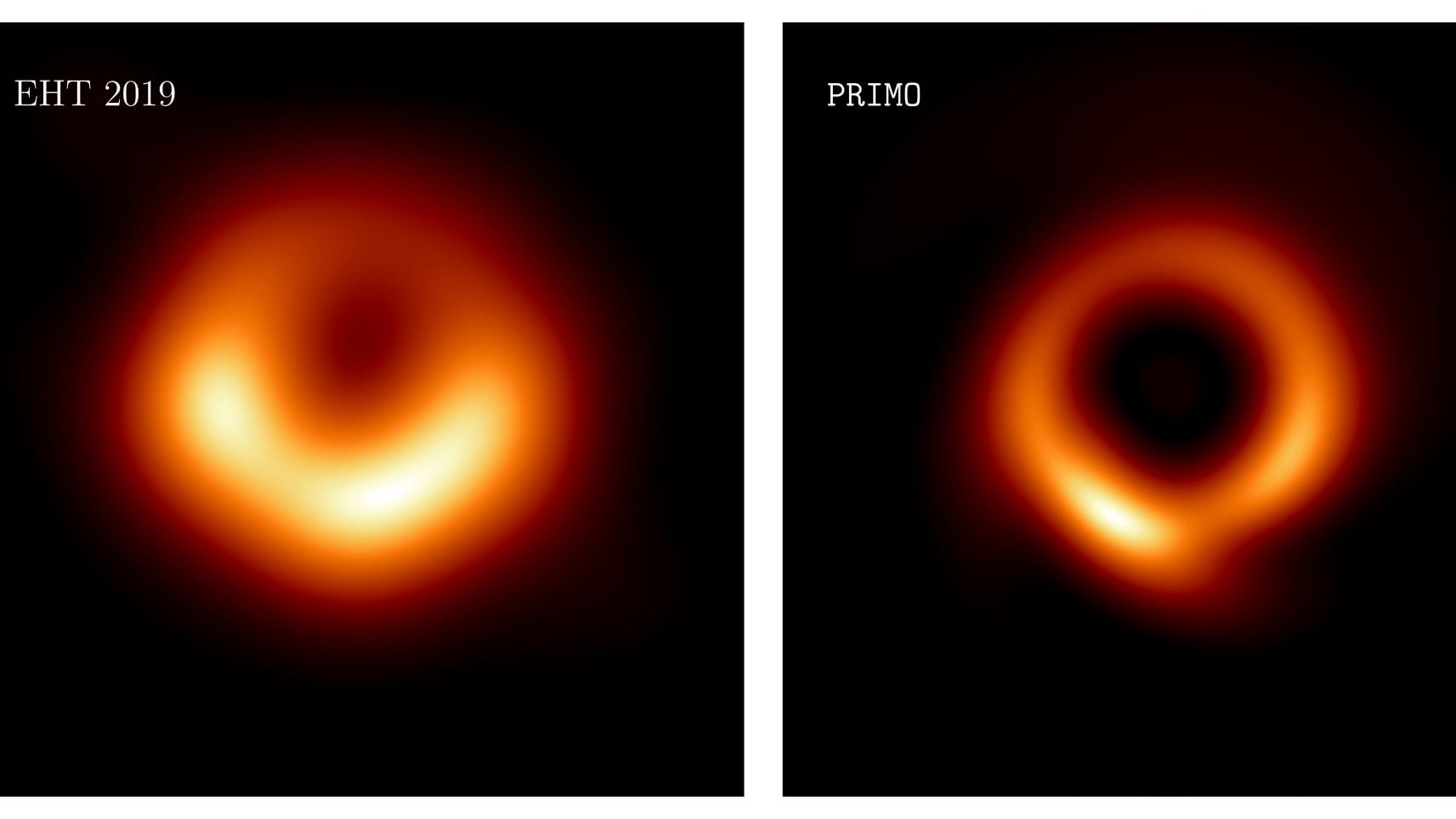
This combination of images provided by researcher Lia Medeiros shows images of the M87 black hole released in 2019, left, and an updated one for 2023. The new version, published Thursday, April 13, 2023, in the Astrophysical Journal Letters — keeps the original shape, but with a skinnier ring and a sharper resolution. Even with many telescopes working together, gaps remained in the data. In the latest study, scientists relied on the same data and used machine learning to fill in the missing pieces. (Lia Medeiros via AP)
By Maddie Burakoff
The first image of a black hole captured four years ago revealed a fuzzy, fiery doughnut-shaped object. Now, researchers have used artificial intelligence to give that cosmic beauty shot a touch-up.
The updated picture, published Thursday in the Astrophysical Journal Letters, keeps the original shape, but with a skinnier ring and a sharper resolution.
The image released in 2019 gave a peek at the enormous black hole at the center of the M87 galaxy, 53 million light-years from Earth. A light-year is 5.8 trillion miles. It was made using data gathered by a network of radio telescopes around the world, showing swirling light and gas.
But even with many telescopes working together, gaps remained in the data. In the latest study, scientists relied on the same data and used machine learning to fill in the missing pieces.
The resulting picture looks similar to the original, but with a thinner “doughnut” and a darker center, researchers said.
“For me, it feels like we’re really seeing it for the first time,” said lead author Lia Medeiros, an astrophysicist at the Institute for Advanced Study in New Jersey.
By having a clearer picture, researchers hope to learn more about the black hole’s properties and gravity in future studies. And Medeiros said the team plans to use machine learning on other images of celestial objects, including possibly the black hole at the center of our Milky Way galaxy.
___
The Associated Press Health and Science Department receives support from the Howard Hughes Medical Institute’s Science and Educational Media Group. The AP is solely responsible for all content.
Jared Madfes, Partner at Tribe Capital, joins Cheddar's Closing Bell, where he says crypto investors should continue to focus on the long-term despite the recent price boost in the hours following Wednesday's Fed decision.
Mobile bill payment application Papaya recently raised $50 million in a series B round led by Bessemer Venture Partners.
Papaya lets users take a photo of any bill, and the app's AI-powered 'bill understanding technology' pays the bill in seconds. The company says its goal is to help people spend more time on things that matter, by making bill-paying as painless and quick as possible. Papaya CEO and co-founder Patrick Kann joined Cheddar News' Closing Bell to discuss.
If you're looking for a date, 2022 might be your year. Online dating platform Bumble is buzzing with dating predictions from its latest survey. Shan Boodram, sex and relationships expert at Bumble, joined Cheddar to discuss some of the findings and what people can expect from the future dating landscape. Some of the results showed that public displays of affection are back on the rise as more people get vaccinated and that more users are opting for alcohol-free first dates. She also explained the trend of "explori-dating," a way that users are attempting to get out of their comfort zone. "People are willing to date outside of their city to get to that," she said.
Anthony Martini, Chief Music Officer of Slip.stream, and Jesse Korwin, CMO of Slip.stream, talk about the challenges creators have uploading music on Twitch and how 'Slip.stream' prioritizes artists by streamlining the licensing process.
On this episode of Cheddar Innovates: Nucleus CEO breaks down what the future of the genomics industry looks like; Biomilq Co-Founders explains how they are is recreating the process of milk production outside the body to combine both nutrition and practicality for new moms; A look at Curiosity Stream's 'Top Science Stories 2021.'
On this episode of Cheddar Innovates: Omorpho Co-Founder explains the innovation driving gravity sportswear; Cool Beans CEO breaks down the science behind 'good mood food;' A look at Curiosity Stream's 'Building The James Webb Telescope.'
The U.S. postal service has confirmed that it secretly developed and tested a blockchain-based mobile voting system ahead of the 2020 election. Susan Greenhalgh, senior advisor on election security, Free Speech for People, joins Cheddar News to discuss the cybersecurity complications of a mobile voting system.