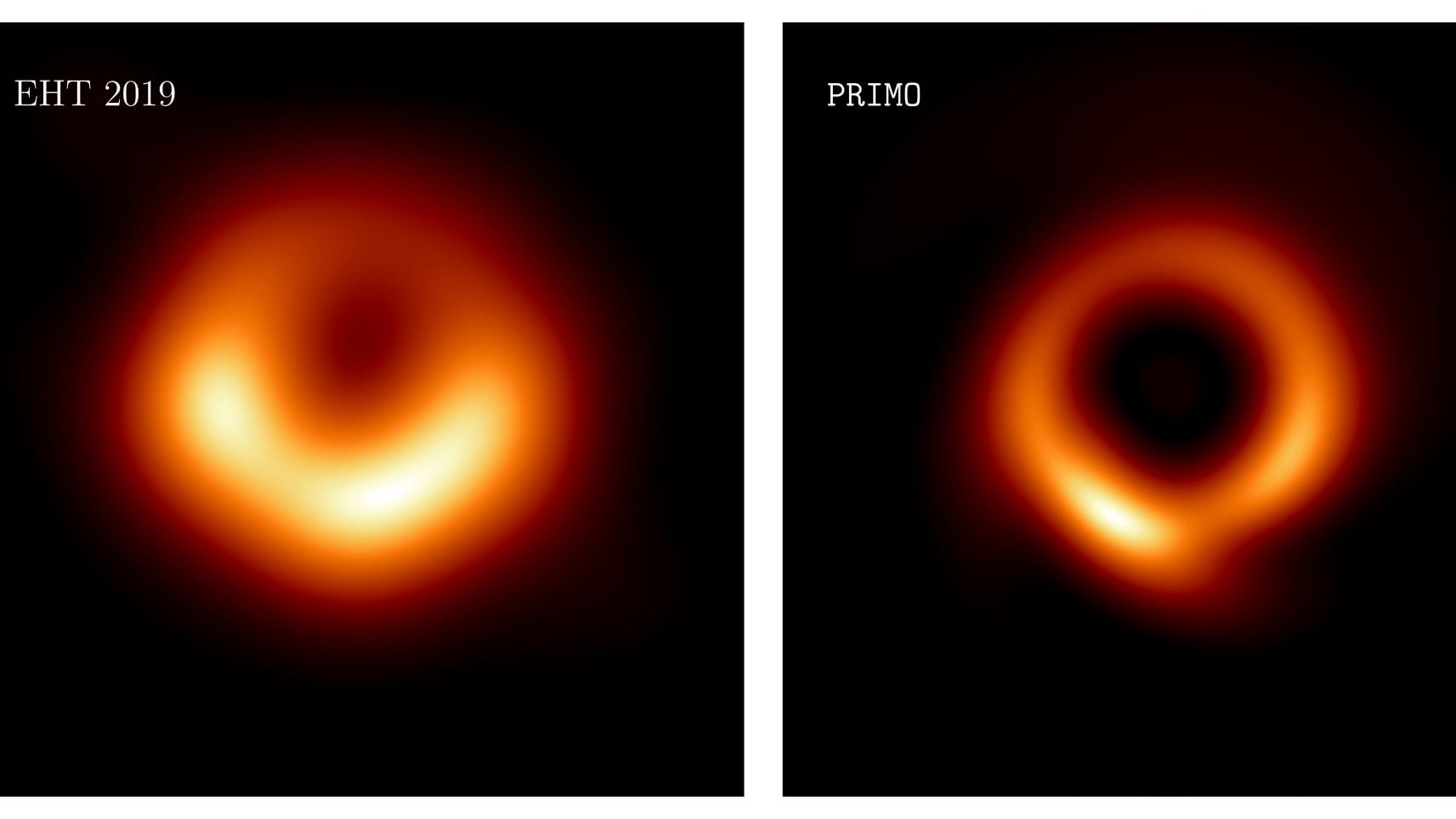
This combination of images provided by researcher Lia Medeiros shows images of the M87 black hole released in 2019, left, and an updated one for 2023. The new version, published Thursday, April 13, 2023, in the Astrophysical Journal Letters — keeps the original shape, but with a skinnier ring and a sharper resolution. Even with many telescopes working together, gaps remained in the data. In the latest study, scientists relied on the same data and used machine learning to fill in the missing pieces. (Lia Medeiros via AP)
By Maddie Burakoff
The first image of a black hole captured four years ago revealed a fuzzy, fiery doughnut-shaped object. Now, researchers have used artificial intelligence to give that cosmic beauty shot a touch-up.
The updated picture, published Thursday in the Astrophysical Journal Letters, keeps the original shape, but with a skinnier ring and a sharper resolution.
The image released in 2019 gave a peek at the enormous black hole at the center of the M87 galaxy, 53 million light-years from Earth. A light-year is 5.8 trillion miles. It was made using data gathered by a network of radio telescopes around the world, showing swirling light and gas.
But even with many telescopes working together, gaps remained in the data. In the latest study, scientists relied on the same data and used machine learning to fill in the missing pieces.
The resulting picture looks similar to the original, but with a thinner “doughnut” and a darker center, researchers said.
“For me, it feels like we’re really seeing it for the first time,” said lead author Lia Medeiros, an astrophysicist at the Institute for Advanced Study in New Jersey.
By having a clearer picture, researchers hope to learn more about the black hole’s properties and gravity in future studies. And Medeiros said the team plans to use machine learning on other images of celestial objects, including possibly the black hole at the center of our Milky Way galaxy.
___
The Associated Press Health and Science Department receives support from the Howard Hughes Medical Institute’s Science and Educational Media Group. The AP is solely responsible for all content.
Paul Travers, CEO of Vuzix, joins Cheddar News to discuss the different scenarios that its augmented reality smart glasses can be used for and his outlook for this technology in 2022.
This year saw big developments in the sector, including the rise of cryptocurrency, announcements about new metaverse and virtual worlds, increased consumer interest in wearable tech, and more. What does 2022 have in store for these aspects of the tech world, and what else can we expect? Hatem Dhiab, Managing Partner at Gerber Kawasaki, joins Cheddar News' Closing Bell to discuss.
With the rollout of 5G technology, mobile phone users are experiencing faster device performance. But as the tech becomes more widely available, 5G won't just make our phones operate faster. Digital productivity across the board is expected to rise. Hugh Odom, founder and president of Vertical Consultants, joined Cheddar's "Closing Bell" to talk about his company's predictions for 5G, including more streamlined virtual doctor visits and helping supply chains become more efficient. Odom also talked about the airline industry's request to the Biden administration to delay the wider rollout of 5G, as they said it will interfere with flying safety.
Jurors in the trial against Theranos CEO Elizabeth Holmes have entered day six of deliberations. Holmes is accused of lying to investors about the functionality of a newly developed blood-testing technology. Andrew George, partner at Baker Botts, joined Cheddar to break down key points in the case and what the jury might be considering during their deliberations. He also noted that the rest of Silicon Valley, including Holmes' business partner, Ramesh "Sunny" Balwani, who is facing identical charges, is closely watching the outcome of deliberations — as it could set the tone for future regulations and Balwani's own trial.
While slumps within the crypto market have typically correlated with major developments, such as China's crypto crackdown or Tesla reversing course on accepting bitcoin, the current slide is coming at a time when the stock market is at or near record levels. Reporter Alex Vuocolo talks about the role of the crypto derivatives market in bitcoin's latest price drop, as well as the future of sustainability in the space.