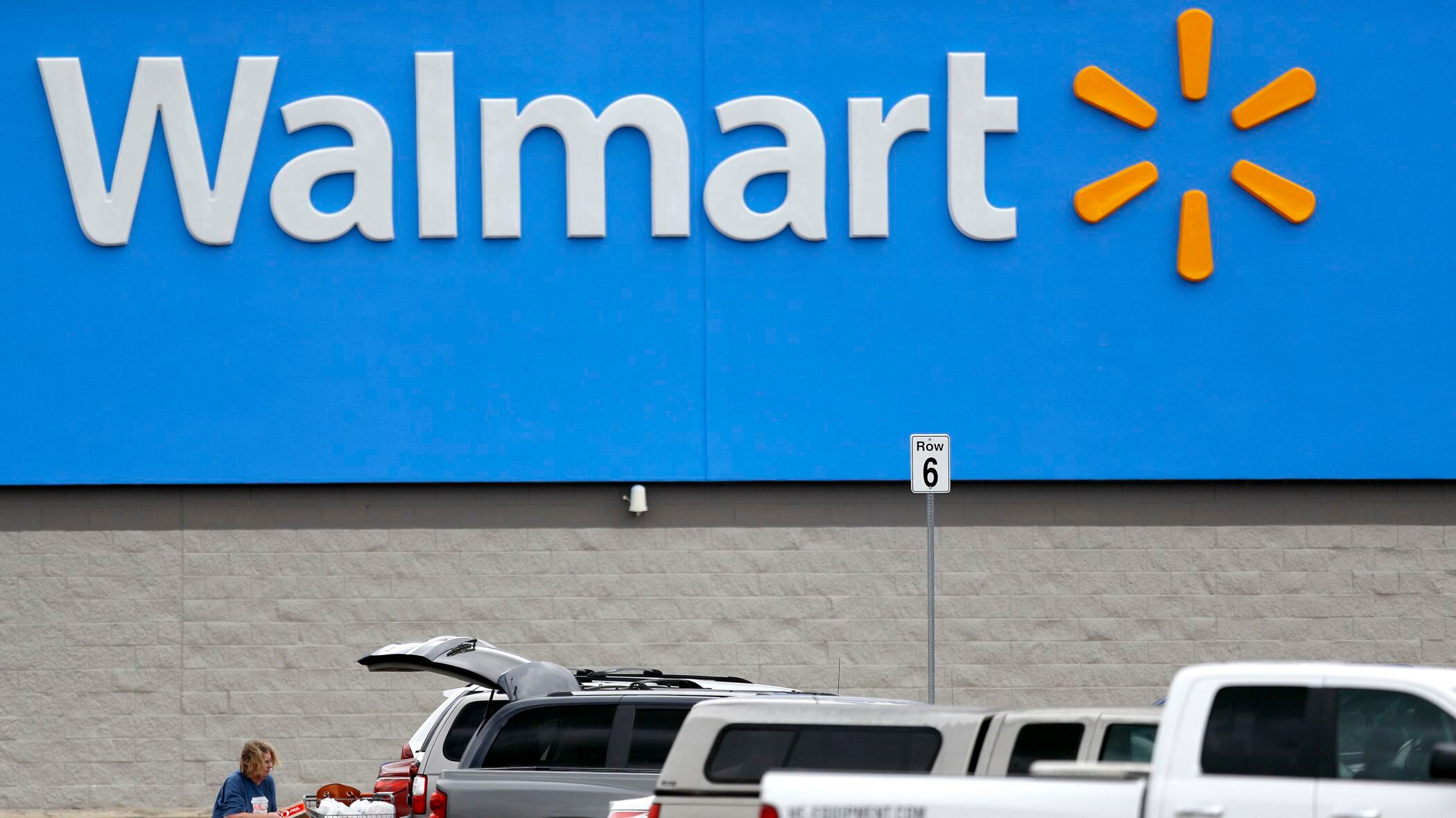
In this March 31, 2020 file photo, a woman pulls groceries from a cart to her vehicle outside of a Walmart store in Pearl, Miss. Walmart is teaming with the General Motors' Cruise autonomous vehicle unit to test automated package delivery in Arizona. (AP Photo/Julio Cortez, File)
By Michael Balsamo and Ann D'Innocenzio
The Justice Department is suing Walmart, alleging the company unlawfully dispensed controlled substances through its pharmacies, helping to fuel the opioid crisis in America.
The civil complaint being filed Tuesday points to the role Walmart’s pharmacies may have played in the crisis by filling opioid prescriptions and by unlawfully distributing controlled substances to the pharmacies during the height of the opioid crisis. Walmart operates more than 5,000 pharmacies in its stores around the country.
The Justice Department alleges Walmart violated federal law by selling thousands of prescriptions for controlled substances that its pharmacists “knew were invalid,” said Jeffrey Clark, the acting assistant attorney general in charge of the Justice Department’s civil division.
Federal law required Walmart to spot suspicious orders for controlled substances and report those to the Drug Enforcement Administration, but prosecutors charge the company didn’t do that. Walmart couldn’t immediately be reached for comment.
“Walmart knew that its distribution centers were using an inadequate system for detecting and reporting suspicious orders,” said Jason Dunn, the U.S. attorney in Colorado. “As a result of this inadequate system, for years Walmart reported virtually no suspicious orders at all. In other words, Walmart’s pharmacies ordered opioids in a way that went essentially unmonitored and unregulated.”
The suit alleges that Walmart made it difficult for its pharmacists to follow the rules, putting “enormous pressure" on them to fill a high volume of prescriptions as fast as possible, while at the same time denying them the authority to categorically refuse to fill prescriptions issued by prescribers the pharmacists knew were continually issuing invalid prescriptions.
AP reported the news of the lawsuit ahead of the Justice Department's public announcement, citing a person who could not discuss the matter publicly before the announced move. The person spoke to the AP on condition of anonymity.
The Justice Department’s lawsuit comes nearly two months after Walmart filed its own preemptive suit against the Justice Department, Attorney General William Barr, and the Drug Enforcement Administration.
In its lawsuit, Walmart said the Justice Department’s investigation — launched in 2016 — had identified hundreds of doctors who wrote problematic prescriptions that Walmart’s pharmacists should not have filled. But the lawsuit charged that nearly 70% of the doctors still have active registrations with the DEA.
Walmart’s lawsuit alleged the government was blaming it for the lack of regulatory and enforcement policies to stem the crisis. The company is asking a federal judge to declare the suit has no basis to seek civil damages. That suit remains ongoing.
The initial investigation was the subject of a ProPublica story published in March. ProPublica reported that Joe Brown, then U.S. attorney for the Eastern District of Texas office, spent years pursuing a criminal case against Walmart for its opioid prescription practices, only to have it stymied after the retail giant’s lawyers appealed to senior officials in the Justice Department.
Two months later, Brown resigned. He didn’t give a reason for his departure except to say he would be “pursuing opportunities in the private and public sectors." Brown went into private practice in the Dallas area.
Updated on December 22, 2020, at 3:44 p.m. ET with additional details.
The nation's largest vacation rental management company, Vacasa, made its public debut on the Nasdaq via a SPAC merger with TPG Pace Solutions. CEO Matt Roberts joined Cheddar to talk about the company's better-than-expected success and the plans to leverage its IPO to expand the business and refine Vacasa's tech. He noted that with five million second homes across the country, the company has much more room to grow as it currently has just 35,000 rental properties in 400 locations available. Roberts also said that there has been no impact on bookings due to the omicron variant of COVID-19.
Marvel's "Shang-Chi and the Legend of the Ten Rings" is gearing up for a sequel following its earlier this year topping the domestic box office to date. Destin Daniel Cretton will return to write and direct while also taking on additional projects in a multi-year deal.
Online platform Assemble is looking to provide career instruction and inspiration to Black, Indigenous, People of Color (BIPOC) of all age groups for access to industries they might not have been privy to prior. Actor, activist, and one of Assemble's three co-founders, Jesse Williams, and CEO Cortney Woodruff joined Cheddar's "Between Bells" to discuss the Assemble mission and what people can expect from the program. "There's a lot of jobs that folks don't know even exist in the first place, and what we know is that there are incredible innovators at the peak of their field that are Black and brown – in every single field," Williams noted.
Payoneer CEO Scott Galit joined Wake Up With Cheddar to talk about the company's partnership with Walmart to provide working capital to retailers on Walmart's marketplace.
As the country continues to bounce back from the job losses felt at the start of the pandemic, businesses are still struggling to fill jobs, mainly due to the record number of people who have voluntarily left the workforce. and experts say that the challenge of finding the people to fill those roles will likely follow us well into 2022. Beth Ann Bovino, U.S. Chief Economist at S&P Global Ratings explains what’s behind the ‘Great Resignation’.
Between uncertainty over the Omicron variant, and the possibility of a sooner-than-expected taper from the Fed, it was an especially volatile week for the markets. The release of the November jobs report on Friday, with job growth coming in way lower than estimates also caused movement on the market. Frances Stacy, Director of Strategy at Optimal Capital explains why all of this, combined with Bitcoin’s huge drop over the weekend, could make for another rough week for investors.
It was a chaotic week for the market, as investors reacted to the new omicron variant. Today though is all about jobs. Just ahead of the November jobs report, David Riley, Chief Investment Strategist at Blue Bay Asset management gave a run down of what to expect from the report, and what it could mean for investors.
Developers for the video game "Call of Duty: Warzone" staged a walkout in protest of 12 quality assurance testers being laid off by parent company Activision Blizzard. This marks the latest work stoppage for the embattled game publishing giant.
Troubled Chinese real estate giant Evergrande is once again nearing the brink of collapse. Shares of Evergrande sunk to a new record low on Monday, closing down 20 percent, as debt default fears resurfaced. Drew Bernstein, co-chairman at consultancy MarcumBP, joined Cheddar's Opening Bell to discuss. He said U.S. investors have to understand that "there is no company in China that's too big to fail, that's for sure," and that the Chinese government will be prioritizing the social welfare of the populace. Bernstein did note that it would be a managed collapse in some form.
Earlier this year, JetBlue flew its inaugural flight into the United Kingdom. It was a game changer — not only did the airline enter the transatlantic market, but the plane that completed the flight was a single-aisle jet. For decades, flying the distance was synonymous with jumbo jets, but today narrow-body aircraft are now proving they are up for the task — and maybe even the best option. In this episode, Cheddar examines why airlines are betting on narrow-body aircraft.