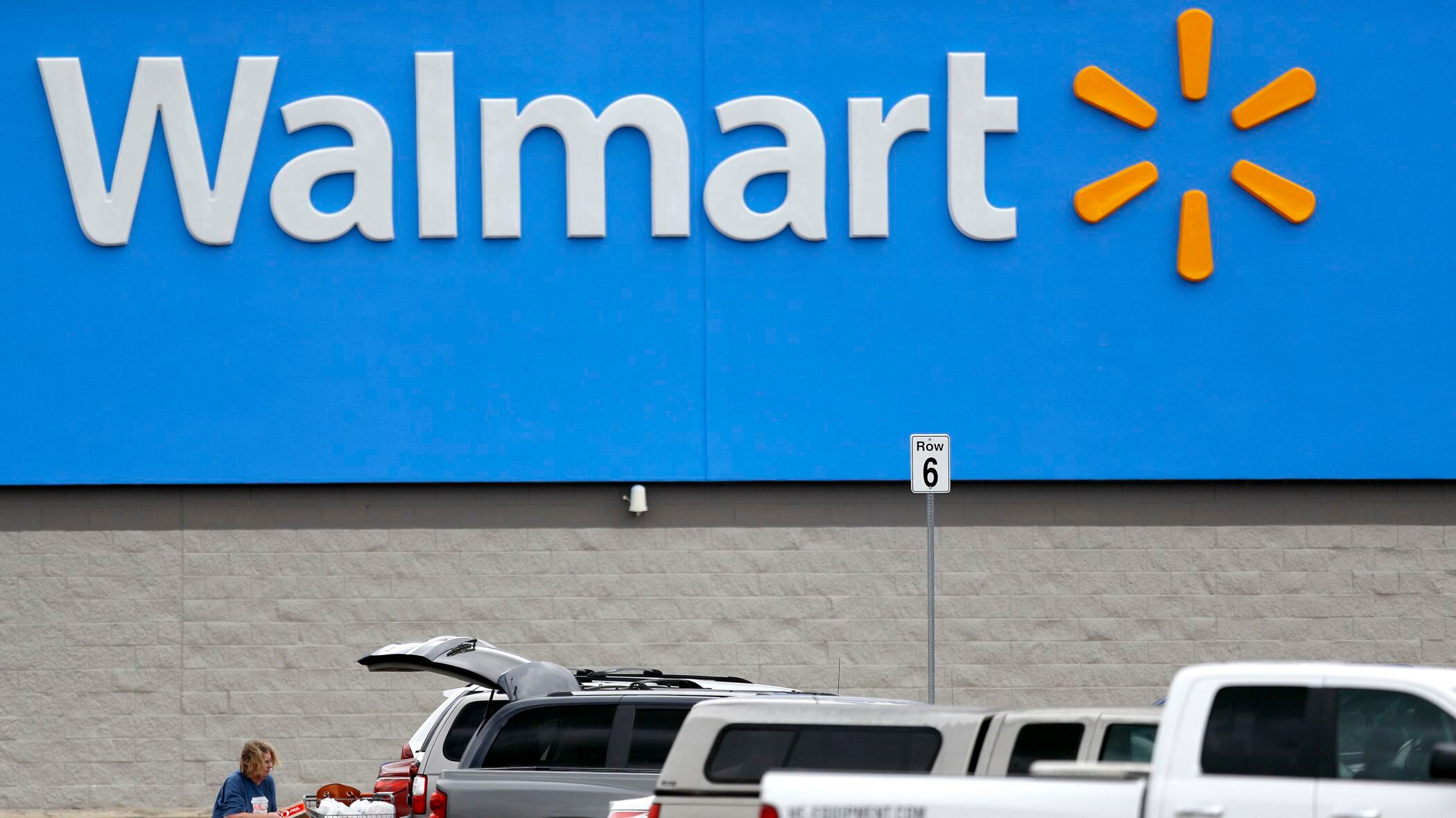
In this March 31, 2020 file photo, a woman pulls groceries from a cart to her vehicle outside of a Walmart store in Pearl, Miss. Walmart is teaming with the General Motors' Cruise autonomous vehicle unit to test automated package delivery in Arizona. (AP Photo/Julio Cortez, File)
By Michael Balsamo and Ann D'Innocenzio
The Justice Department is suing Walmart, alleging the company unlawfully dispensed controlled substances through its pharmacies, helping to fuel the opioid crisis in America.
The civil complaint being filed Tuesday points to the role Walmart’s pharmacies may have played in the crisis by filling opioid prescriptions and by unlawfully distributing controlled substances to the pharmacies during the height of the opioid crisis. Walmart operates more than 5,000 pharmacies in its stores around the country.
The Justice Department alleges Walmart violated federal law by selling thousands of prescriptions for controlled substances that its pharmacists “knew were invalid,” said Jeffrey Clark, the acting assistant attorney general in charge of the Justice Department’s civil division.
Federal law required Walmart to spot suspicious orders for controlled substances and report those to the Drug Enforcement Administration, but prosecutors charge the company didn’t do that. Walmart couldn’t immediately be reached for comment.
“Walmart knew that its distribution centers were using an inadequate system for detecting and reporting suspicious orders,” said Jason Dunn, the U.S. attorney in Colorado. “As a result of this inadequate system, for years Walmart reported virtually no suspicious orders at all. In other words, Walmart’s pharmacies ordered opioids in a way that went essentially unmonitored and unregulated.”
The suit alleges that Walmart made it difficult for its pharmacists to follow the rules, putting “enormous pressure" on them to fill a high volume of prescriptions as fast as possible, while at the same time denying them the authority to categorically refuse to fill prescriptions issued by prescribers the pharmacists knew were continually issuing invalid prescriptions.
AP reported the news of the lawsuit ahead of the Justice Department's public announcement, citing a person who could not discuss the matter publicly before the announced move. The person spoke to the AP on condition of anonymity.
The Justice Department’s lawsuit comes nearly two months after Walmart filed its own preemptive suit against the Justice Department, Attorney General William Barr, and the Drug Enforcement Administration.
In its lawsuit, Walmart said the Justice Department’s investigation — launched in 2016 — had identified hundreds of doctors who wrote problematic prescriptions that Walmart’s pharmacists should not have filled. But the lawsuit charged that nearly 70% of the doctors still have active registrations with the DEA.
Walmart’s lawsuit alleged the government was blaming it for the lack of regulatory and enforcement policies to stem the crisis. The company is asking a federal judge to declare the suit has no basis to seek civil damages. That suit remains ongoing.
The initial investigation was the subject of a ProPublica story published in March. ProPublica reported that Joe Brown, then U.S. attorney for the Eastern District of Texas office, spent years pursuing a criminal case against Walmart for its opioid prescription practices, only to have it stymied after the retail giant’s lawyers appealed to senior officials in the Justice Department.
Two months later, Brown resigned. He didn’t give a reason for his departure except to say he would be “pursuing opportunities in the private and public sectors." Brown went into private practice in the Dallas area.
Updated on December 22, 2020, at 3:44 p.m. ET with additional details.
Garrett Nelson, Senior Analyst and VP of Equity Research at CFRA Research, joins Cheddar News' Closing Bell, where he breaks down where automakers like Ford, Tesla, Rivian, and Lucid currently stand at the start of 2022 and what we should expect to transpire in the upcoming year.
Fintech startup Milo has launched what it says to be the world's first crypto mortgage. As part of the offering, clients will be able to use Bitcoin as collateral to purchase property and qualify for a 30-year loan. Josip Rupena, CEO and Founder of Milo, joins Cheddar News' Closing Bell, where he explains how this offering is a winning solution for crypto investors who want to invest in real estate.
Software company BigPanda recently raised $190 million in Series D funding, led by Advent International and Insight Partners. The funding round gives the company unicorn status with a $1.2 billion valuation. BigPanda develops A.I. software that detects and analyzes problems in I.T. systems. The company says it aims to be the solution for other companies that do not have enough manpower to manage their data, as more and more industries continue to build a broader digital presence. BigPanda co-founder and CEO Assaf Resnick joined Cheddar News' Closing Bell to discuss.
AT&T and Verizon have agreed to delay activating their 5G services around airports due to safety concerns. This comes after major U.S. airlines voiced their concern over the rollout of 5G technology, warning of an impending "catastrophic" aviation crisis. Hugh Odom, founder and president of Vertical Consultants, telecom expert, and former AT&T attorney, joined Cheddar Movers to discuss.
Melissa Armo, founder and CEO of The Stock Swoosh, breaks down the factors affecting profitability for banks this year and highlights opportunities within the financial sector.
While more inflation means higher prices, some businesses are looking for alternatives to avoid scaring off their customers. 'Shrinkflation,' a fancy word for downsizing, happens when companies reduce the size or quantity of their products while still charging the same prize... or even more.
Chris Markowski, 'Watchdog on Wall Street' host and president of Markowski Investments, joins Cheddar News to discuss.
The list of banks reducing or cutting overdraft fees has just grown. Both Bank of America and Wells Fargo have announced plans to end non-sufficient funds and overdraft fees. It's a move that economists are calling 'brilliant,' and is sure to hike up the pressure on large national and regional banks to follow in their footsteps. Greg McBride, the chief financial analyst at Bankrate, joins Cheddar News to discuss.
In fashion, the term "nude" is a common description of a shade slightly darker than champagne with a hint of blush or peach, but how does that translate to the wearer's skin tone? One shapewear brand's mission is to make sure "nude" is as inclusive as possible. Erin Carpenter, founder of Nude Barre, joined All Hands to discuss.
Tech giants Meta, Amazon, Alphabet, and Apple are faced with a bipartisan antitrust legislation effort underway in the Senate Judiciary Committee. The companies stand accused of promoting their own goods and services over smaller competitors on their platforms, holding too much monopolistic power via their app stores and services. Adam Kovacevich, founder and CEO of Chamber of Progress, a technology industry trade group, joined Cheddar to argue that the bills that are being debated currently could end up hurting consumers, rather than helping.
A saving grace for offices during pandemic lockdowns, video communication platform Zoom announced its own plans for doors to reopen from its Work Transformation Summit 2022. Dubbed Workstyles, CFO Kelly Steckelberg joined Cheddar to discuss the self-reported, tiered levels for how employees will be reporting going forward, from the majority of workers going hybrid to personnel who will work fully from home or the office where it makes sense. Steckelberg also talked about the company's plans for the future, stating “what we can control is our own execution," as Zoom's stock hit a 52-week low.