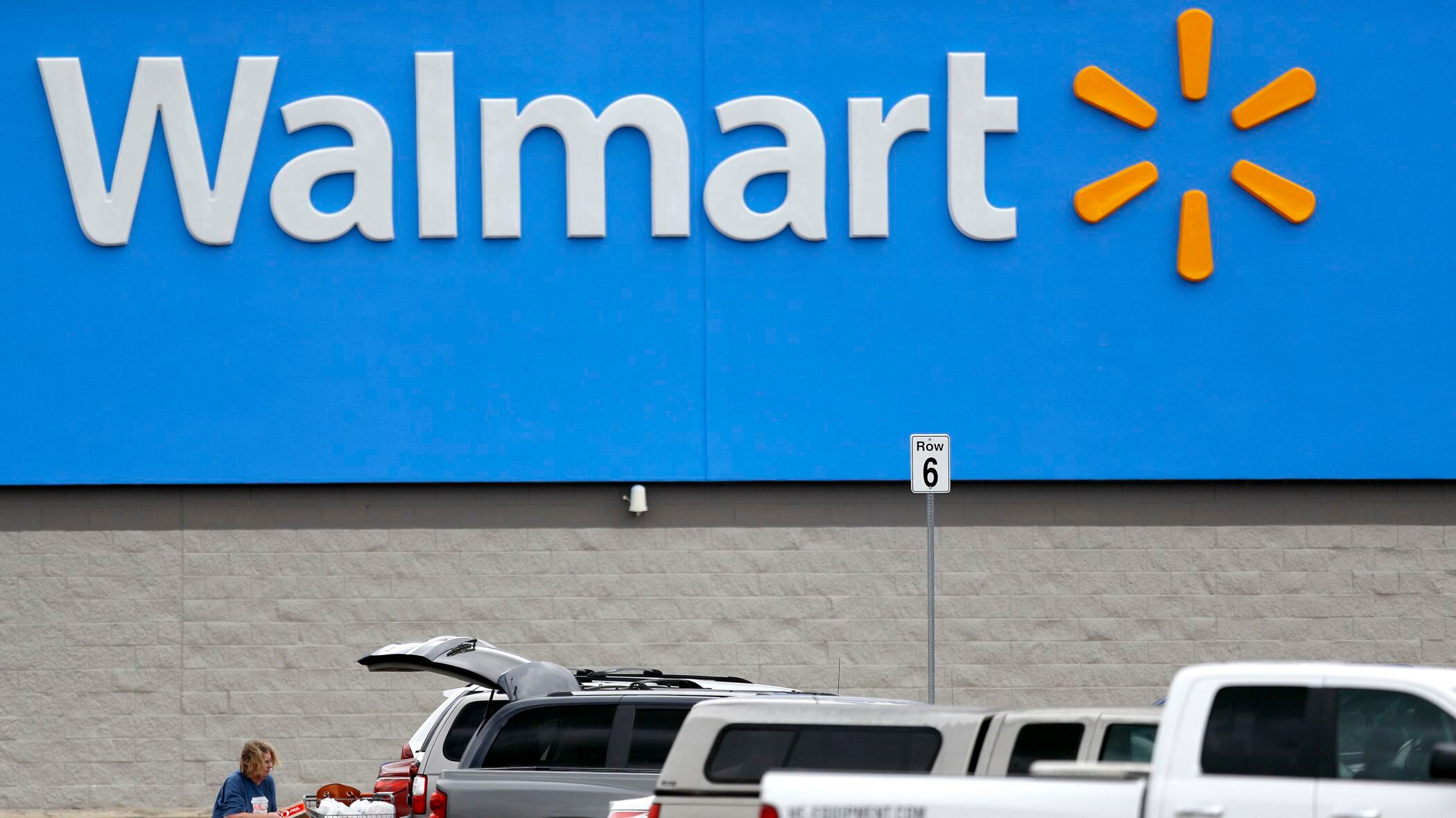
In this March 31, 2020 file photo, a woman pulls groceries from a cart to her vehicle outside of a Walmart store in Pearl, Miss. Walmart is teaming with the General Motors' Cruise autonomous vehicle unit to test automated package delivery in Arizona. (AP Photo/Julio Cortez, File)
By Michael Balsamo and Ann D'Innocenzio
The Justice Department is suing Walmart, alleging the company unlawfully dispensed controlled substances through its pharmacies, helping to fuel the opioid crisis in America.
The civil complaint being filed Tuesday points to the role Walmart’s pharmacies may have played in the crisis by filling opioid prescriptions and by unlawfully distributing controlled substances to the pharmacies during the height of the opioid crisis. Walmart operates more than 5,000 pharmacies in its stores around the country.
The Justice Department alleges Walmart violated federal law by selling thousands of prescriptions for controlled substances that its pharmacists “knew were invalid,” said Jeffrey Clark, the acting assistant attorney general in charge of the Justice Department’s civil division.
Federal law required Walmart to spot suspicious orders for controlled substances and report those to the Drug Enforcement Administration, but prosecutors charge the company didn’t do that. Walmart couldn’t immediately be reached for comment.
“Walmart knew that its distribution centers were using an inadequate system for detecting and reporting suspicious orders,” said Jason Dunn, the U.S. attorney in Colorado. “As a result of this inadequate system, for years Walmart reported virtually no suspicious orders at all. In other words, Walmart’s pharmacies ordered opioids in a way that went essentially unmonitored and unregulated.”
The suit alleges that Walmart made it difficult for its pharmacists to follow the rules, putting “enormous pressure" on them to fill a high volume of prescriptions as fast as possible, while at the same time denying them the authority to categorically refuse to fill prescriptions issued by prescribers the pharmacists knew were continually issuing invalid prescriptions.
AP reported the news of the lawsuit ahead of the Justice Department's public announcement, citing a person who could not discuss the matter publicly before the announced move. The person spoke to the AP on condition of anonymity.
The Justice Department’s lawsuit comes nearly two months after Walmart filed its own preemptive suit against the Justice Department, Attorney General William Barr, and the Drug Enforcement Administration.
In its lawsuit, Walmart said the Justice Department’s investigation — launched in 2016 — had identified hundreds of doctors who wrote problematic prescriptions that Walmart’s pharmacists should not have filled. But the lawsuit charged that nearly 70% of the doctors still have active registrations with the DEA.
Walmart’s lawsuit alleged the government was blaming it for the lack of regulatory and enforcement policies to stem the crisis. The company is asking a federal judge to declare the suit has no basis to seek civil damages. That suit remains ongoing.
The initial investigation was the subject of a ProPublica story published in March. ProPublica reported that Joe Brown, then U.S. attorney for the Eastern District of Texas office, spent years pursuing a criminal case against Walmart for its opioid prescription practices, only to have it stymied after the retail giant’s lawyers appealed to senior officials in the Justice Department.
Two months later, Brown resigned. He didn’t give a reason for his departure except to say he would be “pursuing opportunities in the private and public sectors." Brown went into private practice in the Dallas area.
Updated on December 22, 2020, at 3:44 p.m. ET with additional details.
Stocks closed lower Thursday with all three major indexes on track to end the week lower. The tech-heavy Nasdaq is on track for its worst week since March 2020, and is down 12% from its record high. Meanwhile, the Dow closed below its 200-day moving average for the first time since December 2021. The S&P 500 didn't fare much better, falling 1.1%. Christopher Wolfe, Chief Investment Officer at First Republic Private Wealth Management, joins Cheddar News' Closing Bell to discuss today's close, this week's market volatility, and more.
Eric Marshall, portfolio manager, Hodges Funds, joins Cheddar News' Closing Bell, where he says the airlines are still not out of the woods when it comes to their COVID-19 recovery, and also addresses the impact of Omicron and inflation weighing on companies at the start of 2022.
Connected cars software development platform Smartcar announced this week it has raised $24 million in a Series B round led by Energize Ventures. Smartcar's software can be integrated into mobile and web apps from mobility businesses. It allows users to do things like locate and unlock a vehicle, as well as check its mileage, fuel level, and battery if the vehicle is electric. Smartcar's technology is compatible with 22 different vehicle brands in 31 different countries. Smartcar co-founder and CEO Sahas Katta joined Cheddar News' Closing Bell to discuss.
Google currently does not accept cryptocurrency as a form of payment in contrast with other big businesses that have taken advantage of the new crypto wealth that's accrued. The tech giant recently hired former PayPal executive Arnold Goldberg to lead its payment division, likely more firmly entering digital currency usage. "I think the real question is, why given the size of the industry, has Google not done this before or been actively accepting and using cryptocurrency, and it's really a lack of regulatory clarity," Halsey Minor, executive chairman of Public Mint, told Cheddar.
The drama surrounding tennis star Novak Djokovic continues after he was deported from Australia over the weekend due to the nation's COVID-19 vaccine requirements. Djokovic was forced to leave the country on the eve of what was to be his first match in defense of his Australian Open title after three judges ruled in favor of his removal and revealed their reasoning for doing so. Adding to his woes, a law recently passed in France is putting his chances of defending his French Open title in jeopardy. The director of Marist's Center for Sports Communication, Jane McManus, joined Cheddar to discuss the ongoing fallout.
Sports Illustrated Swimsuit is marking the 58th anniversary of its first print issue with the announcement of a new advertising mandate called Pay With Change. The magazine's annual print will now only feature brands who are helping drive gender equality forward, creating a sweeping call to action for the publishing industry. MJ Day, editor-in-chief of SI Swimsuit, joined Cheddar to discuss the goals of the new initiative.
Sonia Thompson, inclusive marketing strategist and consultant, breaks down the need to retool the hiring process and how organizations can make for a better workplace environment.
Netflix is set to report its Q4 earnings after the bell on Thursday. Wall Street is bullish on the streaming giant, estimating it will report its highest total of new subscribers for any quarter in 2021. But the company also faced major hurdles last year, from slowing revenue growth to rising streaming competition to increasing production costs. Chris Legg, senior managing director at Progress Partners, gives a preview.