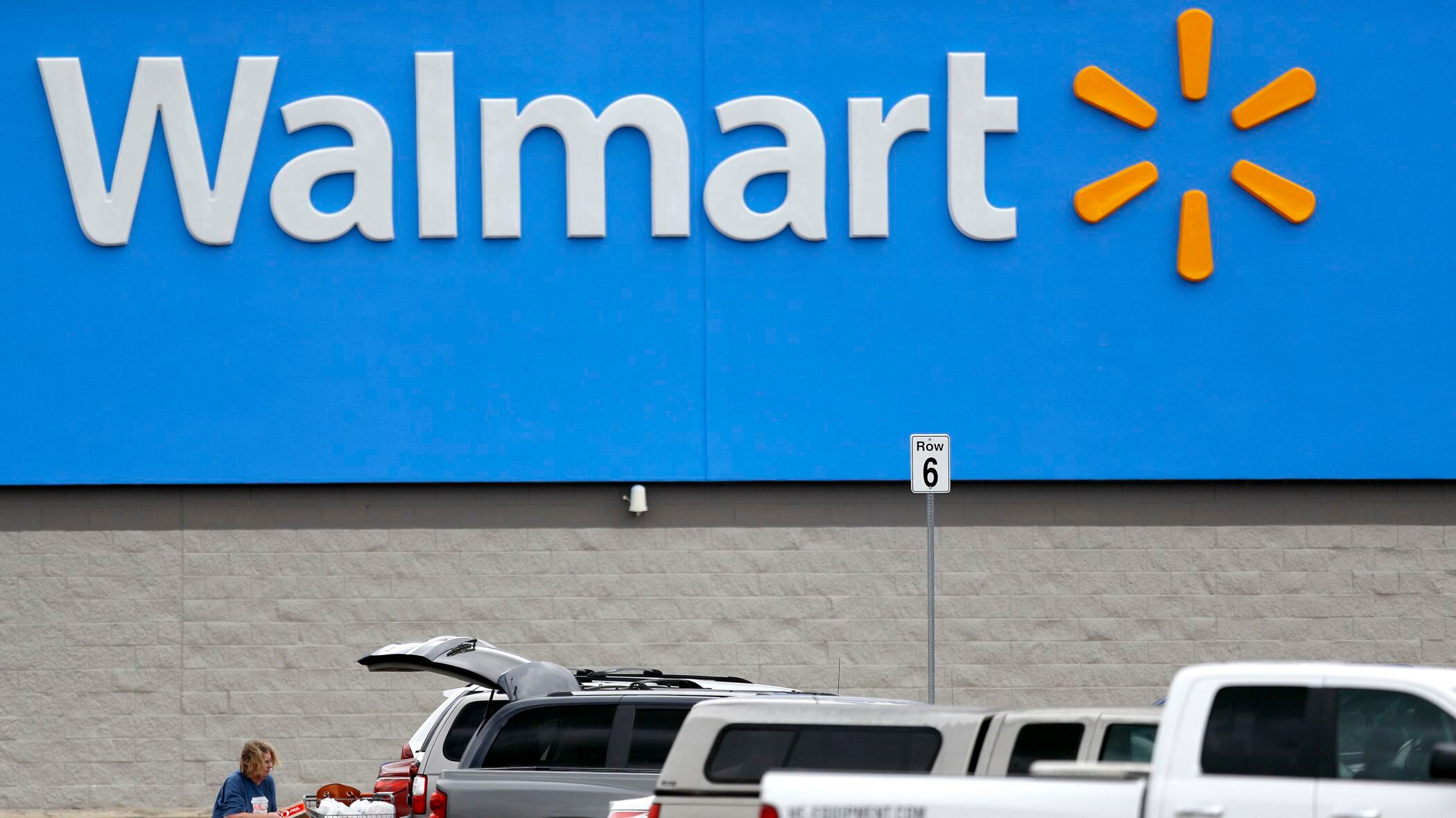
In this March 31, 2020 file photo, a woman pulls groceries from a cart to her vehicle outside of a Walmart store in Pearl, Miss. Walmart is teaming with the General Motors' Cruise autonomous vehicle unit to test automated package delivery in Arizona. (AP Photo/Julio Cortez, File)
By Michael Balsamo and Ann D'Innocenzio
The Justice Department is suing Walmart, alleging the company unlawfully dispensed controlled substances through its pharmacies, helping to fuel the opioid crisis in America.
The civil complaint being filed Tuesday points to the role Walmart’s pharmacies may have played in the crisis by filling opioid prescriptions and by unlawfully distributing controlled substances to the pharmacies during the height of the opioid crisis. Walmart operates more than 5,000 pharmacies in its stores around the country.
The Justice Department alleges Walmart violated federal law by selling thousands of prescriptions for controlled substances that its pharmacists “knew were invalid,” said Jeffrey Clark, the acting assistant attorney general in charge of the Justice Department’s civil division.
Federal law required Walmart to spot suspicious orders for controlled substances and report those to the Drug Enforcement Administration, but prosecutors charge the company didn’t do that. Walmart couldn’t immediately be reached for comment.
“Walmart knew that its distribution centers were using an inadequate system for detecting and reporting suspicious orders,” said Jason Dunn, the U.S. attorney in Colorado. “As a result of this inadequate system, for years Walmart reported virtually no suspicious orders at all. In other words, Walmart’s pharmacies ordered opioids in a way that went essentially unmonitored and unregulated.”
The suit alleges that Walmart made it difficult for its pharmacists to follow the rules, putting “enormous pressure" on them to fill a high volume of prescriptions as fast as possible, while at the same time denying them the authority to categorically refuse to fill prescriptions issued by prescribers the pharmacists knew were continually issuing invalid prescriptions.
AP reported the news of the lawsuit ahead of the Justice Department's public announcement, citing a person who could not discuss the matter publicly before the announced move. The person spoke to the AP on condition of anonymity.
The Justice Department’s lawsuit comes nearly two months after Walmart filed its own preemptive suit against the Justice Department, Attorney General William Barr, and the Drug Enforcement Administration.
In its lawsuit, Walmart said the Justice Department’s investigation — launched in 2016 — had identified hundreds of doctors who wrote problematic prescriptions that Walmart’s pharmacists should not have filled. But the lawsuit charged that nearly 70% of the doctors still have active registrations with the DEA.
Walmart’s lawsuit alleged the government was blaming it for the lack of regulatory and enforcement policies to stem the crisis. The company is asking a federal judge to declare the suit has no basis to seek civil damages. That suit remains ongoing.
The initial investigation was the subject of a ProPublica story published in March. ProPublica reported that Joe Brown, then U.S. attorney for the Eastern District of Texas office, spent years pursuing a criminal case against Walmart for its opioid prescription practices, only to have it stymied after the retail giant’s lawyers appealed to senior officials in the Justice Department.
Two months later, Brown resigned. He didn’t give a reason for his departure except to say he would be “pursuing opportunities in the private and public sectors." Brown went into private practice in the Dallas area.
Updated on December 22, 2020, at 3:44 p.m. ET with additional details.
Stocks closed at session lows Thursday, mostly due to a larger tech selloff after Facebook parent company Meta reported weak earnings results one day before. The Nasdaq closed down nearly 4% for its worst day since September 2020. Erin Gibbs, Chief Investment Officer at Main Street Asset Management, joins Closing Bell to discuss today's close, Meta earnings, Amazon earnings, and more
Spotify beat fourth quarter earnings expectations, and also reported a jump in monthly active users and in paid subscribers. The report comes as the company grapples with a new question: is it simply a streaming platform, or is it a media company responsible for the content it posts, like Joe Rogan's controversial podcast? Greg Martin, Co-Founder of Rainmaker Securities, joins Closing Bell to discuss why the stock took a hit even though earnings results were positive, how the company can move forward through the Rogan controversy, and more.
Chen Arad, Chief Operating Officer for Solidus Labs, joins Cheddar News' Closing Bell, where he explains why Wormhole was particularly vulnerable to a $320+ million crypto hack and discusses what new investors need to do in order to protect their assets.
E-commerce platform for construction and building materials RenoRun has raised $142 million in a Series B round, which the company says is the fourth largest Series B round in Canadian history. RenoRun’s platform offers same-day delivery of construction materials to job sites in Canada and the United States. The company aims to revolutionize the construction industry by maximizing productivity and efficiency. RenoRun co-founder and CEO Eamonn O’Rourke joins Cheddar News' Closing Bell to discuss.
Facebook parent company Meta reported weaker-than-expected fourth quarter earnings, and also issued disappointing guidance for Q1 2022. The tech giant is also under pressure due to Apple's iOS privacy change, as well as continued multi-billion dollar losses for its metaverse focused business unit. Angelo Zino, Tech Analyst at CFRA Research, joins Closing Bell to discuss the earnings results, how Apple's iOS privacy change will impact revenue, whether the metaverse is an underrated investment opportunity, and more.
Rental prices are rising across the country, causing millions to relocate. Average rents rose 14 percent last year, and Americans expect rents will continue to rise by about 10 percent just this year. Daryl Fairweather, chief economist at Redfin, joins Cheddar News to discuss.
The video game industry has seen monumental growth the past few years - with an increasing amount of companies jumping head first into the space. In January alone, Microsoft announced its plan to acquire Activision Blizzard, game publisher Take-Two agreed to buy Zynga, and most recently, Sony announced it has agreed to buy game developer Bungie for $3.6 billion. Tobias Batton, CEO and founder of Ex Populus, joined Cheddar Movers to discuss the surge in M&A activity in the gaming space.
Facebook parent Meta reported disappointing results in its first quarterly earnings report since rebranding to focus on the metaverse. The tech giant delivered mixed results with quarterly profit falling well below Wall Street expectations. Shares plunged more than 20 percent in after hours trading as a result. Martin Garner, COO of CCS Insight, joined Cheddar Movers to break down the company's results.
Karyn Cavanaugh, Chief Investment Officer at Carolinas Wealth Management, breaks down which industries investors should watch this earnings season and highlights which sectors have upside potential.
Super Group, the company behind leading global online sports betting and gaming businesses Betway and Spin, has landed on Wall Street. The company went public via SPAC with Sports Entertainment Acquisition Corp., and now lists on the NYSE under the ticker symbol 'SGHC.' This debut comes as the U.S. sports betting market continues to heat up with more and more states legalizing the practice. Eric Grubman, chairman of Super Group, joined Cheddar to discuss.