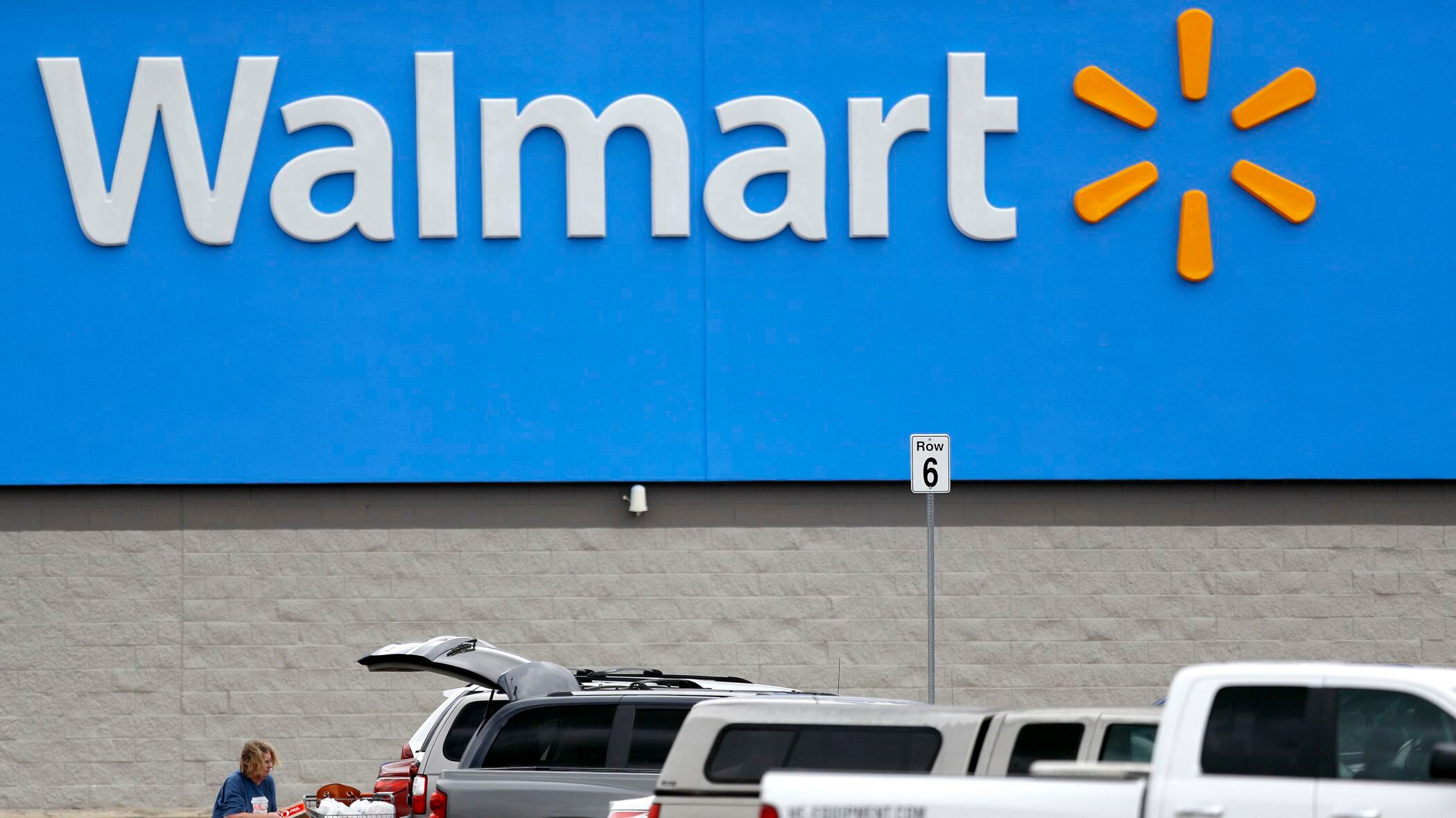
In this March 31, 2020 file photo, a woman pulls groceries from a cart to her vehicle outside of a Walmart store in Pearl, Miss. Walmart is teaming with the General Motors' Cruise autonomous vehicle unit to test automated package delivery in Arizona. (AP Photo/Julio Cortez, File)
By Michael Balsamo and Ann D'Innocenzio
The Justice Department is suing Walmart, alleging the company unlawfully dispensed controlled substances through its pharmacies, helping to fuel the opioid crisis in America.
The civil complaint being filed Tuesday points to the role Walmart’s pharmacies may have played in the crisis by filling opioid prescriptions and by unlawfully distributing controlled substances to the pharmacies during the height of the opioid crisis. Walmart operates more than 5,000 pharmacies in its stores around the country.
The Justice Department alleges Walmart violated federal law by selling thousands of prescriptions for controlled substances that its pharmacists “knew were invalid,” said Jeffrey Clark, the acting assistant attorney general in charge of the Justice Department’s civil division.
Federal law required Walmart to spot suspicious orders for controlled substances and report those to the Drug Enforcement Administration, but prosecutors charge the company didn’t do that. Walmart couldn’t immediately be reached for comment.
“Walmart knew that its distribution centers were using an inadequate system for detecting and reporting suspicious orders,” said Jason Dunn, the U.S. attorney in Colorado. “As a result of this inadequate system, for years Walmart reported virtually no suspicious orders at all. In other words, Walmart’s pharmacies ordered opioids in a way that went essentially unmonitored and unregulated.”
The suit alleges that Walmart made it difficult for its pharmacists to follow the rules, putting “enormous pressure" on them to fill a high volume of prescriptions as fast as possible, while at the same time denying them the authority to categorically refuse to fill prescriptions issued by prescribers the pharmacists knew were continually issuing invalid prescriptions.
AP reported the news of the lawsuit ahead of the Justice Department's public announcement, citing a person who could not discuss the matter publicly before the announced move. The person spoke to the AP on condition of anonymity.
The Justice Department’s lawsuit comes nearly two months after Walmart filed its own preemptive suit against the Justice Department, Attorney General William Barr, and the Drug Enforcement Administration.
In its lawsuit, Walmart said the Justice Department’s investigation — launched in 2016 — had identified hundreds of doctors who wrote problematic prescriptions that Walmart’s pharmacists should not have filled. But the lawsuit charged that nearly 70% of the doctors still have active registrations with the DEA.
Walmart’s lawsuit alleged the government was blaming it for the lack of regulatory and enforcement policies to stem the crisis. The company is asking a federal judge to declare the suit has no basis to seek civil damages. That suit remains ongoing.
The initial investigation was the subject of a ProPublica story published in March. ProPublica reported that Joe Brown, then U.S. attorney for the Eastern District of Texas office, spent years pursuing a criminal case against Walmart for its opioid prescription practices, only to have it stymied after the retail giant’s lawyers appealed to senior officials in the Justice Department.
Two months later, Brown resigned. He didn’t give a reason for his departure except to say he would be “pursuing opportunities in the private and public sectors." Brown went into private practice in the Dallas area.
Updated on December 22, 2020, at 3:44 p.m. ET with additional details.
Next-generation gaming ecosystem Joystick recently raised $8 million in a seed round and is in the process of raising a $110 million Series A funding round. Gaming ecosystems are a relatively new type of platform in the Web3 space, allowing users to maximize their play-to-earn gaming opportunities, exchange crypto-currencies, and sell their digital assets. Joystick says its platform is flipping the current model on its head by giving players the opportunity to keep 100% of the revenue they earn. Robin Defay, co-founder and CEO of Joystick, and Michael Le, co-founder of Joystick and TikTok content creator, join Cheddar News' Closing Bell to discuss.
Abe Stein, Head of Innovation at Sports Innovation Lab, joins Cheddar News' Closing Bell, where he explains why the top four spots on his company's 2022 list are European soccer clubs and discusses Sports Innovation Lab's plan to publish data on women's pro sports teams in the not-too-distant future.
Joel Birch, Co-Founder and CEO of Stacked, joins Cheddar News' Closing Bell, where he explains why he doesn't see any new catalysts that would lead to a Bitcoin rally at the moment. He also reiterates that now is a good time for long-term Bitcoin investors to buy low.
The dating app Bumble has sponsored bills and pushed lawmakers to criminalize the online practice of sending unsolicited nudes or “cyberflashing." Payton Iheme, Bumble's head of public policy for the Americas, joined Cheddar News to discuss why the app was going after the harassing behavior beyond its own platform. "Now, while we went to work internally in the company, and we created something called private detector to automatically blur those images so the user can decide if they want to see them, there's nothing for the rest of the internet," she said. "And so that's why we went to work with these laws."
The holiday weekend saw Disney+ and Netflix competing head-to-head for streaming views as the Disney behemoth kicked off the unofficial start to summer with its release of "Obi-Wan Kenobi" and Netflix responded with the first part of "Stranger Things" Season 4. The streaming giants caught the eye of Wall Street, and Seth Schachner, the managing director at consultancy Strat Americas, joined Cheddar News to break down the heavy hitters. "This is a very tough, competitive game, and I don't see it getting any easier," he said. "I think you'll probably see more consolidation."
Amid high inflation, shoppers are pinching their pennies in the grocery stores and becoming more frugal when food shopping. However, supermarkets like Kroger are pushing back against passing on the higher costs and demanding reasons for the higher food prices from suppliers.
The founder and president of Cyborg Mobile Kobie Hatcher has been on a strong trajectory to disrupt his industry with a program called The New Technologists. It's not only meant to address the diversity gap within large tech companies but also help pave the way to transform the lives of young BIPOC students. He joined Cheddar News to talk about how he's working to make a difference with the lack of diversity in tech. “There's truly no lack of talent out there. It's just identifying them and letting them know that, hey, I've been in the tech sector for over 20 years. I see you. I know what you can bring, bring it, we need it," Hatcher said.