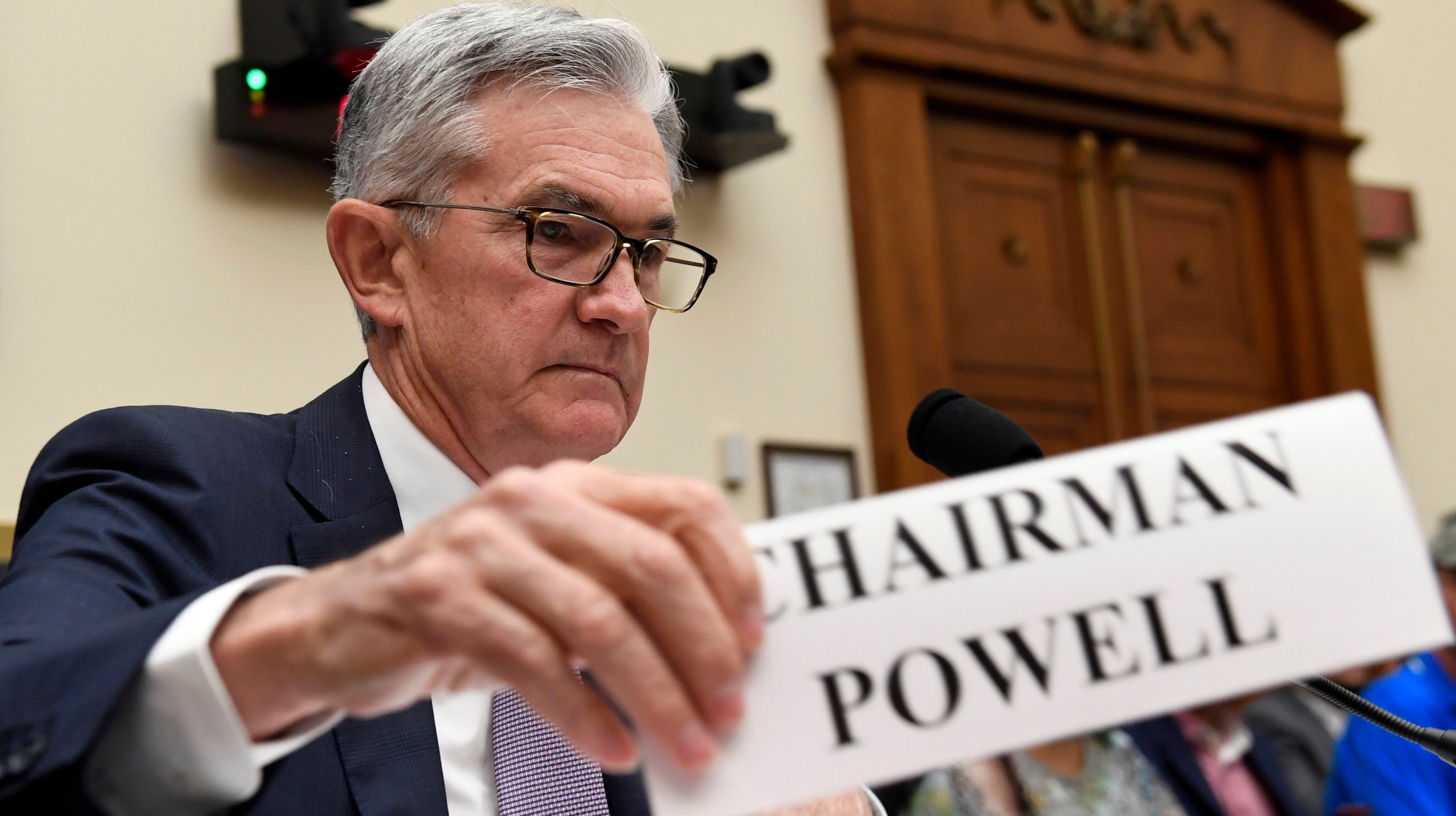
Federal Reserve Chairman Jerome Powell told lawmakers on Wednesday that “uncertainties” in the economy have increased in recent months, indicating that the U.S. central bank will likely cut interest rates at the end of July to sustain growth.
Stocks spiked ahead of Powell’s remarks to the House Committee on Financial Services, with the S&P 500 topping 3,000 points for the first time ever.
“In particular, economic momentum appears to have slowed in some major foreign economies, and that weakness could affect the U.S. economy,” Powell said. “And there is a risk that weak inflation will be even more persistent than we currently anticipate.”
Powell added, nonetheless, that the economy has “performed reasonably well” so far in 2019, which is the 11th consecutive year of economic growth.
Yet the country’s enduring trade disputes, the rising federal debt ceiling, and global uncertainties, such as Brexit, all could potentially threaten the economic growth in the U.S., according to the Fed.
“We are carefully monitoring these developments, and we will continue to assess their implications for the U.S economic outlook and inflation,” Powell said.
The concerns, which Powell referred to as "crosscurrents," appear to remain despite the strong jobs report released last week and a thawing of trade tensions with China following the G-20 Summit in Japan.
The Fed is set to gather later this month for its Federal Open Market Committee meeting, which is held eight times a year to determine necessary adjustments on interest rates and other monetary policies. A cut in interest rates to spur growth has been widely anticipated, especially after the central bank decided to keep rates steady in June.
Powell — who was nominated by President Trump to chair the Fed in 2017 — and the Fed have repeatedly been attacked by the president for not cutting interest rates.
Just last month, Trump slammed the Fed, which has historically stayed above the fray of politics, saying that the bank “doesn’t know what it is doing” and bemoaned decisions to raise interest rates “far too fast.”
"This president has made it very clear that he has no understanding or respect for the independence of the Federal Reserve," Rep. Maxine Waters (D-Calif.), the committee’s chairwoman, said at the hearding. "It is essential that the Federal Reserve maintains its independence from the executive branch."
In response to a question from Waters, Powell said Wednesday that he would not step down if Trump demanded his resignation.
“The law clearly gives me a four-year term and I fully intend to serve it,” he said.