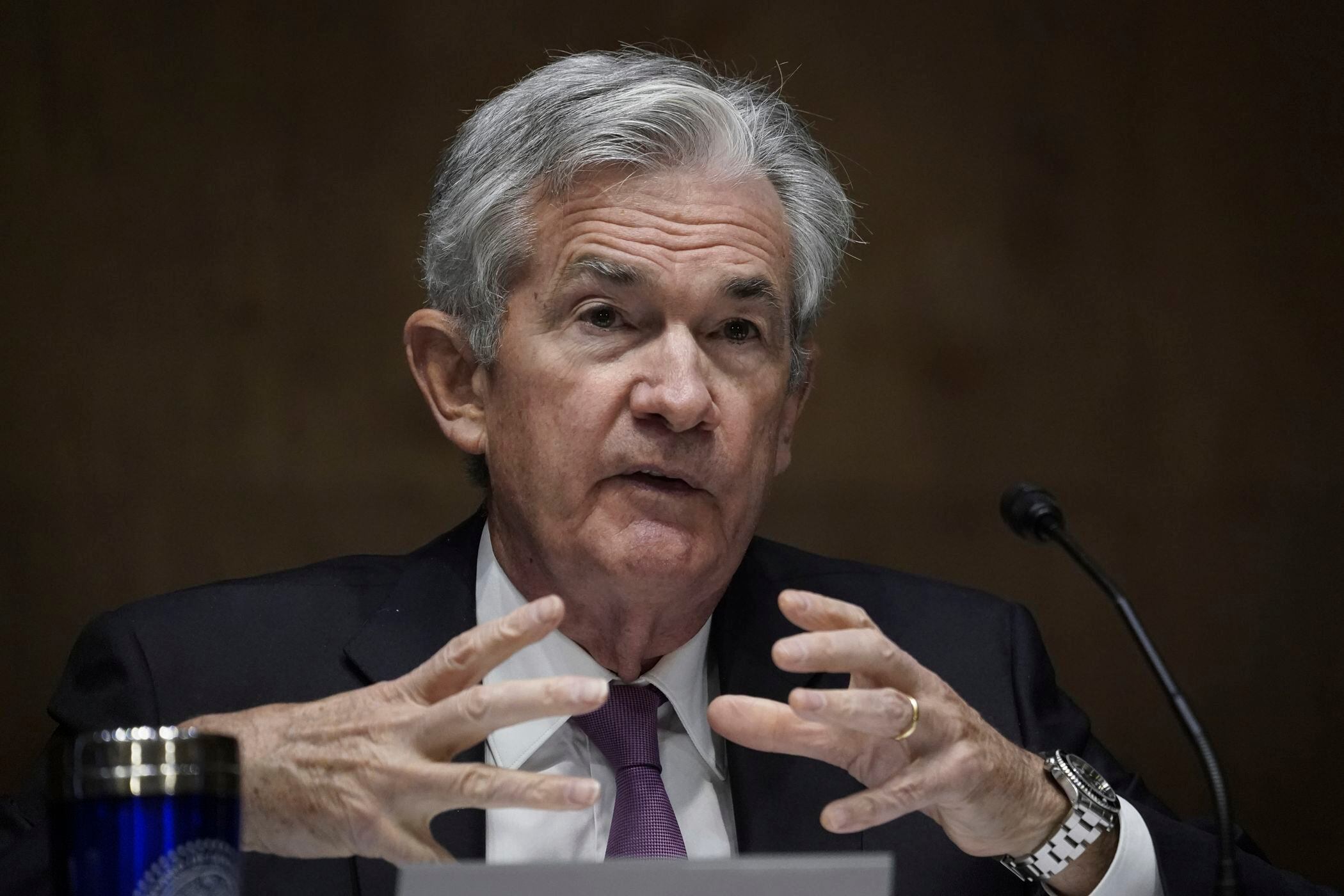
Federal Reserve Board Chairman Jerome Powell testifies during a Senate Banking Committee hearing, Thursday Sept. 24, 2020 on Capitol Hill in Washington about the CARES Act and the economic effects of the coronavirus pandemic. (Drew Angerer/Pool via AP)
By Martin Crutsinger
The Federal Reserve kept its benchmark interest rate at a record low near zero Thursday and signaled its readiness to do more if needed to support an economy under threat from a worsening coronavirus pandemic.
The Fed announced no new actions after its latest policy meeting but left the door open to provide further assistance in the coming months. The central bank again pledged to use its "full range of tools to support the U.S. economy in this challenging time.” The economy in recent weeks has weakened after mounting a tentative recovery from the deep pandemic recession in early spring.
Several Fed officials have expressed concern that Congress has failed so far to provide further aid for struggling individuals and businesses. But the Fed's policy statement, issued after a two-day meeting, made no mention of lawmakers' failure to act.
A multi-trillion-dollar stimulus, enacted in the spring, had helped sustain jobless Americans and ailing businesses but has since expired. The failure of lawmakers to agree on any new rescue package has clouded the future for the unemployed, for small businesses, and for the economy as a whole. There is some hope, though, that a logjam can be broken and more economic relief can be enacted during a post-election “lame-duck” session of Congress between now and early January.
The central bank has been buying Treasury and mortgage bonds to hold down long-term borrowing rates to encourage spending. And it has kept its key short-term rate, which influences many corporate and individual loans, near zero. Some economists think the policymakers' next move will be to expand its bond buying effort, which is intended to boost the economy by lowering longer-term borrowing rates.
The Fed’s latest policy meeting coincided with an anxiety-ridden election week and an escalation of the virus across the country. Most economists warn that the economy cannot make a sustained recovery until the pandemic is brought under control and most Americans are confident enough to return to their normal habits of shopping, traveling, dining and congregating in groups.
President Biden announced a ban on Russian oil and natural gas imports to the U.S. in response to its invasion of Ukraine, a move he warned could lead to an even greater surge in gas prices. The ban is prompting a conversation about the current oil production levels in the U.S. and whether or not the industry can ramp up production to soften the blow to American families at the gas pump. Clark Williams-Derry, Energy Finance Analyst with the Institute for Energy Economics and Financial Analysis, breaks down the state of the U.S. oil industry and how the ban might impact production levels here at home.
PepsiCo, Coca-Cola, McDonald’s, and Starbucks are the latest American food brands to have halted business operations in Russia after having faced scrutiny and criticism for originally failing to do so amid the country's invasion of Ukraine.
As Russia intensifies its war on Ukraine, President Biden announced a ban on oil imported from the aggressor nation. Critics of Russia have said this would be the best way to force Putin to pull back, but curbs on Russian oil exports are expected to send already skyrocketing oil and gas prices even higher, further impacting consumers, businesses, financial markets, and the global economy. Leslie Beyer, CEO of the Energy Workforce and Technology Council, joined Cheddar News' Closing Bell to discuss. "It's certainly going to increase pricing, but it is the right thing to do," she said. "The industry itself has already pulled out of the significant portion of its operations in Russia."
As airlines recover from COVID-19 and the industry becomes more competitive than ever, low-fare carrier Breeze Airlines is offering 35 new routes and reduced prices for its first-class experiences. CEO David Neeleman joined Cheddar News to talk about the rollout of services amid plenty of headwinds including high fuel costs. "We can limit a lot of costs because we're a technology company that happens to fly airplanes," he noted.
Despite women as a whole being among the groups most impacted by pandemic job losses, homesharing platform Airbnb reported that women hosts brought in $12 billion in revenue last year. Catherine Powell, Airbnb's global head of hosting, joined Cheddar News to discuss how women hosting has become a huge asset for the company. "Last year 21 percent more women joined the platform than men," she said. "So they are joining the platform. They are being successful. They're more super hosts, and they're doing incredibly well."