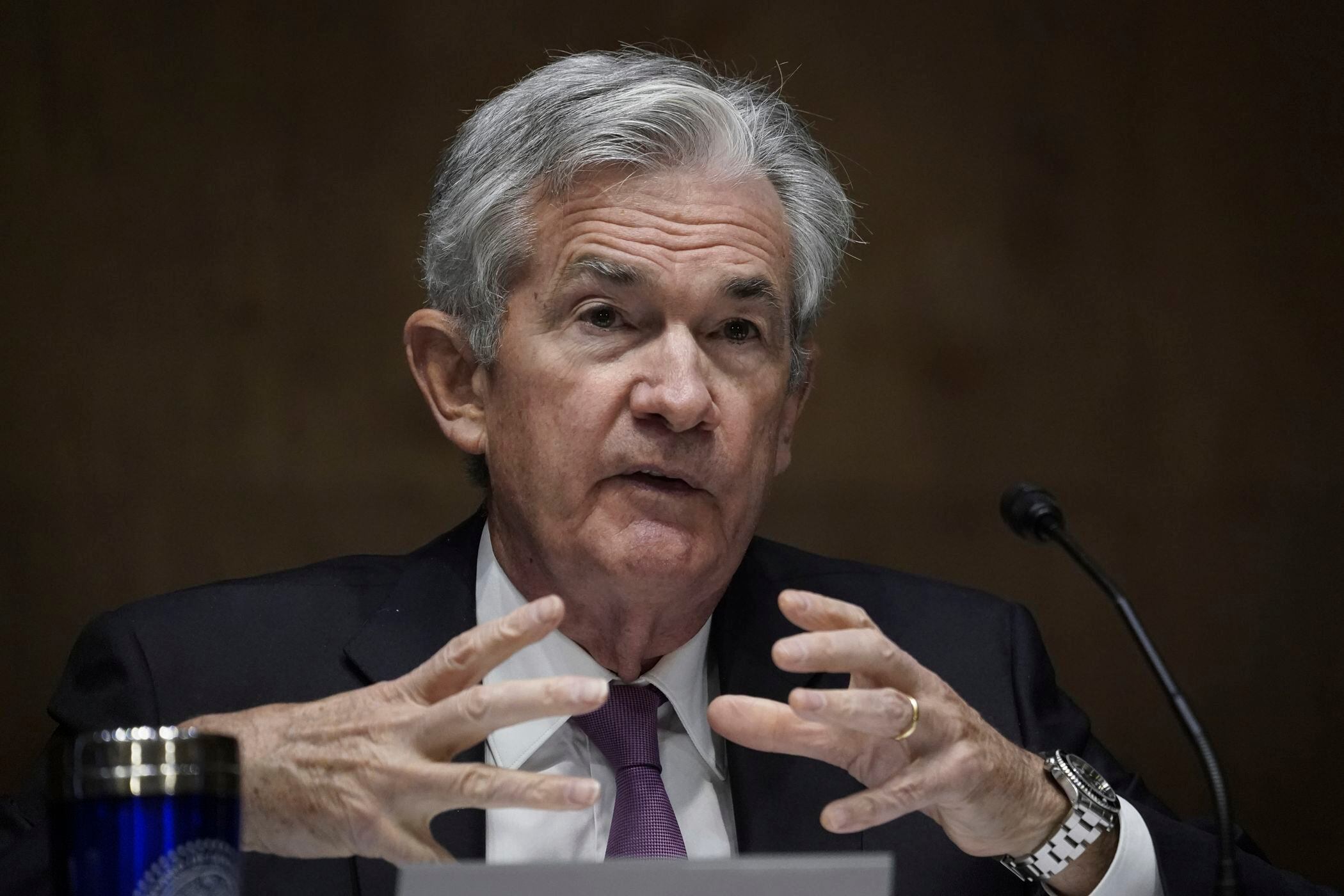
Federal Reserve Board Chairman Jerome Powell testifies during a Senate Banking Committee hearing, Thursday Sept. 24, 2020 on Capitol Hill in Washington about the CARES Act and the economic effects of the coronavirus pandemic. (Drew Angerer/Pool via AP)
By Martin Crutsinger
The Federal Reserve kept its benchmark interest rate at a record low near zero Thursday and signaled its readiness to do more if needed to support an economy under threat from a worsening coronavirus pandemic.
The Fed announced no new actions after its latest policy meeting but left the door open to provide further assistance in the coming months. The central bank again pledged to use its "full range of tools to support the U.S. economy in this challenging time.” The economy in recent weeks has weakened after mounting a tentative recovery from the deep pandemic recession in early spring.
Several Fed officials have expressed concern that Congress has failed so far to provide further aid for struggling individuals and businesses. But the Fed's policy statement, issued after a two-day meeting, made no mention of lawmakers' failure to act.
A multi-trillion-dollar stimulus, enacted in the spring, had helped sustain jobless Americans and ailing businesses but has since expired. The failure of lawmakers to agree on any new rescue package has clouded the future for the unemployed, for small businesses, and for the economy as a whole. There is some hope, though, that a logjam can be broken and more economic relief can be enacted during a post-election “lame-duck” session of Congress between now and early January.
The central bank has been buying Treasury and mortgage bonds to hold down long-term borrowing rates to encourage spending. And it has kept its key short-term rate, which influences many corporate and individual loans, near zero. Some economists think the policymakers' next move will be to expand its bond buying effort, which is intended to boost the economy by lowering longer-term borrowing rates.
The Fed’s latest policy meeting coincided with an anxiety-ridden election week and an escalation of the virus across the country. Most economists warn that the economy cannot make a sustained recovery until the pandemic is brought under control and most Americans are confident enough to return to their normal habits of shopping, traveling, dining and congregating in groups.
On this episode of On The Job presented by ADP: Gemma Burgess, CEO of Ferguson Partners, explains what people are looking for in an employer, and how to convey positive work culture to potential employees; Amy Leschke-Kahle, Vice President of Performance Acceleration at The Marcus Buckingham Company, an ADP company, breaks down how encouraging employee engagement and empowering employee voices can benefit every workplace and busts a myth about employee engagement while working from home; Jim Huether, CEO of Hyperice, discusses Hyperice's new employee mental health initiative, known as the Workplace Alliance, with 100-plus companies to combat the ongoing mental health crisis and how they're taking a hands-on, data-driven approach to the mental health crisis.
Amy Leschke-Kahle, Vice President of Performance Acceleration at The Marcus Buckingham Company, an ADP company, joins Cheddar to discuss how encouraging employee engagement and empowering employee voices can benefit every workplace and busts a myth about employee engagement while working from home.
Jim Huether, CEO of Hyperice, joins Cheddar to discuss Hyperice's new employee mental health initiative, known as the Workplace Alliance, with 100-plus companies to combat the ongoing mental health crisis and how they're taking a hands-on, data-driven approach to the mental health crisis.
Consumer prices saw an 8.6 percent jump in May, with fuel prices showing the biggest surge, climbing 17 percent last month. As inflation continues to climb to levels not seen in 40 years, President Biden took to calling out ExxonMobil and other major oil companies, accusing them of holding back production while continuing to collect huge profits at the cost of the consumer. Mark Avallone, the president of Potomac Wealth Advisors, joined Cheddar's Opening Bell to discuss. “They have reduced long-term expenditures. But why? Because the world is going to alternative energy and as consumers, if we thought that that welcome change to alternatives was going to happen without pain, we might have been mistaken," he said. "The less investment they make in oil because they're getting ready for a new world of electric vehicles, the less we're going to be prepared for oil shocks such as the one we got when Russia invaded Ukraine."
Catching you up on the stories you need to know this morning, the U.S. could soon get its first major gun safety law in years, the House Select Committee investigating the January 6th attack on the U.S. capitol holds its second hearing, and today might just be the day the Supreme Court overturns Roe v. Wade, and decides on new gun laws.