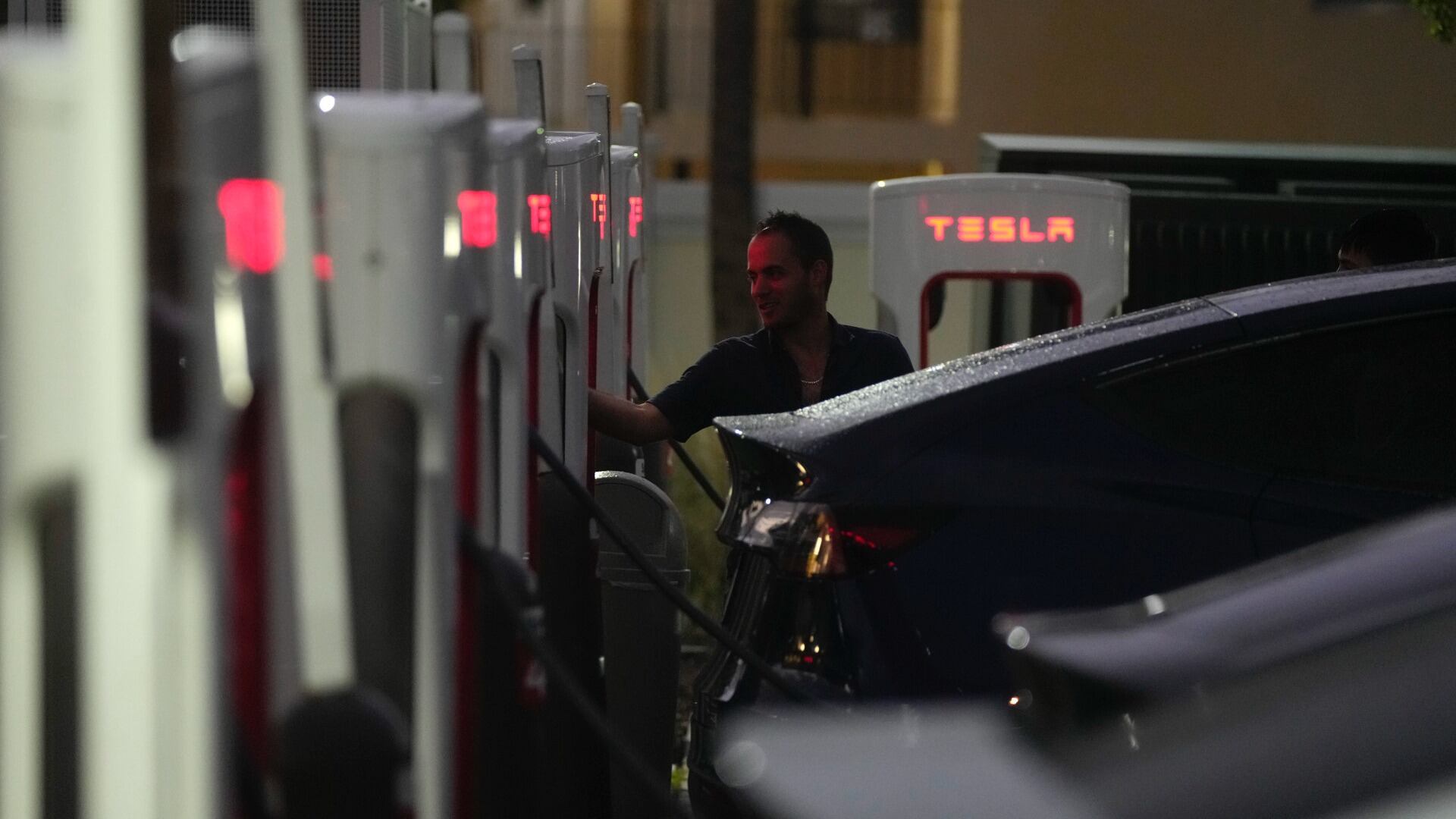
A driver charges his car at a Tesla Supercharger station, Wednesday, Nov. 16, 2022, in Miami. A tweet from Elon Musk indicating that Tesla might allow some owners who are testing a "Full Self-Driving" system to disable an alert that reminds them to keep their hands on the steering wheel has drawn attention from U.S. safety regulators. (AP Photo/Rebecca Blackwell, File)
The National Highway Traffic Safety Administration (NHTSA) is investigating a tweet from Elon Musk indicating Tesla might allow some customers who are testing the company's "Full Self-Driving" system to disable an alert that tells them to keep their hands on the wheel.
The tweet caught the agency's eye because it is currently investigating whether Tesla's autopilot feature was involved in 11 crashes with emergency vehicles since the company started beta-testing the system in 2021. The electric vehicle maker said earlier this year that 15 percent of the 160,000 Tesla vehicles on U.S. roads are participating in the beta.
Musk has noted multiple times in the past that Tesla vehicles are not ready for fully automated driving. Tesla's website also states that both the Autopilot and Full Self-Driving systems require a “fully attentive driver who has their hands on the wheel and is prepared to take over at any moment.”
Why Tesla would get rid of the alert then is unclear. As part of the broader investigation into the feature, NHTSA has asked Musk to clarify what exactly he meant in the tweet.
NHTSA previously pointed out that numerous Tesla crashes have occurred in which the driver had their hands on the wheel but was still not paying attention, even with alerts telling them to pay attention.
Musk's tweet was a reply to a fan on twitter who proposed that drivers with more than 10,000 miles on the "Full Self-Driving" mode should be able to turn off the so-called "steering wheel nag."
Musk tweeted back, “Agreed, update coming in Jan.”
The growth of the metaverse is bringing new challenges to managing safe, diverse communities. Helping Cheddar kick off Women's History Month, Tiffany Xingyu Wang, chief marketing officer for AI-powered content moderation company Spectrum Labs, joined Cheddar's Opening Bell to discuss how platforms can help create safer, more inclusive online communities in the metaverse and about her own experience as a woman in technology. "Trust is really the new digital transformation, and it should not be a siloed task solely belonging to chief security officers, to privacy officers, or the people who were given the task of trust and safety," she said. "It should be a priority for all the C suite and a whole company to rally around."
On this episode of Cheddar Innovates: Vision Marine Technologies CEO discusses how e-boats will play a role in the fight against the climate crisis; Lasso CEO breaks down how the design behind these compression socks can prevent injuries and improve performance; Cheddar gets a look at Curiosity Stream's 'The Tombs Of Egypt.'
Catriona Campbell, CTIO, UK and Ireland, EY, joins Cheddar News to discuss how business leaders can bridge the gap between their technology investments and their aspirations, and breaks down the human aspects of A.I.
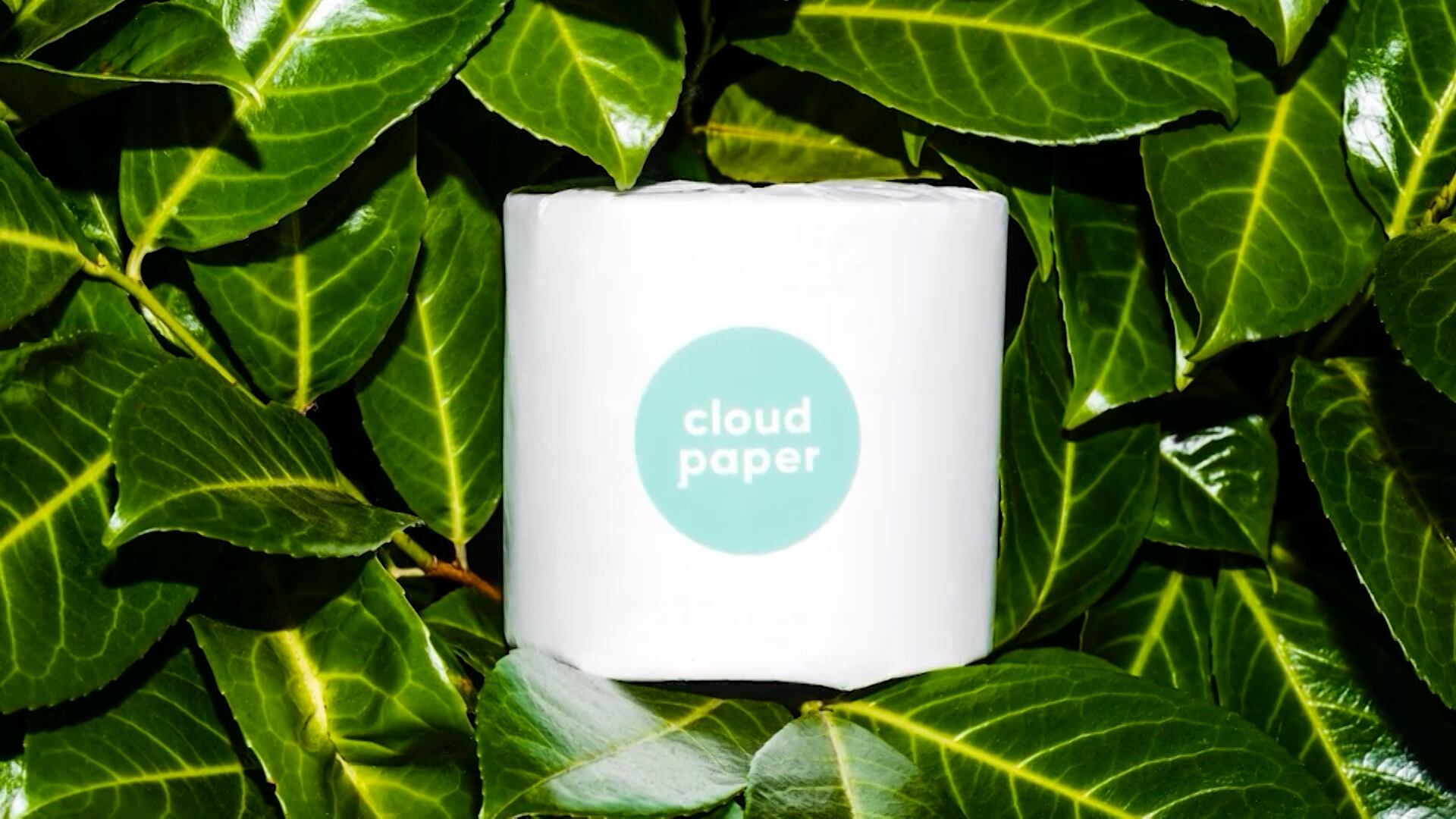
Bamboo-based toilet paper company Cloud Paper raised $5 million in a recent funding round. Its product is a bamboo-based alternative to traditional toilet paper made from trees, and its mission is to end the deforestation caused by traditional paper products. Cloud Paper says the raise will allow it to make significant investments in its supply chain, product development, and hiring. Ryan Fritsch, a co-founder of Cloud Paper, joined Cheddar News' Closing Bell to discuss.
The Biden Administration has now issued new guidelines when it comes to carbon capture. The new guidelines handed down this week encouraged the widespread use of climate attacks that traps and stores carbon emissions. The goal here is the process would help keep carbon out of the atmosphere without requiring a whole lot of change by big companies and manufacturing plants. Several scientists say that this method would be crucial to help us decrease the use of carbon emissions by the year 2050. Professor of Civil and Environmental Engineering at Stanford University, Mark Jacobson, joined Cheddar to discuss more.