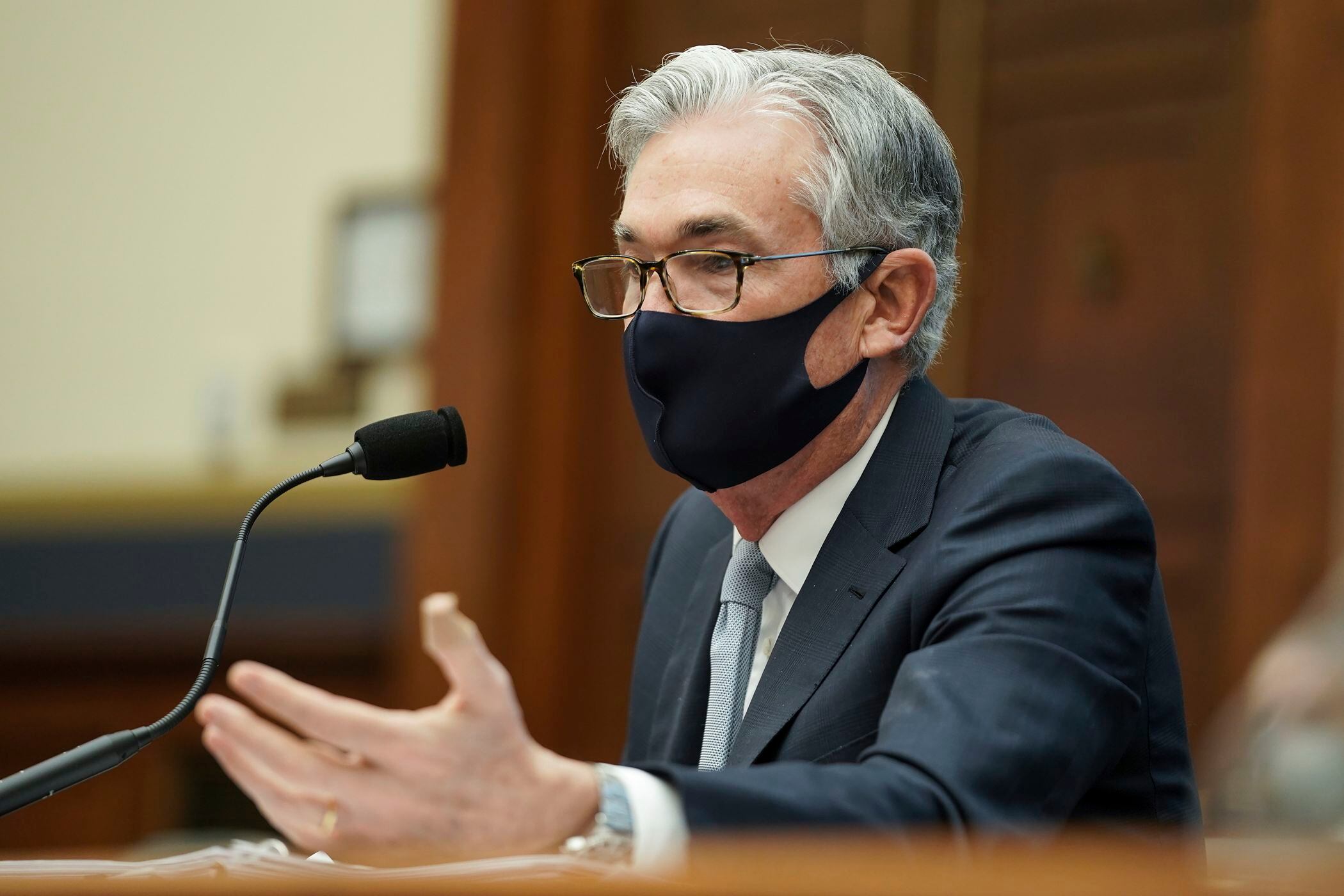
Federal Reserve Chairman Jerome Powell testifies before a House Financial Services Committee hearing on Capitol Hill in Washington, Wednesday, Dec. 2, 2020. (Greg Nash/Pool via AP)
By Christopher Rugaber
The Federal Reserve's policymakers face an unusual conundrum as they meet this week: A short-term economic outlook that is worsening even while the longer-term picture is brightening thanks to the emergence of coronavirus vaccines.
When its meeting concludes Wednesday, the Fed could announce steps to try to offset the pandemic's increasing drag on growth. Or it could choose to mostly watch and wait, for now.
The central bank's policy meeting coincides with a record-shattering resurgence of the coronavirus, which has caused an increase in business restrictions and made more Americans reluctant to shop, travel and dine out. Some analysts say the economy could shrink in early 2021 before recovering as vaccines combat the virus.
Economists are divided on whether the Fed will announce any new actions this week. One option the policymakers could take would be to announce a shift in the Fed's bond purchases. The Fed has been buying $80 billion in Treasury bonds and $40 billion in mortgage bonds each month in an effort to keep borrowing rates down.
The idea of a shift would be to buy more longer-term bonds and fewer shorter-term securities, to hold down longer-term interest rates. The Fed has already cut its benchmark short-term rate to a record low near zero.
Yet the Fed's tools take time to support the economy, which adds a layer of complexity given the short-term gloom and longer-term optimism.
“Near-term downside risk may not be enough of a reason" to provide more stimulus "if the outlook for the economy in three to six months remains strong,” Lewis Alexander, U.S. chief economist at Nomura Securities, said in a research note.
Another complicating factor is that even as negotiations continue, Congress has yet to agree on another round of urgently needed financial aid for millions of unemployed Americans, thousands of struggling businesses, and cash-short states and cities.
Many Fed policymakers, including Chair Jerome Powell, have repeatedly urged Congress to provide more support. Most proposals on Capitol Hill include extending unemployment benefit programs that are scheduled to expire in about two weeks. At that point, roughly 9 million jobless people will lose all their unemployment aid, state or federal.
“They're all looking to fiscal stimulus,” Tim Duy, an economics professor at the University of Oregon and author of the “Fed Watch” blog, referring to potential rescue aid from Congress.
Recent data is pointing to an economy that is getting worse. More Americans are seeking unemployment benefits, a sign that layoffs are likely rising, and overall hiring slowed in November to its slowest pace since April. Credit and debit card data suggests that holiday spending is weaker than it was last year.
Still, Fed officials may not yet be ready to take new steps, perhaps believing they have already provided nearly all the help they can for the economy through ultra-low rates.
At their meeting in November, Fed policymakers discussed the idea of buying more longer-term bonds, among other options, according to minutes published three weeks later. Doing so could further reduce the yield on 10-year Treasurys, which influence other borrowing costs, such as mortgage and credit card rates.
By contrast, the purchase of, say, two-year Treasurys has less effect on the most common loan rates, though it can help the Treasury market function more smoothly, which was the original goal of the Fed's bond-buying program this year.
While Fed officials worry that the pandemic will severely harm the economy this winter, not all are sold on more stimulus.
“We expect very strong growth next year," Robert Kaplan, president of the Federal Reserve Bank of Dallas, told CNBC this month. "But I think the next three to six months are going to be challenging. And it appears to us that growth is decelerating, and if this resurgence keeps heading the wrong way, which it is, that slowing and deceleration could get worse.”
But Kaplan, a voting member of the Fed's policymaking committee, said, “I would not want” to alter the bond-buying program “at this point.”
He added: “I don’t know that increasing the size or extending maturities of our bond purchases would help address this situation that I’m concerned about over the next three to six months."
“As always,” though, Kaplan said, "I will go into the meeting with an open mind.”
Other Fed bank presidents, including Charles Evans of the Chicago Fed and Mary Daly of the San Francisco Fed, have also suggested in recent weeks that a change to the bond-buying program at this point might not be necessary. Neither Evans nor Daly has a vote on the Fed's policy committee, but they will participate in this week's meeting.
Even if it doesn't announce a policy shift this week, the Fed will likely provide additional guidance about its bond purchases. After its November meeting, it said it would keep buying bonds “over coming months." The minutes from that meeting said that most policymakers wanted to provide more specific guidance “fairly soon.” Analysts have interpreted that to likely mean this week's meeting.
The Fed isn't expected to tie its bond purchases to any specific level of inflation or unemployment but instead suggest a more general goal. Alexander said it could be as simple as stating that bond purchases will continue “until the recovery is well-advanced.”
The minutes of the November meeting also showed that the policymakers expect to start slowing their bond purchases before they begin raising interest rates. And economists foresee no Fed rate hikes until as late as 2024 or 2025. On Wednesday, the Fed will issue forecasts through 2023 that are expected to show no rate hikes at all.
Emma Searson, an author on the just-released Renewables on the Rise report and the director, 100% Renewable Campaign at Environment America, joined Cheddar to discuss the rapidly growing renewable energy sector. Between 2011 and 2020, the report shows that wind, solar, and geothermal energy production grew about 15 percent annually and that wind and solar alone account for 11 percent of electricity in the country. "There are a few really important drivers of the renewable energy progress that we're seeing all across the country," Searson said, highlighting falling prices, technology improvements, and supportive policies.
Wendy O, host of 'The O Show' joins Cheddar News to discuss the recent rally from cryptocurrency, Ether. She also discussed incoming New York City mayor Eric Adams wanting to teach kids crypto in schools.
Professional sports is facing a reckoning right now over several stories painting an ugly picture of a toxic work environment, encompassing multiple teams in multiple leagues and dealing with different issues.
This week, the NHL's Chicago Blackhawks ousted their general manager and senior director of hockey operations after an investigation confirmed former player Kyle Beach's claims that the team's former video coach Brad Aldrich sexual assaulted him back in 2010, with upper management ignoring his claims until after the team won the Stanley Cup that season. Last night, Joel Quenneville, now the coach of the Florida Panthers but Chicago's coach that season, stepped down from his post.
This comes just a few weeks after the NFL was rocked by leaked emails showing now-former Las Vegas Raiders Head Coach Jon Gruden using racist, sexist and homophobic language. He resigned soon after the emails came to light. We can't forget, though, that those emails come from a much broader investigation of the toxic work environment in the offices of the Washington Football Team. NFL Commissioner Roger Goodell said this week the league wouldn't publicly release anything from its investigation of the team, but lawyers for many of the women interviewed in the case say they want a public report.
And last January, just one month after hiring him, the New York Mets had to fire then-General manager Jared Porter, who admitted to sending explicit, unsolicited texts and images to a female reporter in 2016 when he worked for the Chicago Cubs. ESPN had been in possession of the texts since 2017, but the woman in question asked the network not to run the story out of fear her career would be harmed. She only reached back out to ESPN after she left the field of journalism altogether. Porter has been banned from the sport through next season.
If you believe in the phrase "where there's smoke, there's fire," professional sports is a five-alarm blaze.
Julie DiCaro, senior writer and editor at Deadspin, joins None of the Above to discuss.
Curaleaf CEO Joe Bayern joined Cheddar's "Closing Bell" to discuss the cannabis company's Q3 earnings report, which came in under expectations and included widening losses. Bayern discussed taking a hit on profitability based on the slower-than-expected expansion in some Northeast markets. While the company reduced its fiscal guidance for 2021 due to a general slowing of the cannabis market, he did note that he still sees much room for growth in 2022 and beyond.
Online consignment and thrift shop thredUP reported a Q3 earnings beat on Monday, and CEO James Reinhart joined Cheddar to discuss exceeding expectations and the state of the business overall. Reinhart said the company is thriving while other businesses may face supply chain issues due to the convenience of its system of acquiring secondhand clothing. "In a world where most consumers are feeling squeezed by prices and seeing apparel shortages, everything we have on thredUP is 100 percent in stock and ready to ship," he said. "And so I think it speaks to real opportunity for resale and a company like thredUP during the holiday season and into 2022."
Former NBA star, commentator, and entrepreneur Baron Davis and Deluxe Corporation Chief Brand Officer Amanda Brinkman, joined Cheddar to discuss Season 6 of the reality show "Small Business Revolution," premiering Tuesday. The season will focus on helping six Black-owned businesses in the Twin Cities, Minneapolis and St. Paul. Davis noted learning about the lack of resources, connections, and opportunities for Black business owners during the show. "There are so many things we need to do as a society to address racial injustice and inequity, however, one of the ways for it is economic empowerment," Brinkman added.
Katia Beauchamp, strategic advisor for FemTec Health and former Birchbox CEO, joined Cheddar to discuss the health and beauty sciences company's recent acquisition of subscription beauty supply provider Birchbox. She noted that FemTec wants to change the perception of the brand to include health as well as beauty. "This is something where we are reimagining how can we help consumers discover beauty products that really help them take great care of themselves, have beautiful underlying health that is shown on the exterior too," she added.
Cryptocurrencies are getting off to a good week. Ethereum surged more than 4% in 24 hours on Monday, hitting a new all-time high above $4,700. Meanwhile, Bitcoin surged 7% to a price of $66,250. Haohan Xu, founder and CEO of Apifiny, joins Cheddar News with thoughts on the growing sector.
The latest Marvel movie hit theaters with one of the biggest opening weekends of the year. 'Eternals' opened over the weekend with an estimated $71 million, the fourth-best domestic debut this year. Erik Davis, managing editor at Fandango, joins Cheddar News to talk about the state of box office sales.