By Jonathan Lemire
Joe Biden swears the oath of office at noon Wednesday to become the 46th president of the United States, taking the helm of a deeply divided nation and inheriting a confluence of crises arguably greater than any faced by his predecessors.
The very ceremony in which presidential power is transferred, a hallowed American democratic tradition, will serve as a jarring reminder of the challenges Biden faces: The inauguration unfolds at a U.S. Capitol battered by an insurrectionist siege just two weeks ago, encircled by security forces evocative of those in a war zone, and devoid of crowds because of the threat of the coronavirus pandemic.
Stay home, Americans were exhorted, to prevent further spread of a surging virus that has claimed more than 400,000 lives in the United States. Biden will look out over a capital city dotted with empty storefronts that attest to the pandemic’s deep economic toll and where summer protests laid bare the nation’s renewed reckoning on racial injustice.
He will not be applauded — or likely even acknowledged — by his predecessor.
Flouting tradition, Donald Trump departed the White House on Wednesday morning ahead of the inauguration rather than accompany his successor to the Capitol. Trump, awaiting his second impeachment trial, stoked grievance among his supporters with the lie that Biden’s win was illegitimate.
Biden, in his third run for the presidency, staked his candidacy less on any distinctive political ideology than on galvanizing a broad coalition of voters around the notion that Trump posed an existential threat to American democracy. On his first day, Biden will take a series of executive actions — on the pandemic, climate, immigration and more — to undo the heart of Trump's agenda. The Democrat takes office with the bonds of the republic strained and the nation reeling from challenges that rival those faced by Abraham Lincoln and Franklin D. Roosevelt.
“Biden will face a series of urgent, burning crises like we have not seen before, and they all have to be solved at once. It is very hard to find a parallel in history,” said presidential historian Michael Beschloss. “I think we have been through a near-death experience as a democracy. Americans who will watch the new president be sworn in are now acutely aware of how fragile our democracy is and how much it needs to be protected.”
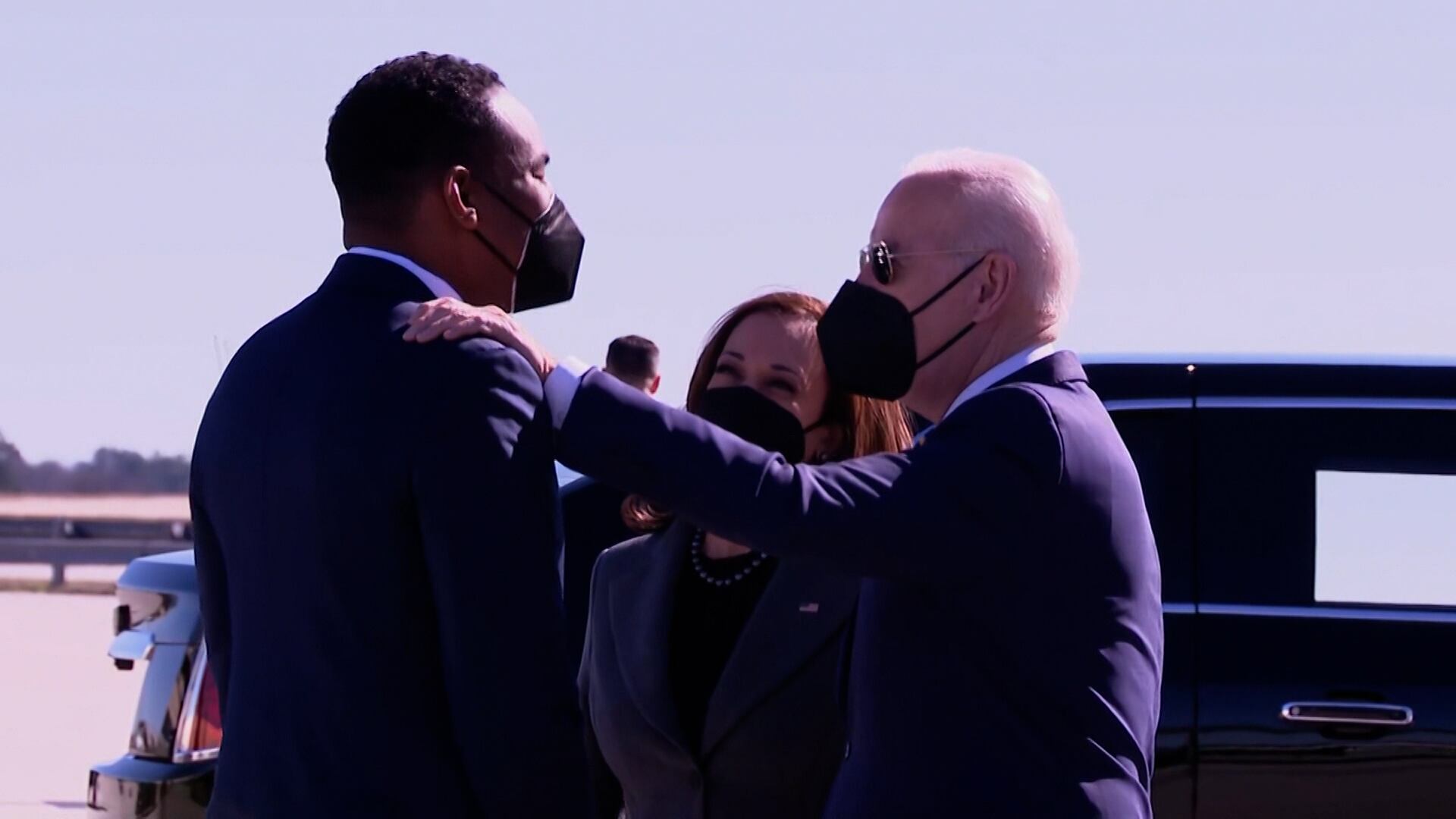
Biden will come to office with a well of empathy and resolve born by personal tragedy as well as a depth of experience forged from more than four decades in Washington. At age 78, he will be the oldest president inaugurated.
More history will be made at his side, as Kamala Harris becomes the first woman to be vice president. The former U.S. senator from California is also the first Black person and the first person of South Asian descent elected to the vice presidency and will become the highest-ranking woman ever to serve in government.
The two will be sworn in during an inauguration ceremony with few parallels in history.
Tens of thousands of troops are on the streets to provide security precisely two weeks after a violent mob of Trump supporters, incited by the Republican president, stormed the Capitol in an attempt to prevent the certification of Biden’s victory.
The tense atmosphere evoked the 1861 inauguration of Lincoln, who was secretly transported to Washington to avoid assassins on the eve of the Civil War, or Roosevelt's inaugural in 1945, when he opted for a small, secure ceremony at the White House in the waning months of World War II.
Despite security warnings, Biden declined to move the ceremony indoors and instead will address a small, socially distant crowd on the West Front of the Capitol. Some of the traditional trappings of the quadrennial ceremony will remain.
The day will begin with a reach across the aisle after four years of bitter partisan battles under Trump. Biden invited Mitch McConnell and Kevin McCarthy, the Republican leaders of the Senate and House, to join him at a morning Mass, along with Chuck Schumer and House Speaker Nancy Pelosi, the Democratic leaders.
Once at the Capitol, Biden will be administered the oath by Chief Justice John Roberts; Harris will be sworn in by Justice Sonia Sotomayor. The theme of Biden’s approximately 30-minute speech will be “America United,” and aides said it would be a call to set aside differences during a moment of national trial.
Biden will then oversee a “Pass in Review,” a military tradition that honors the peaceful transfer of power to a new commander in chief. Then, Biden, Harris and their spouses will be joined by a bipartisan trio of former presidents — Bill Clinton, George W. Bush and Barack Obama — to lay a wreath at the Tomb of the Unknown Soldier at Arlington National Ceremony.
Later, Biden will join the end of a slimmed-down inaugural parade as he moves into the White House. Because of the pandemic, much of this year's parade will be a virtual affair featuring performances from around the nation.
In the evening, in lieu of the traditional glitzy balls that welcome a new president to Washington, Biden will take part in a televised concert that also marks the return of A-list celebrities to the White House orbit after they largely eschewed Trump. Among those in the lineup: Bruce Springsteen, Justin Timberlake and Lin-Manuel Miranda. Lady Gaga will sing the national anthem at the Capitol earlier in the day.
Trump will be the first president in more than a century to skip the inauguration of his successor. In a cold wind, Marine One took off from the White House and soared above a deserted capital city to his own farewell celebration at nearby Joint Base Andrews. There, he'll board Air Force One for the final time as president for the flight to his Florida estate.
Trump will nonetheless shadow Biden’s first days in office.
Trump’s second impeachment trial could start as early as this week. That could test the ability of the Senate, poised to come under Democratic control, to balance impeachment proceedings with confirmation hearings and votes on Biden’s Cabinet choices.
Biden was eager to go big early, with an ambitious first 100 days that includes a push to speed up the distribution of COVID-19 vaccinations to anxious Americans and pass a $1.9 trillion virus relief package. On Day One, he’ll also send an immigration proposal to Capitol Hill that would create an eight-year path to citizenship for immigrants living in the country illegally.
He also planned a 10-day blitz of executive orders on matters that don’t require congressional approval — a mix of substantive and symbolic steps to unwind the Trump years. Among the planned steps: rescinding travel restrictions on people from several predominantly Muslim countries; rejoining the Paris climate accord; issuing a mask mandate for those on federal property; and ordering agencies to figure out how to reunite children separated from their families after crossing the border.
The difficulties he faces are immense, to be mentioned in the same breath as Roosevelt taking office during the Great Depression or Obama, under whom Biden served eight years as vice president, during the economic collapse. And the solution may be similar.
“There is now, as there was in 1933, a vital need for leadership,” said presidential historian Doris Kearns Goodwin, “for every national resource to be brought to bear to get the virus under control, to help produce and distribute the vaccines, to get vaccines into the arms of the people, to spur the economy to recover and get people back to work and to school.”
Additional reporting by Associated Press writers Jill Colvin and Darlene Superville.