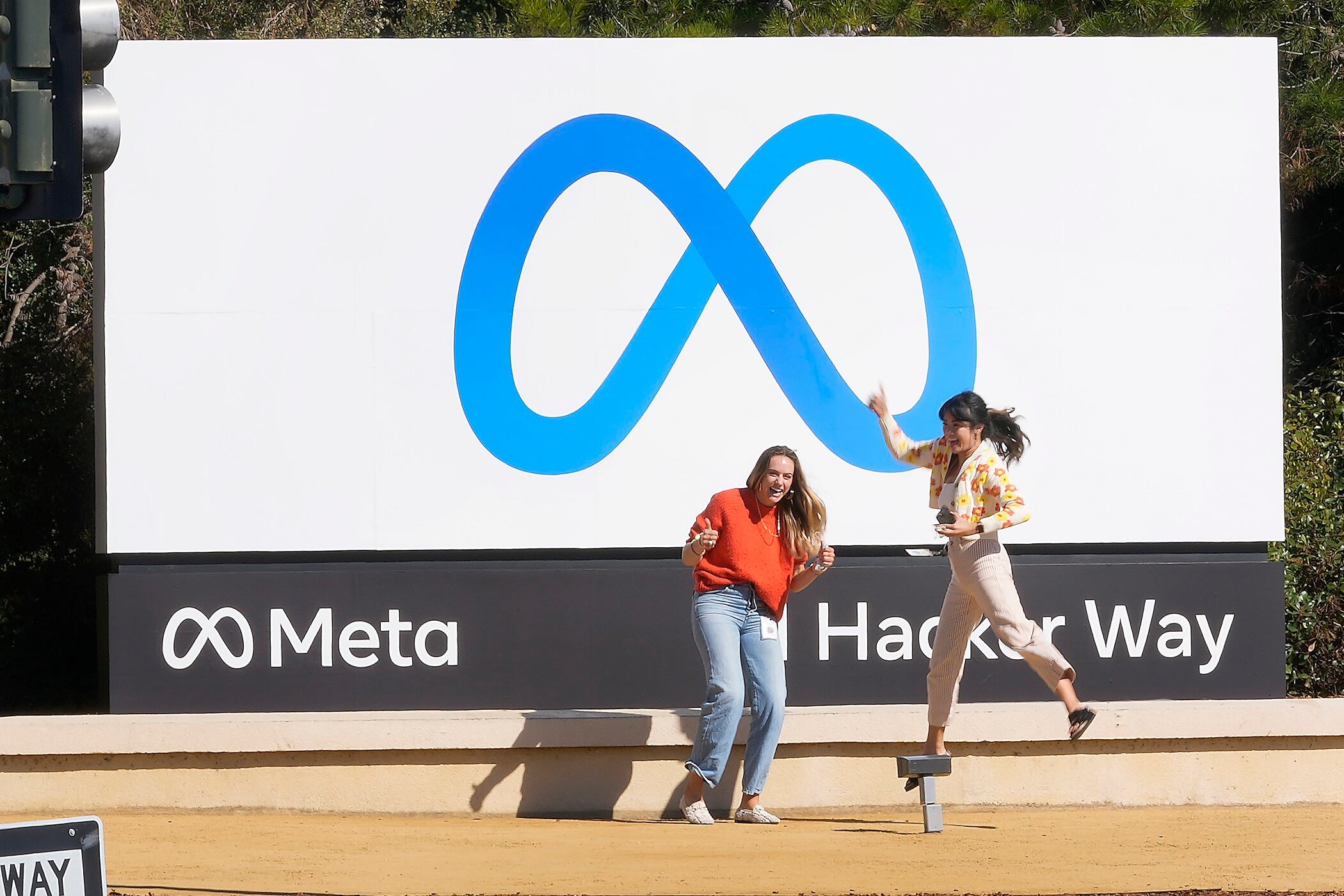
Facebook employees take a photo with the company's new name and logo outside its headquarters in Menlo Park, Calif., Oct. 28, 2021. Facebook’s parent company Meta on Monday, Jan. 24, 2022 said it has created what it believes is among the fastest artificial intelligence supercomputers running today. The social media giant said it hopes the machine will help lay the groundwork for its building of the metaverse, a virtual reality construct intended to supplant the internet as we know it today. Facebook said it believes the computer will be the fastest in the world once it is fully built around the middle of the year. (AP Photo/Tony Avelar)
Facebook’s parent company Meta on Monday said it has created what it believes is among the fastest artificial intelligence supercomputers running today.
The social media giant said it hopes the machine will help lay the groundwork for its building of the metaverse, a virtual reality construct intended to supplant the internet as we know it today.
Facebook said it believes the computer will be the fastest in the world once it is fully built around the middle of the year.
Supercomputers are extremely fast and powerful machines built to do complex calculations not possible with a regular home computer. Meta did not disclose where the computer is located or how much it is costing to build.
The computer, which is already up and running but is still being built, is called AI Research SuperCluster. Meta says it will help its AI researchers build “new and better” artificial intelligence models that can learn from “trillions” of examples and work across hundreds of different languages simultaneously and analyze text, images and video together.
The way Meta is defining the power of its computer is different from how conventional and more technically powerful supercomputers are measured because it relies on the performance of graphics-processing chips, which are useful for running “deep learning” algorithms that can understand what’s in an image, analyze text and translate between languages, said Tuomas Sandholm, a computer science professor and co-director of the AI center at Carnegie Mellon University.
“We hope RSC will help us build entirely new AI systems that can, for example, power real-time voice translations to large groups of people, each speaking a different language, so they can seamlessly collaborate on a research project or play an AR game together,” Meta said in a blog post.
The company said its supercomputer will incorporate “real-world examples” from its own systems into training its AI. It says its previous efforts used only open-source and other publicly available data sets.
“They are going to, for the first time, put their customer data on their AI research computer,” Sandholm said. “That would be a really big change to give AI researchers and algorithms access to all that data.”
President Donald Trump's administration last month awarded a $1.2 billion contract to build and operate what's expected to become the nation’s largest immigration detention complex to a tiny Virginia firm with no experience running correction facilities.
Chipmaker Nvidia is poised to release a quarterly report that could provide a better sense of whether the stock market has been riding an overhyped artificial intelligence bubble or is being propelled by a technological boom that’s still gathering momentum.
Cracker Barrel said late Tuesday it’s returning to its old logo after critics — including President Donald Trump — protested the company’s plan to modernize.
Low-value imports are losing their duty-free status in the U.S. this week as part of President Donald Trump's agenda for making the nation less dependent on foreign goods. A widely used customs exemption for international shipments worth $800 or less is set to end starting on Friday. Trump already ended the “de minimis” rule for inexpensive items sent from China and Hong Kong, but having to pay import taxes on small parcels from everywhere else likely will be a big change for some small businesses and online shoppers. Purchases that previously entered the U.S. without needing to clear customs will be subject to the origin country’s tariff rate, which can range from 10% to 50%.
Southwest Airlines will soon require plus-size travelers to pay for an extra seat in advance if they can't fit within the armrests of one seat. This change is part of several updates the airline is making. The new rule starts on Jan. 27, the same day Southwest begins assigning seats. Currently, plus-size passengers can pay for an extra seat in advance and later get a refund, or request a free extra seat at the airport. Under the new policy, refunds are still possible but not guaranteed. Southwest said in a statement it is updating policies to prepare for assigned seating next year.
Cracker Barrel is sticking with its new logo. For now. But the chain is also apologizing to fans who were angered when the change was announced last week.
Elon Musk on Monday targeted Apple and OpenAI in an antitrust lawsuit alleging that the iPhone maker and the ChatGPT maker are teaming up to thwart competition in artificial intelligence.