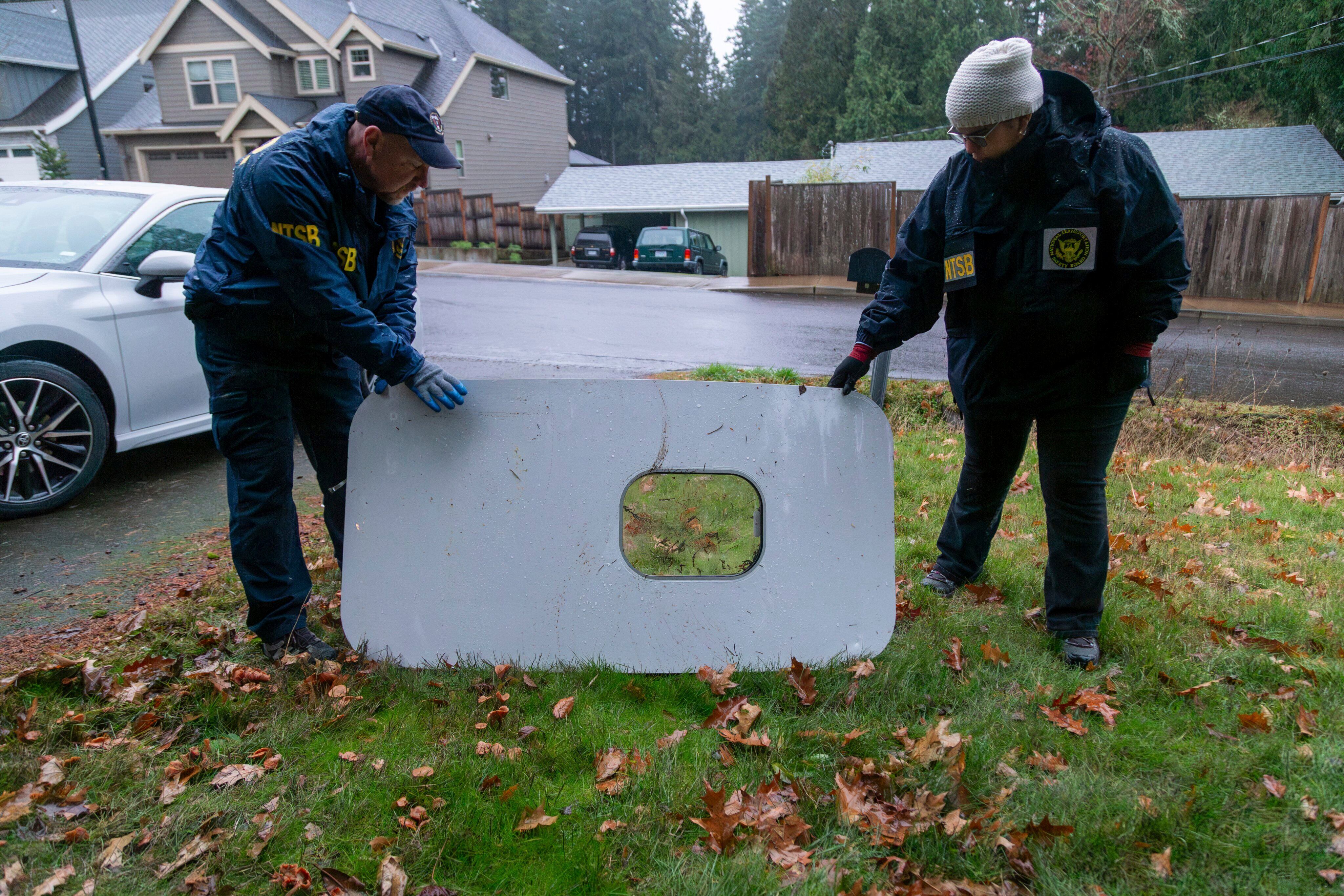
This photo released by the National Transportation Safety Board shows the door plug from Alaska Airlines Flight 1282 on Monday, Jan. 8, 2024, in Portland, Ore. A panel used to plug an area reserved for an exit door on the Boeing 737 Max 9 jetliner blew out Jan. 5, shortly after the flight took off from Portland, forcing the plane to return to Portland International Airport. (National Transportation Safety Board via AP)
Federal officials are investigating whether Boeing failed to make sure a panel that blew off a jetliner in midflight last week was safe and manufactured to meet the design that regulators approved.
The Federal Aviation Administration said Thursday that the investigation is focusing on plugs used to fill spots for extra exits when those doors are not required on Boeing 737 Max 9 jetliners.
The plug that blew off an Alaska Airlines Max 9 was found near Portland, Oregon, and will be be examined in a government laboratory.
“This incident should have never happened and it cannot happen again,” the FAA said in a statement. “Boeing’s manufacturing practices need to comply with the high safety standards they’re legally accountable to meet.”
The FAA notified Boeing of the investigation in a letter dated Wednesday and asked it to respond within 10 business days.
The agency said Boeing's response should include “the root cause of the encountered condition(s)" and steps the company is taking to prevent a recurrence.
The FAA has grounded Max 9 jets, including all 65 operated by Alaska and 79 used by United Airlines until Boeing can develop inspection guidelines and planes can be examined. Alaska has canceled all flights by Max 9s through Saturday.
Investigators with the National Transportation Safety Board said this week they have not been able to find four bolts that are used to help secure the 63-pound door plug. They are not sure whether the bolts were there before the plane took off.
Despite a hole in the side of the plane, pilots were able to return to Portland and make an emergency landing. No serious injuries were reported.
Tesla, the car company run by Elon Musk, reported Wednesday that it sold more vehicles in the past three months after boycotts hit hard earlier this year, but profits still fell sharply. Third-quarter earnings fell to $1.4 billion, from $2.2 billion a year earlier. Excluding charges, per share profit of 50 cents came in below analysts' estimate. Tesla shares fell 3.5% in after-hours trading. Musk said the company's robotaxi service, which is available in Austin, Texas, and San Francisco, will roll out to as many as 10 other metro areas by the end of the year.
Starbucks’ AI barista aims to speed service and improve experience. Nick Lichtenberg, Fortune Business Editor, explains its impact on workers and customers.
As Big Tech reports Q3 earnings, investors await proof that massive AI and cloud investments from Meta, Apple, Microsoft, and Alphabet are driving real growth.
Eric Trump joins us to discuss American Bitcoin’s mission, market strategy, and why he believes the U.S. must lead the next era of digital currency innovation.
Unreal Snacks CEO Kevin McCarthy shares how dye-free candy is leading the sweets revolution—just in time for what could be a record-breaking Halloween 2025.
In a daring daylight robbery on Sunday, thieves used a basket lift to scale the Louvre’s facade, smash display cases, and steal eight priceless jewels.