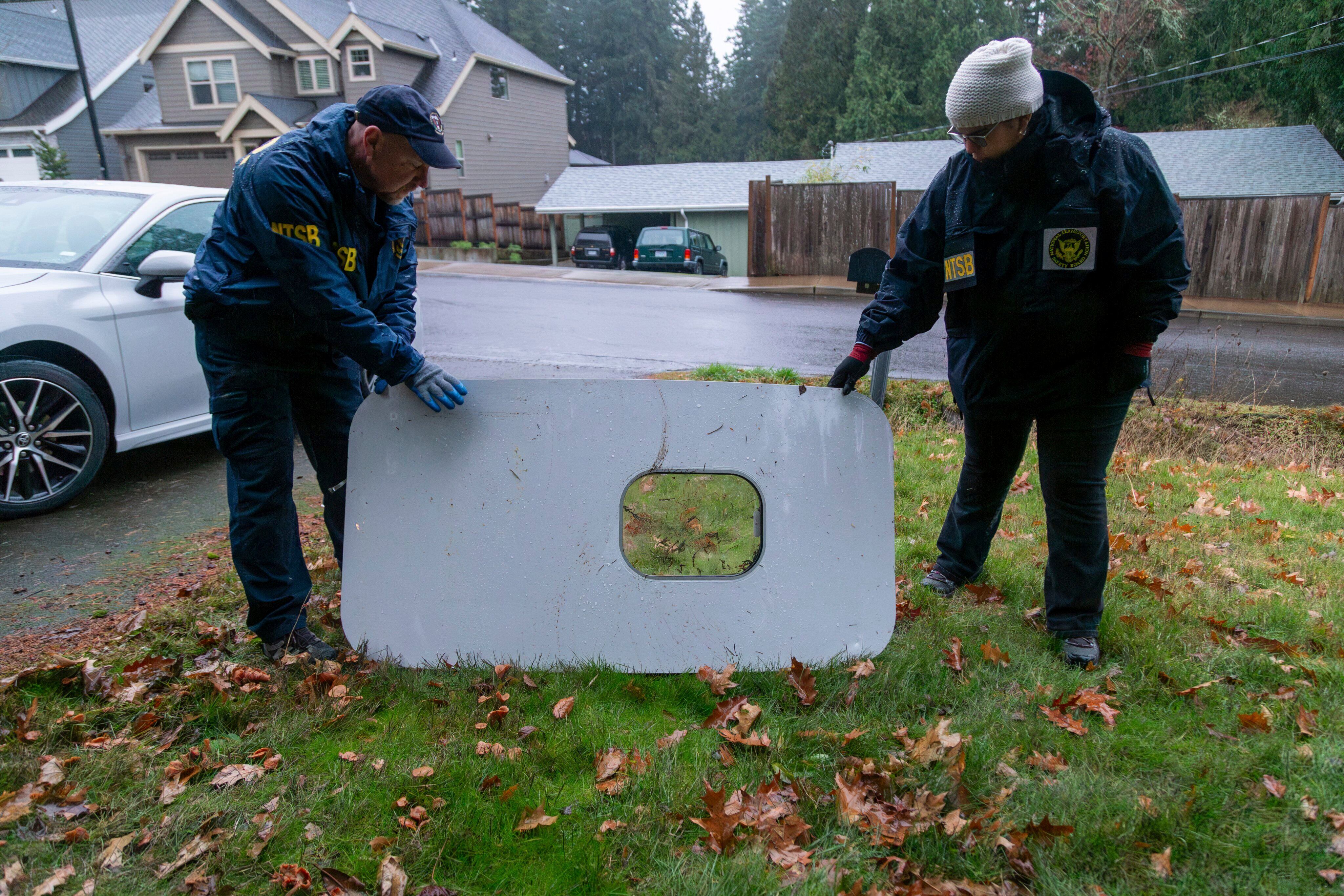
This photo released by the National Transportation Safety Board shows the door plug from Alaska Airlines Flight 1282 on Monday, Jan. 8, 2024, in Portland, Ore. A panel used to plug an area reserved for an exit door on the Boeing 737 Max 9 jetliner blew out Jan. 5, shortly after the flight took off from Portland, forcing the plane to return to Portland International Airport. (National Transportation Safety Board via AP)
Federal officials are investigating whether Boeing failed to make sure a panel that blew off a jetliner in midflight last week was safe and manufactured to meet the design that regulators approved.
The Federal Aviation Administration said Thursday that the investigation is focusing on plugs used to fill spots for extra exits when those doors are not required on Boeing 737 Max 9 jetliners.
The plug that blew off an Alaska Airlines Max 9 was found near Portland, Oregon, and will be be examined in a government laboratory.
“This incident should have never happened and it cannot happen again,” the FAA said in a statement. “Boeing’s manufacturing practices need to comply with the high safety standards they’re legally accountable to meet.”
The FAA notified Boeing of the investigation in a letter dated Wednesday and asked it to respond within 10 business days.
The agency said Boeing's response should include “the root cause of the encountered condition(s)" and steps the company is taking to prevent a recurrence.
The FAA has grounded Max 9 jets, including all 65 operated by Alaska and 79 used by United Airlines until Boeing can develop inspection guidelines and planes can be examined. Alaska has canceled all flights by Max 9s through Saturday.
Investigators with the National Transportation Safety Board said this week they have not been able to find four bolts that are used to help secure the 63-pound door plug. They are not sure whether the bolts were there before the plane took off.
Despite a hole in the side of the plane, pilots were able to return to Portland and make an emergency landing. No serious injuries were reported.
Low-value imports are losing their duty-free status in the U.S. this week as part of President Donald Trump's agenda for making the nation less dependent on foreign goods. A widely used customs exemption for international shipments worth $800 or less is set to end starting on Friday. Trump already ended the “de minimis” rule for inexpensive items sent from China and Hong Kong, but having to pay import taxes on small parcels from everywhere else likely will be a big change for some small businesses and online shoppers. Purchases that previously entered the U.S. without needing to clear customs will be subject to the origin country’s tariff rate, which can range from 10% to 50%.
Southwest Airlines will soon require plus-size travelers to pay for an extra seat in advance if they can't fit within the armrests of one seat. This change is part of several updates the airline is making. The new rule starts on Jan. 27, the same day Southwest begins assigning seats. Currently, plus-size passengers can pay for an extra seat in advance and later get a refund, or request a free extra seat at the airport. Under the new policy, refunds are still possible but not guaranteed. Southwest said in a statement it is updating policies to prepare for assigned seating next year.
Cracker Barrel is sticking with its new logo. For now. But the chain is also apologizing to fans who were angered when the change was announced last week.
Elon Musk on Monday targeted Apple and OpenAI in an antitrust lawsuit alleging that the iPhone maker and the ChatGPT maker are teaming up to thwart competition in artificial intelligence.
Hear from Gabino & Stephen Roche on Saphyre’s institutional AI platform that centralizes pre‑ and post‑trade data, redefining settlement speed and accuracy.
Elon Musk’s X has reached a tentative settlement with former employees of the company then known as Twitter who’d sued for $500 million in severance pay.