Harvard students hold signs at a July 1 protest of the Supreme Court ruling against affirmative action. (Photo by Craig F. Walker/The Boston Globe via Getty Images)
BOSTON (AP) — The U.S. Department of Education has opened an investigation into Harvard University's policies on legacy admissions, which give an edge to applicants with family ties to alumni.
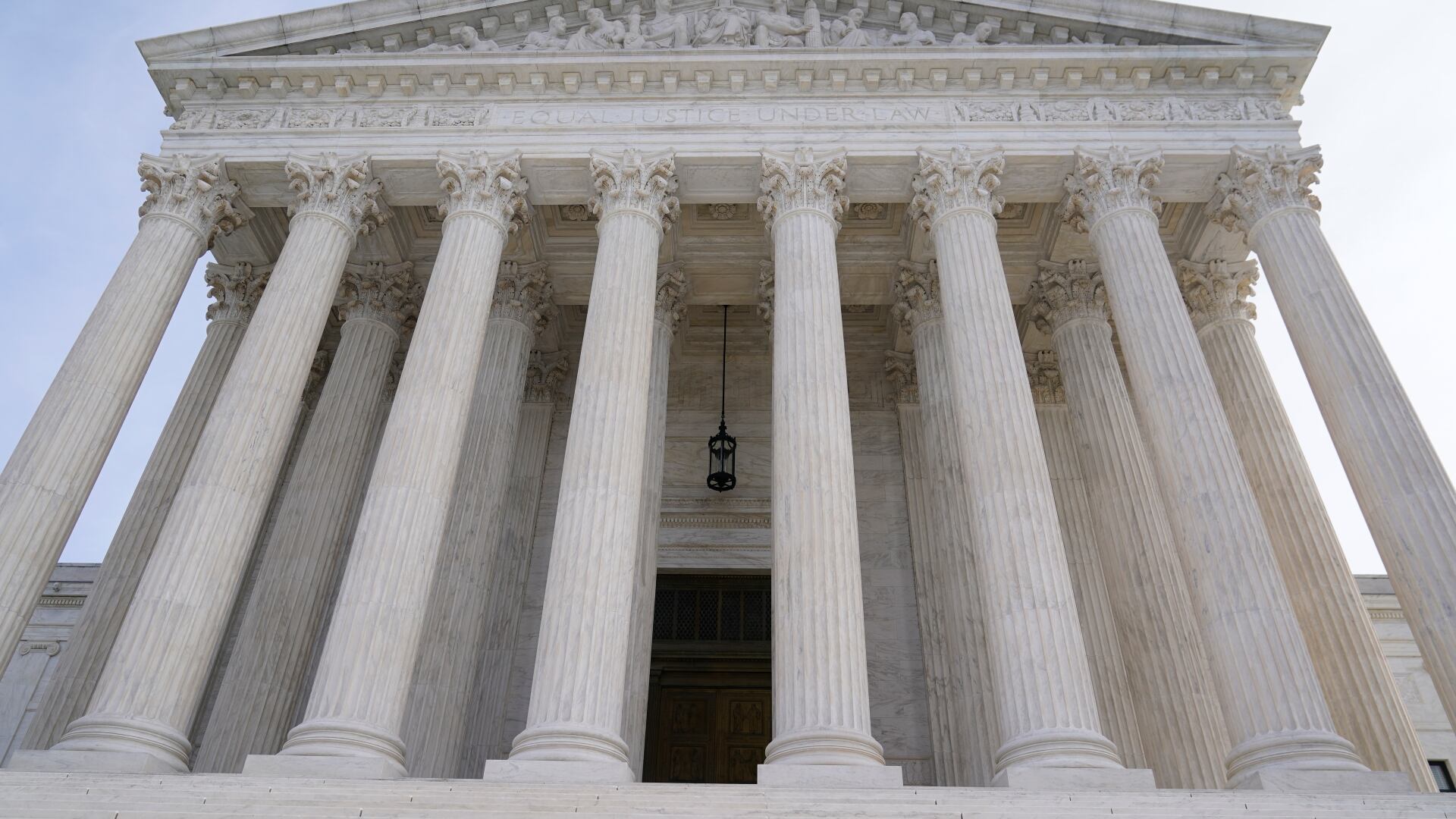
Top colleges' preferential treatment of children of alumni, who are often white, has been facing new scrutiny since the Supreme Court last month struck down the use of affirmative action as a tool to diversify college campuses.
The department notified Lawyers for Civil Rights, a nonprofit based in Boston, on Monday that it was investigating the group's claim that alleges the university “discriminates on the basis of race by using donor and legacy preferences in its undergraduate admissions process.”
An Education Department spokesperson confirmed its Office for Civil Rights has opened an investigation at Harvard and declined further comment.
The complaint was filed July 3 on behalf of Black and Latino community groups in New England. The group argued that students with legacy ties are up to seven times more likely to be admitted to Harvard, can make up nearly a third of a class and that about 70% are white. For the Class of 2019, about 28% of the class were legacies with a parent or other relative who went to Harvard.
“Qualified and highly deserving applicants of color are harmed as a result, as admissions slots are given instead to the overwhelmingly white applicants who benefit from Harvard’s legacy and donor preferences,” the group said in a statement. “Even worse, this preferential treatment has nothing to do with an applicant’s merit. Instead, it is an unfair and unearned benefit that is conferred solely based on the family that the applicant is born into.”
A spokesperson for Harvard on Tuesday said the university has been reviewing its admissions policies to ensure compliance with the law since the Supreme Court ruling on affirmative action.
“As this work continues, and moving forward, Harvard remains dedicated to opening doors to opportunity and to redoubling our efforts to encourage students from many different backgrounds to apply for admission,” the spokesperson said.
Last week, Wesleyan University in Connecticut announced that it would end its policy of giving preferential treatment in admissions to those whose families have historical ties to the school. Wesleyan President Michael Roth said a student’s “legacy status” has played a negligible role in admissions, but would now be eliminated entirely.
In recent years, schools including Amherst College in Massachusetts, Carnegie Melon University in Pennsylvania and Johns Hopkins University in Maryland also have eliminated legacy admissions.
Legacy policies have been called into question after last month’s Supreme Court ruling banning affirmative action and any consideration of race in college admissions. The court’s conservative majority effectively overturned cases reaching back 45 years, forcing institutions of higher education to seek new ways to achieve student diversity.
NAACP President and CEO Derrick Johnson said he commended the Education Department for taking steps to ensure the higher education system "works for every American, not just a privileged few.”
"Every talented and qualified student deserves an opportunity to attend the college of their choice. Affirmative Action existed to support that notion. Legacy admissions exists to undermine it,” he said.
A study led by Harvard and Brown researchers, published Monday, found that wealthy students were twice as likely to be admitted to elite schools compared to their lower- or middle-income counterparts who have similar standardized test scores.
The study looked at family income and admissions data at the Ivy League and Stanford, MIT, Duke and the University of Chicago, found that legacy admissions policies were a contributing factor to the advantage high-income students have at these schools. Athletic recruitment and extracurricular credentials, which are stronger when students attend affluent private high schools, were the other two factors.
Inflation remains hot as the January PPI has increased by 1 percent, twice what analysts had been expecting with a jump of 9.7 over the year. Beth Ann Bovino, the U.S. chief economist, for S&P Global Ratings, joined Cheddar News to discuss the rapid pace of inflation alongside higher wages, predicting the Federal Reserve will act quickly and forcefully this year. "They haven't changed their forecast, yet, that's gonna come out soon. But we expect that a March rate hike is basically pretty much baked in the cake," she said. "We think six rate hikes in total for 2022."
For black history month, Cheddar is highlighting black business leaders who are driving the need for representation forward. On February 10, the U.S. Chamber of Commerce hosted an event called 'Developing the Black-Owned Business Ecosystem.' The virtual event was organized under the lobbying group's two initiatives -- the Equality of Opportunity Initiative, and the Coalition to Back Black Businesses. The event highlighted the developments needed to develop more black-owned businesses in the U.S. Dr. Anthony Wilbon, Dean of the School of Business at Howard University, joined Cheddar News' Closing Bell to discuss his experience as a speaker at the event.
A newly declassified letter by senators Ron Wyden and Martin Heinrich claimed the CIA. has been conducting a Secret Surveillance Program which has been collecting a bulk of data from American citizens. The letter which was written in April of 2021 urges the CIA to come clean about the kind of data it collects and how many Americans have been impacted. According to these two senators, the program did not have the safeguards of congressional oversight.
Art Hogan, Chief Market Strategist at National Securities, joined Cheddar News' Closing Bell, where he says investors are taking a wait-and-see approach when it comes to the situation between Russia and the Ukraine and elaborates on the impact higher oil prices stemming from the conflict would have on the market.
Last week, Senators Ron Wyden of Oregon and Martin Heinrich of New Mexico, Democrats on the Senate Intelligence Committee, wrote a a letter airing concerns that the CIA is collecting the data of American citizens without their consent. The lawmakers fear that the program might be exploiting private data. Morgan Wright, the chief security advisor at cybersecurity firm SentinelOne, joined Cheddar News to discuss the ramifications of the letter. "We don't have all the dots in one place to connect them," said Wright, cautioning against jumping to conclusions.
Russian President Vladimir Putin and his Foreign Minister Sergey Lavrov said that diplomacy is still possible, while U.S. officials warn that an attack on Ukraine is imminent. Cheddar News speaks with James Astill, Washington bureau chief of The Economist on the latest developments in Eastern Europe.
As the number of Russian troops rose to 130,000 along its Ukrainian border, hopes for a diplomatic solution remain among world leaders. Jason McMann, head of geopolitical risk analysis at Morning Consult, joined Cheddar News to break down the fluid situation. "We saw signs pointing towards an increase in tensions between Ukraine and Russia, whereas today we're seeing some signs that the Russian government may be willing to continue down a path of diplomatic negotiations to try and find some sort of non-military solution," he said.
Nancy Pelosi and House Democratic leaders are now planning to amend the stop trading on congressional knowledge act, otherwise known as the 'Stock' Act. This 2012 law governs how members disclose the purchase or sale of stocks and amending it would close a loophole, eliminating the trading of individual stocks by members of congress. Pelosi has consistently opposed a ban on stock trading by lawmakers and congressional staff...so what's changed? Kedric Payne, Vice President of Campaign Legal Center, joins Cheddar News to discuss.
In a 5-4 vote, the U.S. Supreme Court allowed for a controversial new version of the Alabama congressional map to remain in place. The lower court had previously ordered that the state must redraw that congressional map because it violates the Voting Rights Act by diluting the political power of Black voters. Redistricting expert Yurij Rudensky joins Cheddar News to weigh in.