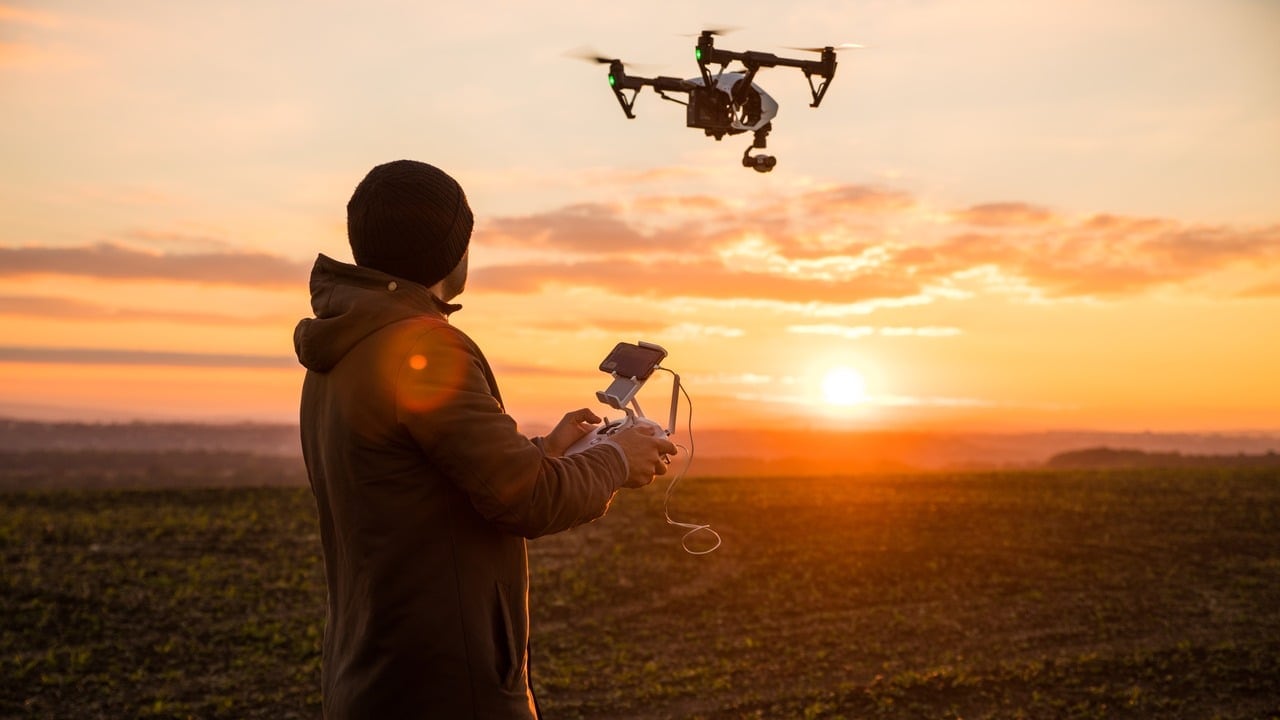
The Federal Aviation Authority (FAA) estimates that between 1.6 and 1.8 million small unmanned aerial vehicles (sUAVs) will be registered for recreational use by the end of 2024. Thanks to their advanced technology and extensive use in various industries, the United States leads the worldwide market for drones.
Many industries use UAVs or, as they’re more commonly called, drones. The list continues to grow from Amazon and Walmart deliveries to construction, conservation, utility companies, and, of course, the military.
When one thinks of agriculture, it brings up thoughts of tractors, long hours, and constantly challenging environmental conditions.
But unmanned drones have found one of their newest homes in agriculture. Farmers used them in the past for site assessment but now utilize them for crop maintenance, including spraying fungicides, herbicides, insecticides, and fertilizers.
Reduced Investment
This emerging industry is taking food growth to a new level. Traditionally, tractors with attachments planted, tilled, sprayed, and harvested crops. Some more extensive operations utilized inefficient and costly methods, like hiring crop dusters to spray crops via small planes.
Tractors are a considerable investment. Just one machine and its necessary attachments — spreaders, seeders, tillers, harvesters, and sprayers — can cost consumers anywhere from $500,000 to $1,000,000,000. “Buying drone equipment that can do as much work as the tractor is only about a $150,000 investment,” says Arthur Erickson, CEO of Texas-based startup Hylio, Inc.
Precision
New AI technology promises precision in the field. Erickson backs this claim up. With the accuracy of this technology, the days of planes or tractors spraying chemicals seem to be coming to a swift end. Additionally, farmers can use fewer chemicals to treat a field since the drone flies directly over the crop and has a directed spray, which leads to little to no chemical drift and loss.
Reduced Maintenance Costs
Aside from the lower initial investment and fewer costly tractor repairs, farmers will pay less to maintain drones. Due to improved coverage, the cost of chemicals and fertilizers is lower, and there is less need for expensive tractors, equipment, and labor.
Environmental Impact
Several factors make drones a favorable option. The hardware consumes a fraction of the fuel that a tractor uses. The drones are battery-operated, relying on in-field generators for charges.
Because of the precise nature of application, maintaining a crop’s health requires fewer harmful chemicals.
The UAVs can perform multiple tasks. At present, they spray and fertilize with liquids. There are also spreader attachments to distribute seeds, granular fertilizers, or chemicals.
Soon, such drones will be able to “scout” farms and orchards to determine any potential treatments needed to maintain crop health. Erickson says this process is currently being developed with smaller drones.
Bringing in the Younger Generation
For many years, many young farmers left family farms to pursue the glamour and salaries of city and suburban life. Drone technology offers change.
Older generations can sometimes feel intimidated by new technology, so millennials and Gen Z return to family farms to manage the new tools.
Startups are popping up nationwide, with many young CEOs opening businesses specializing in bringing drones to farms and orchards and maintaining the fields. These companies make it unnecessary for individual farms to foot drone costs, and save farmers even more money.
Not All Drones Are Created Equal
As with computers, cellphones, TVs, and other technology requiring specialty components, most parts come from China or India. With the expanding use of drones in agriculture, the government expressed concern that American agriculture is unwittingly giving away vital competitive and national security information.
The Federal Government’s Cybersecurity and Infrastructure Security Agency (CISA) released a Cybersecurity Guidance statement in January 2024. The guidance states public and private sector users are encouraged to procure or transition to secure-by-design systems.
In response to questions of Chinese manufactured Hylio parts, Erickson responds, “Some non-critical components ( as defined by the U.S. govt. ) like motors and rotors are made in China; our software was developed in the U.S. by Hylio Engineers, and we store any information gathered on U.S.-based servers.” This software makes these drones different from other UAVs that use Chinese software.
What Crops Do Farmers Maintain With Drones?
Giant drones are ideal for the extra-large fields in the Midwest. Drones help maintain crops such as wheat, rye, beans, hay, sorghum, and especially sweet corn, which is a high-maintenance crop.
Additionally, drones are tools for nut and fruit production, like almonds in California, citrus in Florida, peaches in Georgia, and apples in New York.
How To Get Started
There are several steps in obtaining an operator’s license to fly an agricultural drone. Most, if not all, companies that supply these drones have licensing services to assist buyers and make it easier.
There are two steps from the FAA. First, a 60-question, multiple-choice test regarding airspace regulations, emergency procedures, and the like. The second step is to apply for an interview. FAA officials interview an applicant personally and do an oral test.
The third is a pesticide applicator’s license. The Environment Protection Agency (EPA) dictates the federal regulations, but each state has additional regulations. Even individual counties, cities, and municipalities have rules governing the use of UAVs.
The Future of Farming Takes Flight
The farming industry’s direction has shifted upward thanks to drone incorporation. These innovative tools are not only changing the landscape of agriculture, but setting a new standard for efficiency, precision and environmental care.
With lower costs, less environmental impact, and chances for tech-savvy generations to take hold of new tools, drones are proving to be game-changers. As technology advances and we continue to find smart solutions like drones, the future of farming shows promise.
This shift toward high-tech agriculture could lead to healthier crops and more sustainable practices. As we navigate these changes, drones are clear to be not merely a passing trend but a fundamental part of agriculture’s next chapter.