Don't Credit Cynthia Nixon for Cuomo's Pot Shift: N.Y. Assemblyman Gottfried
*By Chloe Aiello*
New York Governor Andrew Cuomo may have radically changed his stance on marijuana ー but his former Democratic primary opponent Cynthia Nixon shouldn't be congratulated for his shift, according to New York State Assembly Health Committee chair Richard Gottfried.
"On this particular issue, I don't think she gets any credit. I know from first-hand conversations from people in the Governor's office, as well as from their public statements going way back, that they have been working on developing this legislation for a long time," Gottfried, who has been working on marijuana policy reform since the 70s, told Cheddar Wednesday.
In a Monday tweet, Nixon suggested that her progressive challenge of Cuomo in the gubernatorial race influenced his late embrace of marijuana reform and other issues.
"Sometimes people ask me: was it worth it? YES. Here’s why," Nixon wrote on Twitter, citing a list from The New York Times reporter Shane Goldmacher compiling some highlights of Cuomo's 2019 agenda.
Included on that list were legalizing marijuana, ending cash bail, and codifying *Roe v. Wade *ー among other issues that were major priorities for Nixon during her campaign. Some have already seized on the tweet, arguing that Nixon scored a victory ー despite losing the election ー by pushing Cuomo further left. But when it comes to marijuana, at least, Gottfried said the governor's shifting views predated the election.
"There has been a really dramatic change in opinion in the Cuomo administration on this issue from back in '14 where he was pretty hostile to medical use. His thinking has I think really caught up with where the public is ー that goes back way before Cynthia Nixon's challenge," he said.
Gottfried said the delay had less to do with determining whether pot would be legalized, and more to do with the details of how exactly legalization might work.
"Do we organize it in ways that welcome in very capitalized big business? Do we try to structure it so that minority entrepreneurs and small businesses have more of a shot at being part of the market? That is what an awful lot of the discussion is about at this point, not the threshold question of do we allow adult use," Gottfried said.
Gottfried himself knows all too well what questions like these involve, having worked on marijuana policy reform for at least 40 years. He helped write a 1977 bill that aimed to [decriminalize marijuana in New York](https://www.nytimes.com/1977/05/05/archives/albany-agreement-reached-on-easing-marijuana-curbs-measures-passage.html?module=inline) and in 2014 cosponsored the bill legalizing medical marijuana in New York. He said he thinks the governor will probably regulate marijuana in a similar fashion to the way alcohol is regulated in New York state.
"We don't allow people who produce alcohol to distribute it, we don't allow them to retail it. Those are very powerful vertical disintegration statutes in New York going back to 1933," he said, adding that the approach helps include small businesses in the retail market.
"I think it's been a pretty good system. I think that is where the governor is looking."
For full interview [click here](https://cheddar.com/videos/cuomo-expected-to-fast-track-legislation-to-legalize-marijuana).
Markets were pointing mostly lower to end the week as investors reacted to the threat of a Covid resurgence in Europe. Jeff Schulze, Investment Strategist at ClearBridge Investments joined Cheddar's Opening Bell to discuss Friday's pre-market activity.
A federal judge tossed out a lawsuit against financial services platform Robinhood following the meme stock saga that swept the investment world. The judge said it found no wrongdoing on Robinhood's part after the platform halted trading on popular meme stocks Gamestop and AMC.
Jill and Carlo are back to cover the latest in the Rittenhouse trial, new information on the origins of Covid, return-to-office and more.
JOIN US FOR THE YOUTUBE WATCH PARTY @ 9aET: http://www.youtube.com/cheddarnow
The U.S. Justice Department has filed a lawsuit against Uber after it was discovered that disabled people were being disproportionately affected by extra “wait time” fees. Attorney Jonathan Bell joined Cheddar to discuss.
Belarus President Alexander Lukashenko has been accused by the EU of manufacturing a migration crisis along his border with Poland. But, even as tensions appear to be stabilizing at the moment, Ali Noorani, the president and CEO of National Immigration Forum and the host of the "Only in America" podcast spoke to Cheddar about the ongoing danger to the migrants who hail from countries like Iraq and Afghanistan. "What is going to happen to folks who are in Belarus who came from these countries? Is Lukashenko going to provide them asylum and protection in Belarus, or are they going to continue to be political pawns in a geopolitical battle," he said. "Real people's lives are being put at great risk."
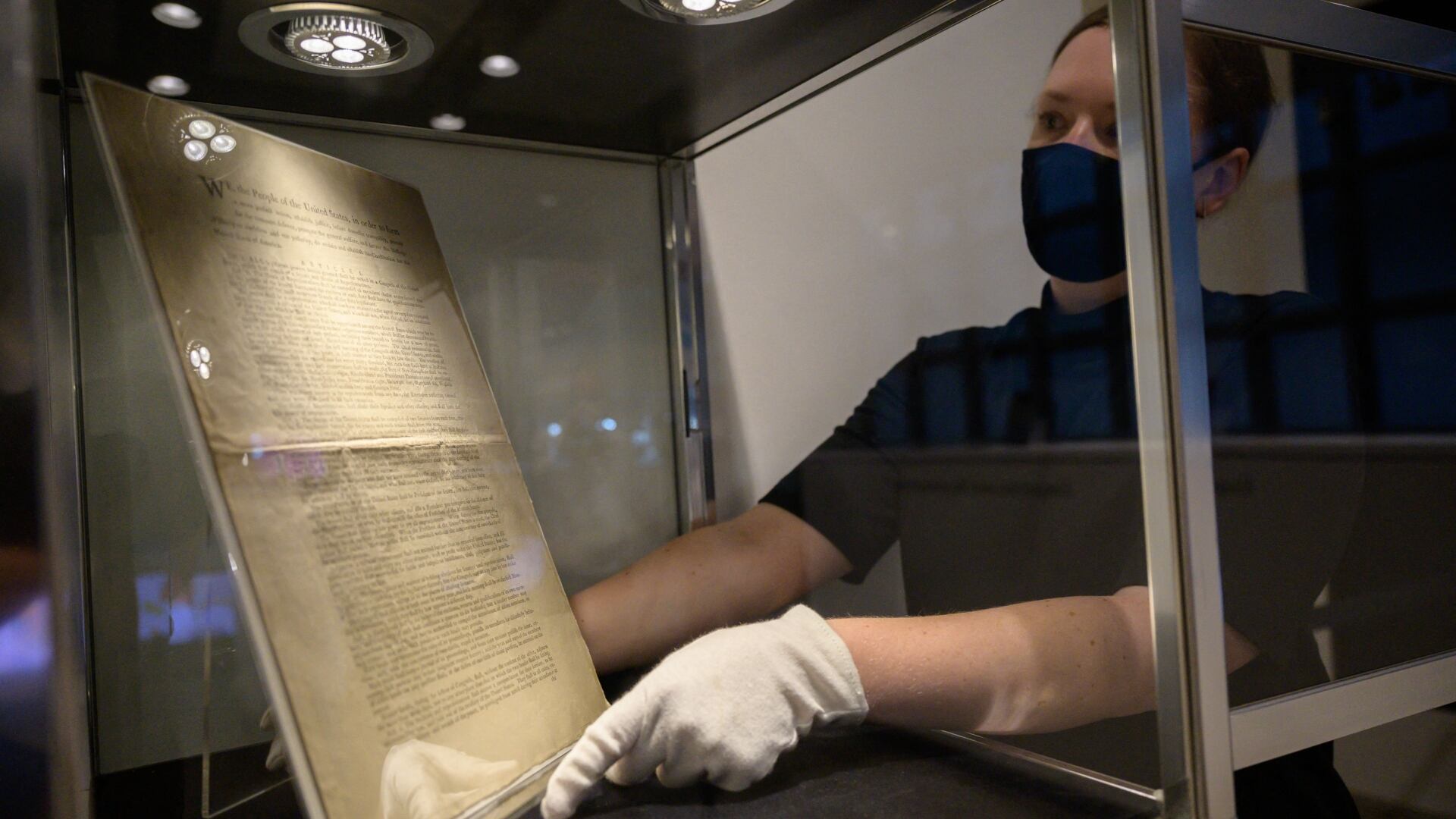
A group of crypto investors has come together to raise millions of dollars in the hopes of owning a rare piece of the U.S. Constitution. According to the crypto group, "Constitution DAO" It is time to put the constitution in the hands of the people. CEO and Founder of Metaversal Yossi Hasson, joined Cheddar to discuss more.
Polarization is among the defining traits of American politics in the 21st century. Sometimes it seems like the only thing we can all agree on is the fact that we don't really agree on anything. But those divisions don't just stop at whether you vote red or blue.
A new survey from the Pew Research Center finds that rather than just two political buckets, we have nine. The "2021 political typology" as it's called distinguishes between different ideological subsets in the Democratic and Republican party. It encompasses everyone from the loudest revolutionary lefties, to the loudest insurrection apologists on the right.
Andrew Daniller, research associate at the Pew Research Center, joins None of the Above to discuss.
Tanya Snyder, transportation reporter at Politico, joins None of the Above with J.D. Durkin to discuss the bipartisan infrastructure law, what it means for the electric vehicle industry and whether Democrats will be able to capitalize on the legislative victory ahead of the 2022 midterms.
Heading into 2022, the eyes of political nerds like us are fixed on statehouses across the country. State legislatures are in the process of taking the data from the 2020 census and using it to draw new congressional districts. The process has major implications for midterms, as Republicans could retake the majority just by gerrymandering enough seats into their column. In Maryland, state level Democrats are considering several maps, one of which would completely draw out the only Republican from the state in Congress.
Bruce DePuyt, senior reporter at Maryland Matters, and Helen Brewer, legal analyst at Princeton's Electoral Innovation Lab, join Cheddar Politics to discuss.