By Jonathan Lemire, Jill Colvin, Zeke Miller and Steve Peoples
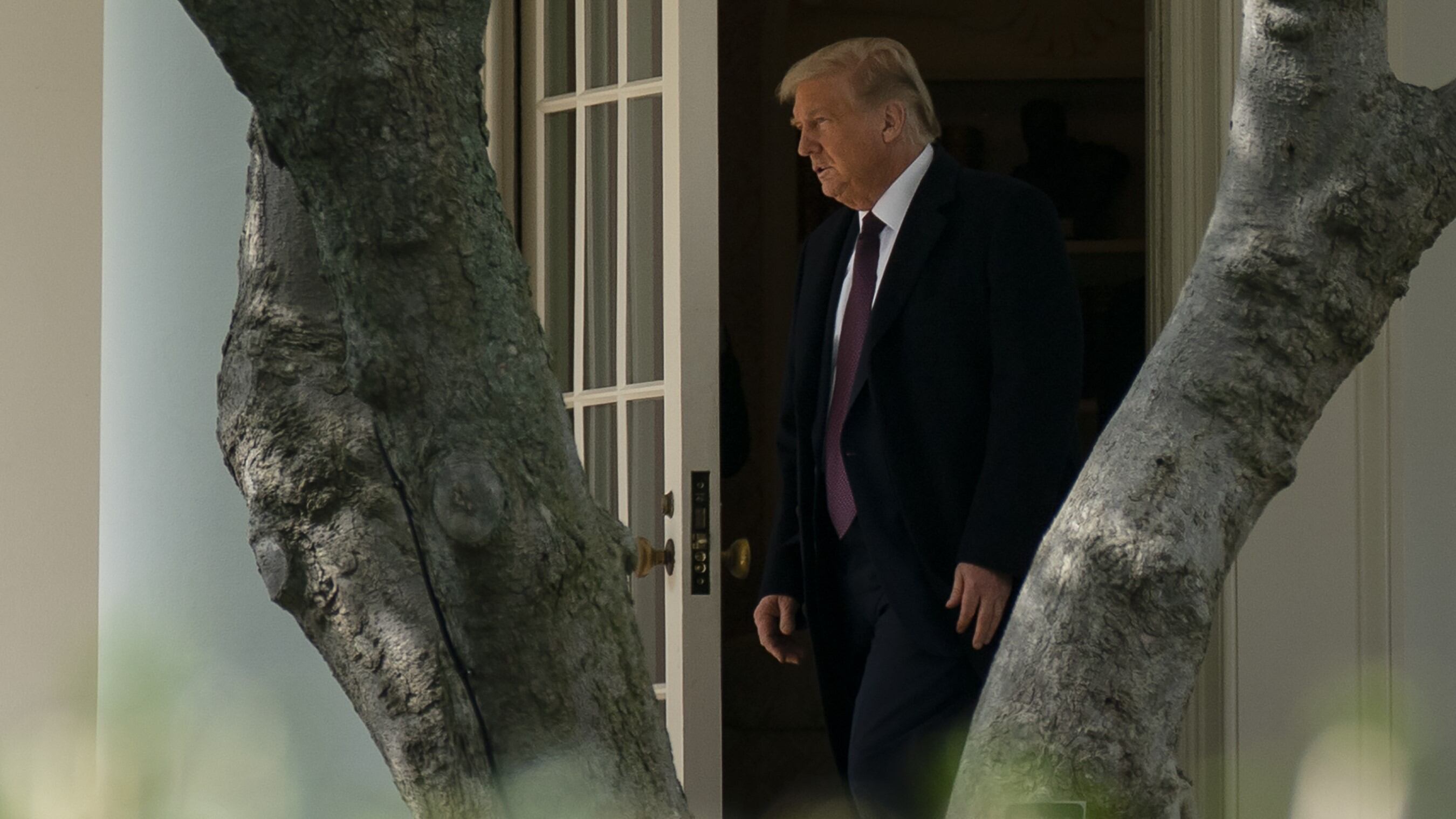
President Donald Trump faces “critical” coming days after a “very concerning” period in his fight against COVID-19 at a military hospital, his chief of staff said Saturday — in contrast to a rosier assessment moments earlier by Trump doctors, who took pains not to reveal the president had received supplemental oxygen at the White House before his hospital admission.
Trump remained at Walter Reed National Military Medical Center on Sunday. He offered his own assessment of his status Saturday evening in a video from his hospital suite, saying he was beginning to feel better and hoped to “be back soon.”
And he was back on social media early Sunday morning, sharing a video of flag-waving supporters, most not wearing masks, gathered outside Walter Reed.
“Thank you so much!” Trump tweeted at 7:18 a.m.
The day before, chief of staff Mark Meadows told reporters outside the hospital, “We're still not on a clear path yet to a full recovery.” In an update Saturday night, Trump's chief doctor expressed cautious optimism but added that the president was "not yet out of the woods.”
The changing, and at times contradictory, accounts created a credibility crisis for the White House at a crucial moment, with the president’s health and the nation’s leadership on the line. With Trump expected to remain hospitalized several more days and the presidential election looming, his condition is being anxiously watched by Americans.
Moreover, the president's health represents a national security issue of paramount importance not only to the functions of the U.S. government but also to countries around the world, friendly and otherwise.
Trump's Democratic challenger, Joe Biden, pulled his attack ads off the air during Trump's hospitalization, and on Sunday, he dispatched senior aides to deliver a largely friendly message.
“We are sincerely hoping that the president makes a very quick recovery, and we can see him back out on the campaign trail very soon," Biden adviser Symone Sanders said on CNN's “State of the Union.”
She added: “This is a glaring reminder that the virus is real.”
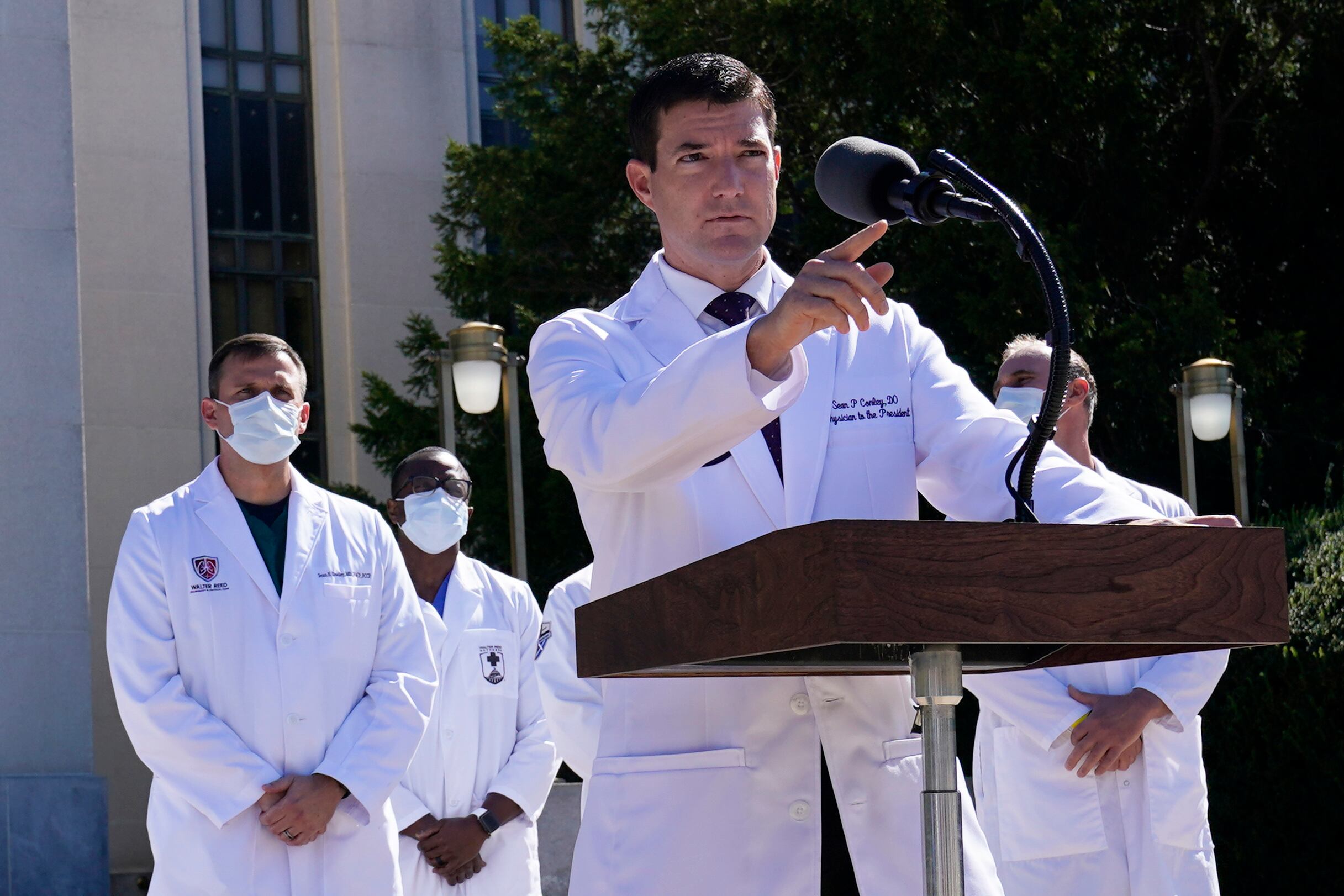
Saturday's briefing by Navy Cmdr. Dr. Sean Conley and other doctors raised more questions than it answered. Conley repeatedly refused to say whether the president ever needed supplemental oxygen, despite repeated questioning, and declined to share key details, including how high a fever Trump had been running before it came back down to a normal range. Conley also revealed that Trump had begun exhibiting “clinical indications” of COVID-19 on Thursday afternoon, earlier than previously known.
Conley spent much of the briefing dodging reporters' questions as he was pressed for details.
“Thursday, no oxygen. None at this moment. And yesterday with the team, while we were all here, he was not on oxygen,” Conley said.
But according to a person familiar with Trump’s condition, Trump was administered oxygen at the White House on Friday morning, before he was transported to the military hospital by helicopter that evening. The person was not authorized to speak publicly and spoke to The Associated Press on condition of anonymity,
Conley said that Trump's symptoms, including a mild cough, nasal congestion and fatigue, “are now resolving and improving,” and that the president had been fever-free for 24 hours. But Trump also is taking aspirin, which lowers body temperature and could mask or mitigate that symptom.
“He’s in exceptionally good spirits,” said another doctor, Sean Dooley. He said Trump's heart, kidney and liver functions were normal and he was not having trouble breathing or walking around.
In an evening health update, Conley said Trump had been up and moving around his medical suite without difficulty and conducting business. “While not yet out of the woods, the team remains cautiously optimistic,” he said.
In the hospital video, Trump defended his decision to continue campaigning and holding large events during a pandemic.
“I had no choice,” said Trump, who refused to abide by basic public health recommendations, including mask-wearing. "I had to be out front. ... I can’t be locked up in a room upstairs and totally safe. ... As a leader, you have to confront problems.”
Trump also thanked his medical team and hailed the state-of-the-art treatments he was receiving, comparing them to “miracles coming down from God.” Trump’s medical care is far superior to the average American's, with around-the-clock attention and experimental treatments.
The president was angry at Meadows' public assessment of his health and, in an effort to prove his vitality, Trump ordered up the video and authorized longtime confidant Rudy Giuliani to release a statement on his behalf that he was feeling well, according to a Republican close to the White House not authorized to publicly discuss private conversations.
Trump is 74 years old and clinically obese, putting him at higher risk of serious complications from a virus that has infected more than 7 million people nationwide and killed more than 209,000 people in the U.S.
First lady Melania Trump remained at the White House to recover from her own bout with the virus. She was “really handling it very nicely,” Trump said in the video, noting with a touch of humor that she was “just a little tiny bit younger” — in fact, 24 years younger.
Meadows himself had insisted Friday morning that Trump had only “mild symptoms" as the White House tried to project an image of normalcy. It was unclear whether Trump already had received oxygen when Meadows spoke.
“President Trump remains in good spirits, has mild symptoms and has been working throughout the day,” press secretary Kayleigh McEnany said late Friday. She said Trump had only been sent to Walter Reed as a precaution.
Trump's administration has been less than transparent with the public throughout the pandemic, both about the president’s health and the virus's spread inside the White House. The first word that a close aide to Trump had been infected came from the media, not the White House. And aides have repeatedly declined to share basic health information, including a full accounting of the president’s symptoms, what tests he’s undertaken and the results.
In a memo released late Friday, Conley did report that Trump had been treated at the hospital with remdesivir, an antiviral medication, after sharing that he'd taken another experimental drug at the White House.
Conley declined to say when Trump had last been tested before he was confirmed to have COVID-19 late Thursday. He initially suggested that Trump was 72 hours into the diagnosis — which would mean that he was confirmed infected Wednesday. Conley later clarified that Trump was administered an accurate test for the virus on Thursday afternoon, after White House aide Hope Hicks was confirmed to be positive and Trump exhibited “clinical indications” of the virus.
The White House has said Trump was expected to stay at the hospital for “a few days” and would continue to work from its presidential suite, which is equipped to allow him to keep up his official duties. In addition to accessibility to tests and equipment, the decision to move to the hospital on Friday was made, at least in part, with the understanding that hurrying there later could send a worrying signal if he took a turn for the worse.
On Saturday, Conley said Trump’s blood oxygen level was 96%, which is in the normal range. The two experimental drugs he has received, given through an IV, have shown some promise against COVID-19. On Friday, he was given a single dose of a drug Regeneron Pharmaceuticals Inc. is testing to supply antibodies to help his immune system fight the virus.
On Friday night, he began a five-day course of remdesivir, a Gilead Sciences drug currently used for moderately and severely ill patients. The drugs work in different ways — the antibodies help the immune system rid the body of virus and remdesivir curbs the virus’s ability to multiply.
“We’re maximizing all aspects of his care,” attacking the virus in multiple ways, Conley said. “I didn’t want to hold anything back if there was any possibility it would add value to his care.”
He noted that in many cases, COVID-19 can become more dangerous as the body responds. “The first week of COVID, and in particular day seven to 10, are the most critical in determining the likely course of this illness,” he said.
At the same time, the White House has been working to trace a flurry of new infections of close Trump aides and allies. Attention is focused in particular on the Sept. 26 White House event introducing Trump’s Supreme Court nominee. That day, Trump gathered more than 150 people in the Rose Garden, where they mingled, hugged and shook hands — overwhelmingly without masks. There were also several indoor receptions, where Trump’s Supreme Court pick, Amy Coney Barrett, her family, senators and others spent time in the close quarters of the White House, photographs show.
Among those who attended and have now tested positive: former New Jersey Gov. Chris Christie, former White House counselor Kellyanne Conway, the president of the University of Notre Dame and at least two Republican lawmakers — Utah Sen. Mike Lee and North Carolina Sen. Thom Tillis. The president’s campaign manager, Bill Stepien, and the head of the Republican National Committee, Ronna McDaniel, have also tested positive, though they were not at the event. Another prominent Republican who has tested positive: Sen. Ron Johnson. R-Wis.
One of the president’s personal assistants, Nick Luna, tested positive after having traveled with Trump several times recently, a White House official said Saturday night. The official wasn’t authorized to discuss the matter by name and spoke on condition of anonymity.
Colvin and Miller reported from Washington. Peoples reported from New York. Associated Press chief medical writer Marilynn Marchione in Milwaukee contributed to this report.