The Democratic National Committee stands by its decision not to allow Fox News to host a Democratic primary debate in the 2020 presidential election, a party official told Cheddar on Thursday.
“Our role at the DNC is to make sure we have a fair process and we do not believe Fox News can have a fair debate,” the DNC communications director Xochitl Hinojosa said.
DNC Chairman Tom Perez announced the party’s decision earlier this week following a bombshell report from investigative journalist Jane Mayer in The New Yorker that outlined how Fox News’s coverage has moved far beyond its conservative bent and is now defined by the close relationship between President Trump and network executives. The report also cited sources who suggested that during the 2016 campaign, then-candidate Trump may been tipped off about some of the questions he would be asked during a Fox News-hosted debate.
“Fox has been both his shield and his sword,” Mayer writes. “The White House and Fox interact so seamlessly that it can be hard to determine, during a particular news cycle, which one is following the other’s lead.”
“Recent reporting has made it clear that we cannot rely on Fox to host a fair and neutral debate,” Perez said in a statement.
Fox News urged the DNC to reconsider its decision. Fox reporters “embody the ultimate journalistic integrity and professionalism” and “offer candidates an important opportunity to make their case to the largest TV news audience in America,” the network's senior vice president, Bill Sammon, said in a statement.
Hinojosa added that the DNC’s concerns lie not with the reporters but with the network’s top brass. “If the top executives are in the pocket of Donald Trump, that is not a good thing and something that deeply concerns us. It is too much of a risk,” she said.
President Trump tweeted his thoughts on the decision:
Hinojosa acknowledged that Fox viewers are “an important audience” and people the DNC “needs to reach,” but urged candidates to go directly to them through other press events and campaign stops.
Yet, regarding the debates, “the damage is done,” Hinojosa said. “We have seen with Fox News that they have not been willing to be fair when it comes to their inappropriate behavior with Donald Trump.”
To accommodate the large number of primary candidates ー 14 and counting ー the summer debates have the option of taking place over two consecutive nights. The nightly lineups will be determined at random.
“My goal in this framework is to give the grassroots a bigger voice than ever before; to showcase our candidates on an array of media platforms; to present opportunity for vigorous discussion about issues, ideas and solutions; and to reach as many potential voters as possible,” Perez said in a statement.
Grant Stark, Director of Research at CapWealth, joins Cheddar News' Closing Bell, where he says that his firm is closely monitoring oil prices amid the geopolitical conflict between Russia and Ukraine, and elaborates on how inflation will continue to be a problem across multiple sectors.
A private prison company plans to run a new pilot program that would place hundreds of migrants caught crossing the U.S.-Mexico border under house arrest. The "home curfew" pilot program is part of "impactful detention reforms," according to a spokesperson for the U.S. Department of Homeland Security. Jacinta Gonzalez, senior campaign organizer with Mijente, joins Cheddar News to discuss.
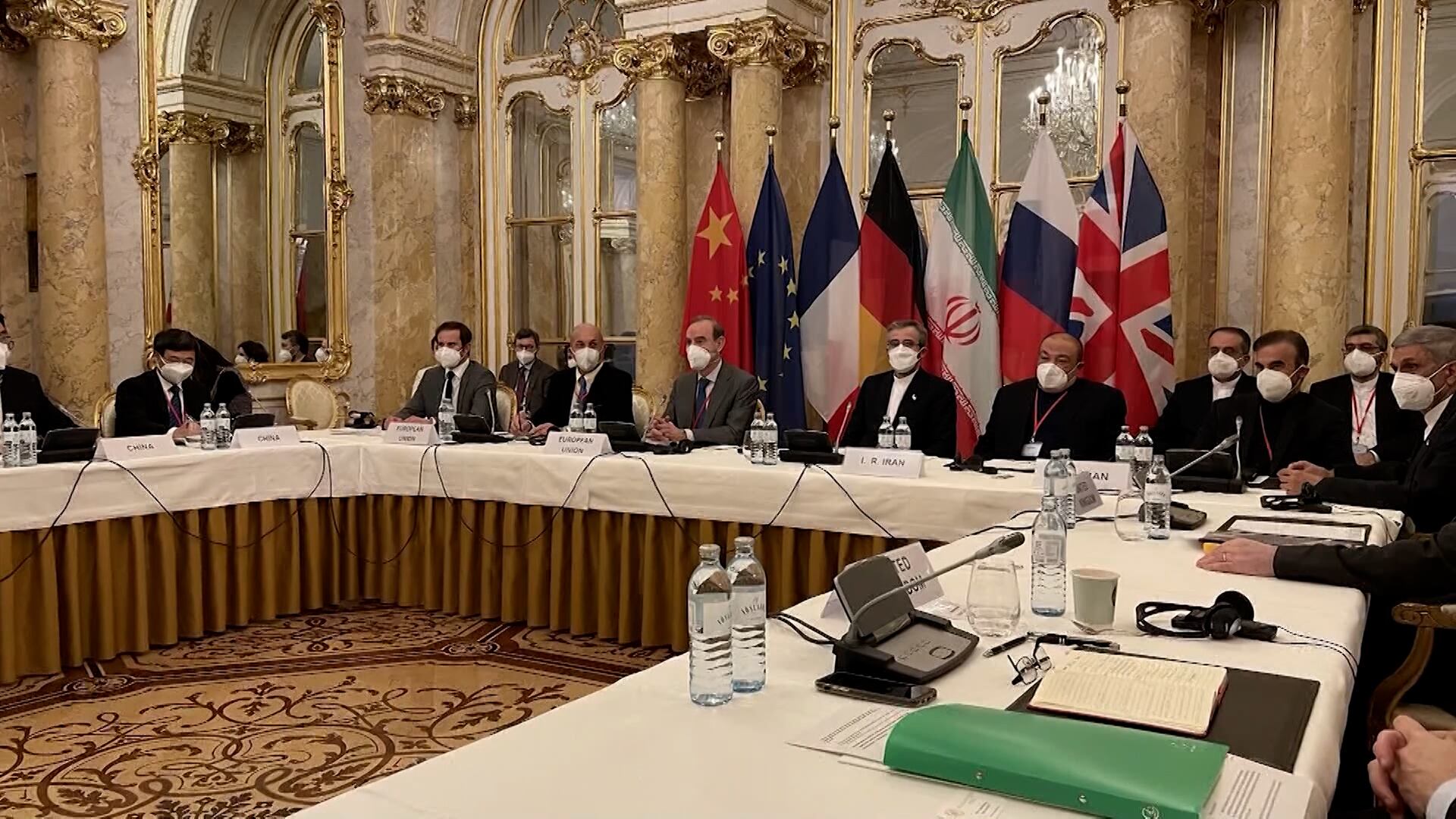
The U.S. is back in negotiations for a nuclear deal with Iran, years after former President Donald Trump withdrew the country from the Joint Comprehensive Plan of Action (JCPOA), which had been meant to curtail the Middle Eastern nation's nuclear ambitions. Former State Department senior advisor to the George W. Bush and Trump administrations, Christian Whiton, joined Cheddar News Wrap to discuss. “It appears to be very similar to the original JCPOA, which does put some constraints on Iran's nuclear program, but also has sunset provisions, including some that in the original plan were expected to take effect in 2025," he said. "And so, if we just reenter that plan, really it just buys perhaps a few years of slowing down, stopping, whatever you want to say, Iran's nuclear program."
The U.S. has announced the first of what could be multiple levels of sanctions against Russia after Moscow recognized two regions of Ukraine as independent. This comes as Britain imposes sanctions on five Russian banks and two oligarchs, and Germany freezes the Nord Stream gas pipeline. Terrell Star, a foreign affairs reporter at The Atlantic Council, joins from Kyiv to discuss.
Growing tensions in Ukraine might soon be impacting consumers in the United States. With Russia on an invasion footing in the region, gas prices are predicted to go up 10 to 15 cents a gallon in the next coming weeks, according to Robert Sinclair, spokesperson for AAA. Sinclair joined Cheddar to break down what could happen even further. "We've been seeing prices go up, and there's been nothing that's happened to affect supplies," he said. "But it's something known as the fear tax where just the talk of something that might interfere with supplies leads to prices going up speculatively."
The end of 3G is upon us. On Tuesday, AT&T became the first major provider to disable its 3G services, and T-Mobile and Verizon plan to follow suit later this year. The shutdowns are expected to impact millions of vehicles that use 3G networks for updates, remote connection, and certain emergency and convenience features. Lance Ulanoff, the U.S. Editor-in-Chief of TechRadar, joined Cheddar's Closing Bell to discuss the ramifications of the changeover.
A new report shows nearly 240 former officials in Congress, the White House, and regulatory agencies have changed careers to work in the crypto industry.
President Biden unveiled new economic sanctions on Russia for what he called "the beginning of a Russian invasion". This came one day after Putin sent troops into two breakaway regions of eastern Ukraine. Alex Ward, national security reporter for POLITICO, explains what these sanctions might do to the global economy.
U.S. stocks ended today's session sharply lower on the heels of rising geopolitical tensions between Russia and Ukraine. Melissa Brown, Managing Director of Applied Research at Qontigo, joins Cheddar News' Closing Bell to discuss.