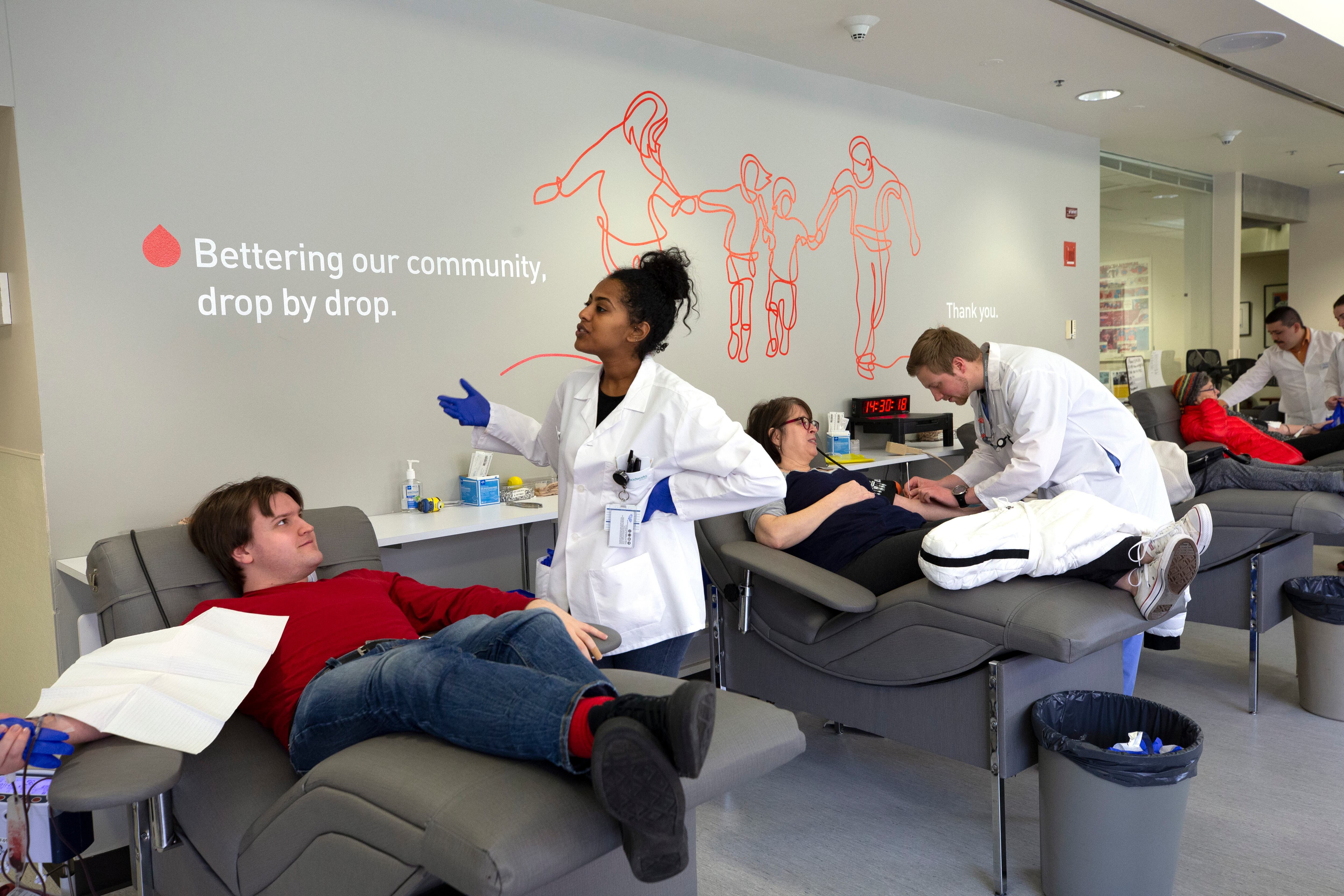
Alex Vance (L) speaks with medical assistant Lydia Rezene as he donates blood at Bloodworks Northwest on March 17, 2020 in Seattle, Washington. Schools provide 25 percent of local blood donations and their closing due to the coronavirus (COVID-19) outbreak has officials worried the region could see a shortage. (Photo by Karen Ducey/Getty Images)
Americans capable, willing, and able to donate blood are encouraged to do so during an era of social distancing.
"Social distancing doesn't have to mean social disengagement," U.S. Surgeon General Dr. Jerome Adams said during the Coronavirus Task Force briefing on Thursday, warning of blood shortages.
American Red Cross Senior Vice President Paul Sullivan told Cheddar he's concerned about an already low blood supply in the U.S., compounded by a recent wave of coronavirus-inspired blood drive cancellations, numbering more than 5,000 drives resulting in some 170,000 fewer donations.
Sullivan said he still plans to continue donating.
However, the Red Cross is changing its normal precautions in response to coronavirus concerns. Sullivan told Cheddar those new precautions include temperature checks before entering the donation space and changing gloves between each collection.
Surgeon General Adams also explained beds are six feet apart and staff members are disinfecting surfaces more often.
"So give blood today. You'll feel good about it, and you'll be helping your country and community during this crisis. And you might even save a life," he said.
Red blood cells only have a shelf life of 42 days and platelets just 5 days, so blood donations must continue in order to continue vital medical procedures to keep people alive.
"As this progresses, the way it will challenge our healthcare system … it will be just that — it will be very challenging," Sullivan warned. "No one gets a transfusion if they don't need it. We don't want to put the medical community in a situation where they have to pick who gets blood and who doesn't."
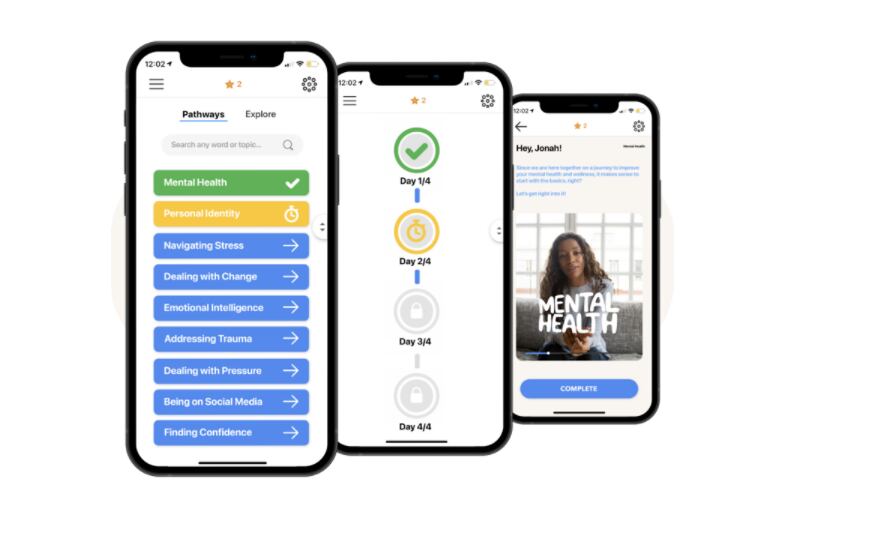
Two friends have joined forces to come up with an app dedicated to making mental health more approachable and to provide users with the tools needed to improve their mental health and overall well-being. Co-Founders of the Dial App Jonah Salita and Marcel Johnson, joined Cheddar to discuss more.
Miss Universe 2021 Harnaaz Sandhu and Smile Train CEO Susie Schaefer join Cheddar News to talk about how Smile Train continues to support those with a cleft lip this International Women's Day.
On this International Women’s Day, Deb Cupp, president of Microsoft U.S., joined Cheddar News to talk about the implementation of her pillars to extend the company's culture, such as acting with care and putting the team first. "What I like about the pillars is they're very simple, so it's easy for us to think about how they show up every day in our lives," Cupp said.
Christian Nunes, President of the National Organization for Women, joins Cheddar Reveals to take a look at where the women's rights movement stands today and where it's headed.
Steven Spielberg has spoken out against the Motion Picture Academy’s decision to move the presentation of eight categories to the pre-show off-air for this year’s Oscars. "We should all have a seat at the supper table together, live at five," said the Academy Award-winning director, who is also nominated for two statues at this year's event.
On this episode of Cheddar Reveals, Sally Roesch Wagner, Historian & Executive Director, The Matilda Joslyn Gage Foundation, discusses how the early women's rights movement evolved and the hidden influence of Native American women on early American feminists.; Christian Nunes, President of the National Organization for Women, takes a look at where the women's rights movement stands today and where it's headed; Cheddar gets a look at Curiosity Stream's 'Ascent of Woman.'
Sally Roesch Wagner, Historian & Executive Director, The Matilda Joslyn Gage Foundation, joins Cheddar Reveals to discuss how the early women's rights movement evolved and the hidden influence of Native American women on early American feminists.