By Mike Schneider

New supervisors leading Disney World’s revamped governing body said Wednesday that they had good intentions about collaborating with the company after they were appointed by Florida Gov. Ron DeSantis but felt betrayed when Disney signed agreements with their predecessors stripping them of most of their authority.

“Our board wanted to work with Disney, but Disney decided they didn’t want to work with us. It was Disney’s way or the highway,” Martin Garcia, chair of the Central Florida Tourism Oversight District, said at the start of a board meeting.

In response, he had a warning about what the DeSantis-appointed supervisors who now oversee Disney World’s vast Florida holdings might try to achieve in an evolving showdown between the governor and Disney: “Nothing is off the table at this point.”

Among the changes board members made Wednesday were eliminating a planning agency and making the board responsible for future planning. They also said that in the future, they might consider acquiring more land under eminent domain, monetizing the district’s assets, banning COVID-19 vaccine and mask mandates, asserting the board's “superior authority” over the district and exploring the construction of affordable housing for Disney workers on Disney World property.

Disney World required masks and had social distancing protocols in place in 2020 when it reopened after closing for several months in an effort to stop COVID-19's spread. DeSantis has been a fierce opponent of virus mask and vaccine mandates and has petitioned the state Supreme Court to convene a grand jury to investigate “any and all wrongdoing” with respect to the COVID-19 vaccines.

Wednesday's meeting continued a battle pitting prospective presidential candidate DeSantis and Republican state lawmakers against Disney that started last year when the entertainment giant publicly opposed what critics call the state’s “Don’t Say Gay” legislation barring school instruction on sexual orientation and gender identity in kindergarten through third grade. In retaliation, Florida lawmakers passed, and DeSantis signed, legislation reorganizing Disney World’s company-controlled government, allowing the governor to appoint the five members of the Board of Supervisors. Disney previously had controlled the board for its 55-year existence.

Last month, the new DeSantis-appointees claimed their Disney-controlled predecessors pulled a fast one by stripping the new board of most powers and giving Disney control over design and construction at the theme park resort before the new members could take their seats.

At Wednesday's meeting, Garcia said the new supervisors last week discovered another “11th-hour agreement” between Disney and the previous supervisors that allows the company to set its own utility rates.

DeSantis and state lawmakers ratcheted up the pressure on Disney on Monday by proposing upcoming legislation that would require state inspections of Disney rides, which would be an unprecedented move since Florida's largest theme park operators have been able to conduct their own inspections. The lawmakers also plan to consider legislation that would revoke the agreements between the previous board supervisors and Disney.

Republican state Sen. Blaise Ingoglia said he had a message for Disney: “You are not going to win this fight. This governor is.”

Disney has said all agreements made with the previous board were legal and approved in a public forum.

Disney CEO Bob Iger earlier this month said that any actions against the company that threaten jobs or expansion at its Florida resort was not only “anti-business" but "anti-Florida.”

The new supervisors have hired a team of high-powered lawyers that includes a former Florida Supreme Court justice to possibly challenge the agreements between Disney and the old board. At Wednesday's meeting, the attorneys outlined their arguments for why the deals were illegal, claiming they weren't properly noticed and were self-dealing. They also said a district can't confer governmental powers to a private entity.

“Disney engaged in a caper worthy of Scrooge McDuck,” said David Thompson, one of the attorneys.

Updated with the latest details.
Share:
More In Politics
All Eyes on Biden: Amid Inflation, Pandemic, How Can President Push Agenda While His Party Controls Washington?
President Joe Biden's first year in office is wrapping up. What has he achieved, and what else remains on the table while the Democrats have control of Washington? Amid an ongoing pandemic and rising inflation, Biden's approval rating is at an all-time low and his party is plagued by infighting. Will he be able to continue pushing key parts of his agenda? Paul Glastris, former Bill Clinton speechwriter & Editor-in-chief of 'Washington Monthly,' joins Cheddar News' Closing Bell to discuss the president's achievements in his first year, where he's fallen short, and what he must do in order to get more of his agenda signed into law.
Senate Bills to Reign in Big Tech Anticompetitive Practices Could Hurt Consumers
Tech giants Meta, Amazon, Alphabet, and Apple are faced with a bipartisan antitrust legislation effort underway in the Senate Judiciary Committee. The companies stand accused of promoting their own goods and services over smaller competitors on their platforms, holding too much monopolistic power via their app stores and services. Adam Kovacevich, founder and CEO of Chamber of Progress, a technology industry trade group, joined Cheddar to argue that the bills that are being debated currently could end up hurting consumers, rather than helping.
Inflation Among Biggest Concern for CEOs in 2022
Concerns over inflation have become one of the biggest worries for executives. A survey from The Conference Board shows that more than 900 CEOs consider inflation a top tier concern, a major shift from last year's survey that had it as a low-level concern. Rebecca Ray, Executive Vice President, Human Capital, The Conference Board joined Cheddar's Opening Bell for more.
Beijing Olympics Sponsors Accused of Indifference Amid Human Rights Concerns
With the 2022 Winter Olympics in Beijing rapidly approaching, clouds of controversy continue to swirl around China's treatment of the Uyghur Muslim minority population, its surveillance state, and security for visiting athletes. Phelim Kine, China correspondent for Politico, joined Cheddar to break down the big storylines surrounding the Beijing Games and highlight what he saw as the complete disregard by top corporate sponsors like P&G, Airbnb, Intel, Visa, and Coca-Cola, for the controversies. "They spend $100 million for every Olympics that they sponsor, and they have frankly shown absolute willful indifference to any type of entreaty to essentially be more vocal about their concerns about human rights in China," he said. Kine also touched on the data privacy fears for athletes as visiting contingents are being told to carry burner phones to avoid security risks.
Texas's Six-Week Abortion Ban Remains in Effect
Texas's six-week abortion ban remains in effect after a federal appeals court ruling on Monday. The U.S. court of appeals for the fifth circuit temporarily transferred the case to the Texas Supreme Court, which is expected to leave the dispute in limbo for months to come. Katie Barlow, attorney and media editor of SCOTUSblog, joins Cheddar News to discuss.
Breaking Down the 5G Deployment Disconnect Between Airlines and Telecoms
Hugh Odom, founder and president of Vertical Consultants, shared his expertise on telecommunications with Cheddar on the safety issue raised about 5G deployment by airlines. The installation was partially delayed again on Tuesday as the airlines warned of potentially catastrophic delays in a letter to the Biden administration. Later, both Verizon and AT&T relented and put a pause on some of the implementations. "The first thing the Biden administration needs to do is get everybody in the room and say, look, aviation industry, identify the problem — wireless industry, come up with a solution," said Odom.
Federal Appeals Court Rules Restrictive Texas Abortion Law to Stay in Place
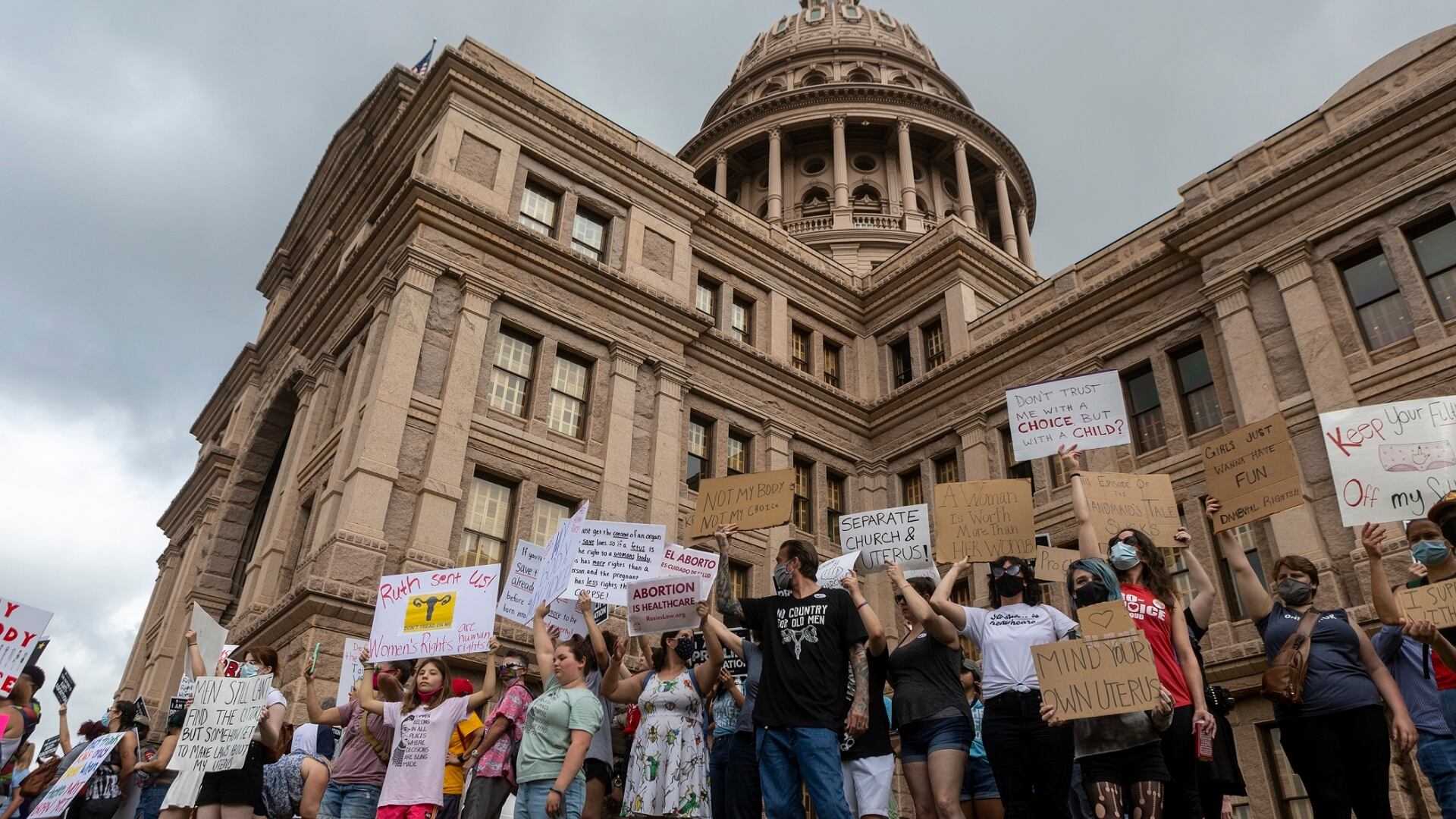
Women's March ATX rally, Saturday, Oct., 2, 2021, at the Texas State Capitol in Austin, Texas. An expected decision by the U.S. Supreme Court in the coming year to severely restrict abortion rights or overturn Roe v. Wade entirely is setting off a renewed round of abortion battles in state legislatures. (AP Photo/Stephen Spillman, File)
Load More