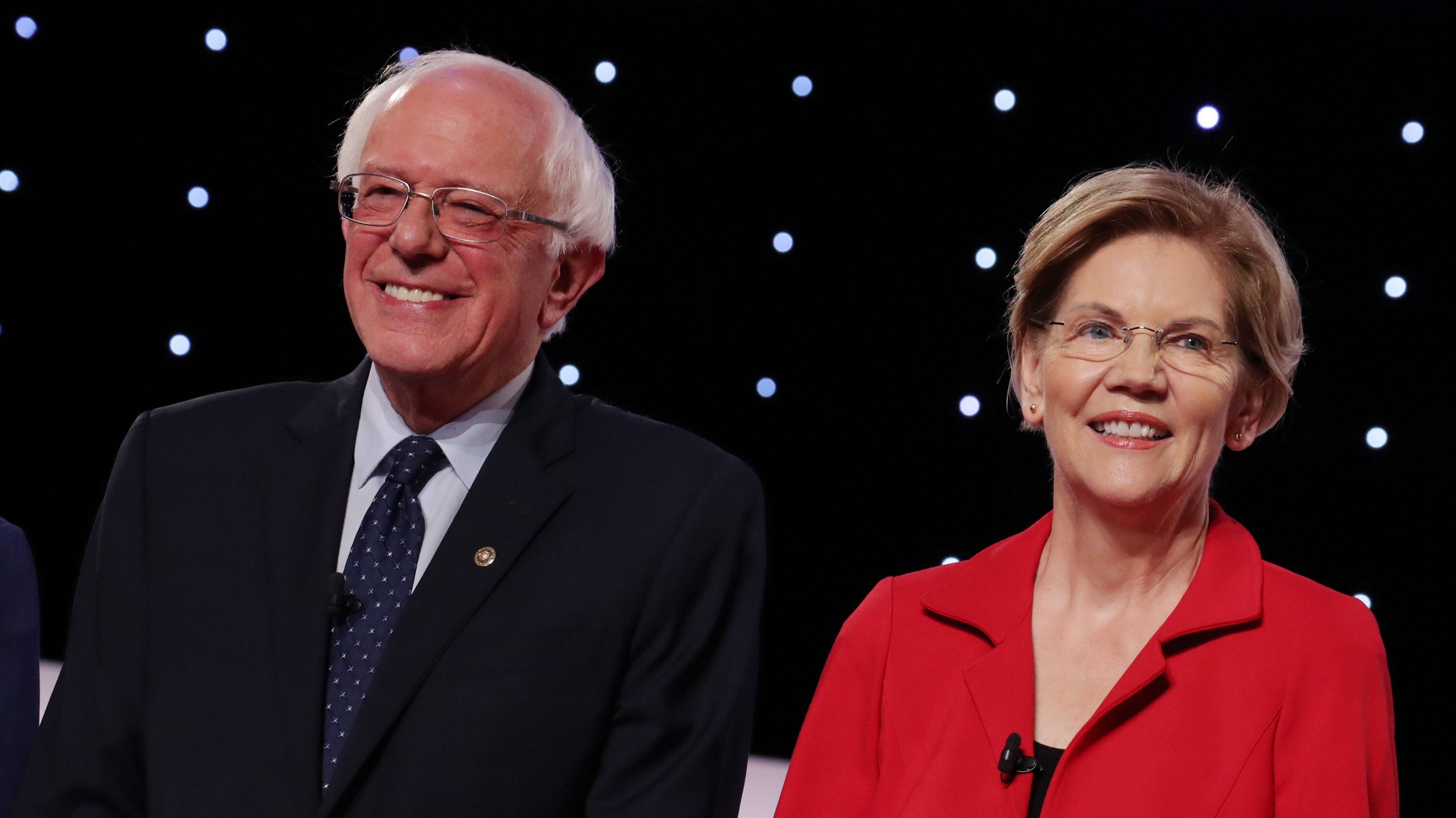
Ten of the top Democratic candidates for president presented their plans to tackle climate change during a marathon, seven-hour town hall broadcast live on CNN Wednesday. The forum represented perhaps the most in-depth public climate debate in U.S. political history, and came as the DNC has steadfastly refused to hold a dedicated official debate on the issue, despite the wishes of many of the candidates.
From Joe Biden to Amy Klobuchar, the candidates delivered a version of the same goal: for the country to reach net zero carbon emissions within the next three decades.
They differed on how to achieve that goal ー and how to pay for it.
Sen. Bernie Sanders called climate change our "common enemy" and suggested the country divert money it appropriates for defense toward clean energy development.
Joe Biden, the frontrunner, was asked why voters should trust him on the issue when he is scheduled to attend a fundraiser hosted by a fossil-fuel executive this week. (He said he "didn't realize" the fundraiser had ties to the industry.)
Sen. Elizabeth Warren urged viewers to ignore talking points from the right about consumer choice as it relates to the environment and focus on the companies that most contribute to greenhouse gas emissions. (According to scientists, the largest 90 carbon producers contributed 57 percent of the rise in carbon dioxide in the atmosphere since 1880.)
“They want to stir up a lot of controversy around your light bulbs, around your straws, and around your cheeseburgers, when 70 percent of the carbon that we’re throwing into the air comes from three industries," Warren said, appearing to refer to the oil, electric power, and building industries.
The same day as the town hall, the Trump administration reversed George W. Bush-era standards for energy-efficient lightbulbs. When moderator Chris Cuomo asked Warren whether the government should be in the business of telling people which kind of lightbulb to buy, Warren responded: "Give me a break."
“This is exactly what the fossil fuel industry wants us to be talking about. That’s what they want us to talk about: This is your problem.”
Sen. Cory Booker told people: "Whatever you want to eat, go ahead and eat it" and called attention to the issue of food deserts in low-income communities, where affordable, healthy food is often hard to come by.
While President Trump touted his administration's environmental policies in the hours before the town hall, a majority of Americans disapprove of his handling of climate change. In a July Washington Post-ABC poll, just 29 percent of respondents approved of Trump's climate policies, such as leaving the Paris agreement.
Mandy Gunasekara, a former EPA official in the Trump administration who now runs an energy lobbying firm and calls herself the "chief architect" of the decision to leave the Paris accord, told Cheddar in an interview that those dismal poll numbers are merely based on a lack of understanding on the part of voters about what Trump has done to "balance economic interest with environmental protection."
"[The Democrats'] solution to everything is bigger government, spending trillions of dollars of taxpayer money for minimal impact or benefit," she said.
Those views are increasingly out of the mainstream when it comes to climate change. One in five Americans now considers global warming to be an "extremely important" issue, according to a Stanford poll. That is compared to fewer than one in 10 who said the same in 1997. Among young voters, it's even more pronounced: nearly 80 percent of 18 to 34 year-olds say they worry "a great deal or fair amount" about the climate, according to Gallup.
Politically, that provides an opportunity for Democrats to appeal to first-time and other Millennial and Gen Z voters by casting the issue in stark relief to President Trump, who has called climate change a "hoax."
As Jonathan Ellis, senior political reporter for the New York Times, pointed out to Cheddar, many of the audience members during the debate who asked questions were affiliated with the youth-sponsored Sunrise Movement, and their questions were among the most thought out and nuanced.
"I do think this was a huge moment last night for the climate change conversation in America," said Ellis