D.C. Council Delays Vote on Bill to Limit Airbnb Rentals
*By Christian Smith*
Washington, D.C., delayed the final vote on a bill that would severely limit operations for home-sharing companies like Airbnb and VRBO in the nation's capital in a surprise move by the D.C. Council Tuesday afternoon.
Council Chairman Phil Mendelson (D) agreed to postpone the vote until Oct. 30 after other council members raised concerns over how the city would pay for the regulations, which would ban short-term rentals of secondary properties in D.C. and would put a 90-day cap on Washingtonians renting out rooms in their primary residences.
Concerns over funding for the regulations largely stem from a recent [report](http://app.cfo.dc.gov/services/fiscal_impact/pdf/spring09/FIS%2022-92%20Short-Term%20Rental%20Regulation%20and%20Affordable%20Housing%20Protection%20Act%20of%202018.pdf) by D.C. Chief Financial Officer Jeffrey DeWitt estimating the regulations would cost the D.C. government almost $100 million over a period of four years.
The delay comes just two weeks after the D.C. Council voted unanimously in favor of advancing the proposed regulation to the second and final vote in the law-making process. Across the board, timing has been an unusual factor in the push to regulate home sharing in D.C., said Andrew Giambrone, the D.C. editor at Curbed.
"The timing of this legislation is pretty interesting," Giambrone said Tuesday in an interview on Cheddar.
"The original bill was introduced back in January of 2017, and it sort of lagged for a year and a half ー didn't make it through committee or wasn't advanced."
If the regulations are approved, they will not go into effect until October of 2019.
This is the first major attempt to regulate home-sharing in the nation's capital since Airbnb launched in D.C. in 2009. The City Council has [estimated](http://chairmanmendelson.com/wp-content/uploads/2018/10/B22-92-Short-Term-Rentals-Regulation-Packet-1.pdf) that there are about 9,000 local short-term rental properties, which Giambrone said is perhaps part of the reason the city is only now confronting home-sharing issues.
"Clearly it is a growing part of the market here for housing in D.C," he said.
For full interview [click here](https://cheddar.com/videos/d-c-could-become-the-next-major-city-to-limit-airbnb).
Although this week's weather is predicted to be less severe than the 2021 storm, Texans are preparing for the worst - stocking up on supplies and emptying shelves in grocery stores, once again. Some Texans still have not recovered from last year's tragedy, and are heading into the next few weeks with anxiety for what's to come. Leslie Beyer, CEO of the Houston-based energy workforce & technology council, joins Cheddar News to discuss if the Texas grid will fail again.
Student loan debt continues to be a major concern for tens of millions of Americans who collectively owe about $1.7 trillion. Black college students often take on larger amounts of student debt in order to pay for a higher education. In turn, they are more likely to struggle post-graduation with repaying their debt, creating a racial wealth gap divide. Andre Perry, senior fellow at Brookings Institution joined All Hands to help break down the black student debt crisis.
After two NYPD officers were killed with an illegal gun, President Biden made a trip to New York City to speak on the issue of gun violence fed by the "iron pipeline" of illegal firearms that make their way from the South to the Big Apple. Kris Brown, the president of the gun violence prevention organization Brady United, joined Cheddar to discuss what this visit from the president could mean for the future of gun laws in America. "He's asked Congress to pass things like expanding the Brady background check system, but with the filibuster a barrier to so much action right now in the Congress, he's looking at solutions that involve funding at the federal level and really involve enforcement."
Following the surprising big beat on estimates for the January jobs report, William M. Rodgers III, vice president and director of the Institute for Economic Equity at the Federal Reserve Bank of St. Louis, joined Cheddar News to break down the data. “We ended 2021 with a strong crescendo to a recovery that had taken hold, and we started 2022 in good fashion." He also discussed the dueling pressures of wage growth and inflation.
Jessica Mason Pieklo, senior vice president and executive editor of the Rewired News Group and co-host of the podcast. "Boom! Lawyered," joins Cheddar Politics to discuss Justice Stephen Breyer's retirement, legacy and potential replacement on the Supreme Court.
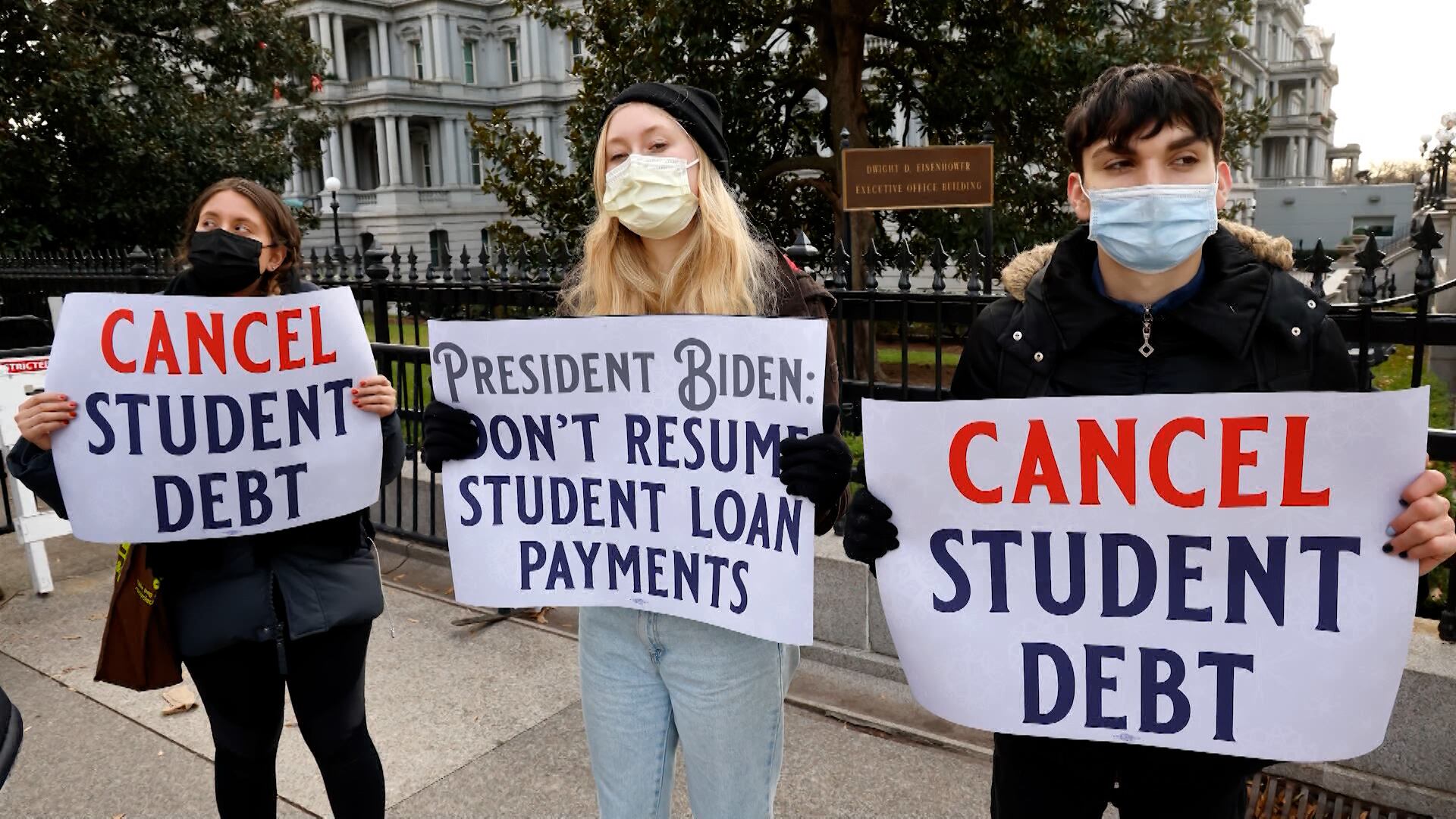
The Biden administration delivered a temporary win for student loan borrowers this year by extending the moratorium on federal payments for a few more months. That moratorium is coming to an end on May 1st and borrowers will again have their monthly loan payment plopped in their lap.
Stephanie Vanderslice, a creative writing professor paying off debt through the Parent Plus program, and Mike Pierce, executive director of the Student Borrower Protection Center, join Cheddar Politics to discuss.
2022 was already going to be a big year for the Supreme Court. We have decisions on major issues like abortion and gun rights on the way. Then, Justice Stephen Breyer announced his retirement and that set up a major confirmation fight for later this year. Amy Howe, co-founder of SCOTUSblog, joins Cheddar Politics to discuss.
The Labor Department released a better-than-expected report of 467,000 jobs added in January. Heather Boushey, Council of Economic Advisers Member for President Biden, joined Cheddar to tout the administration's handling of the economy amid the pandemic and the upward revisions for the previous month. "It also shows that, because of the revisions, the economy was stronger over the past couple of months," she said. "I don't think that this can be said enough, but economic forecasting during an historic pandemic is extremely difficult." Boushey also addressed issues involving wage growth versus the rapid rise of inflation.