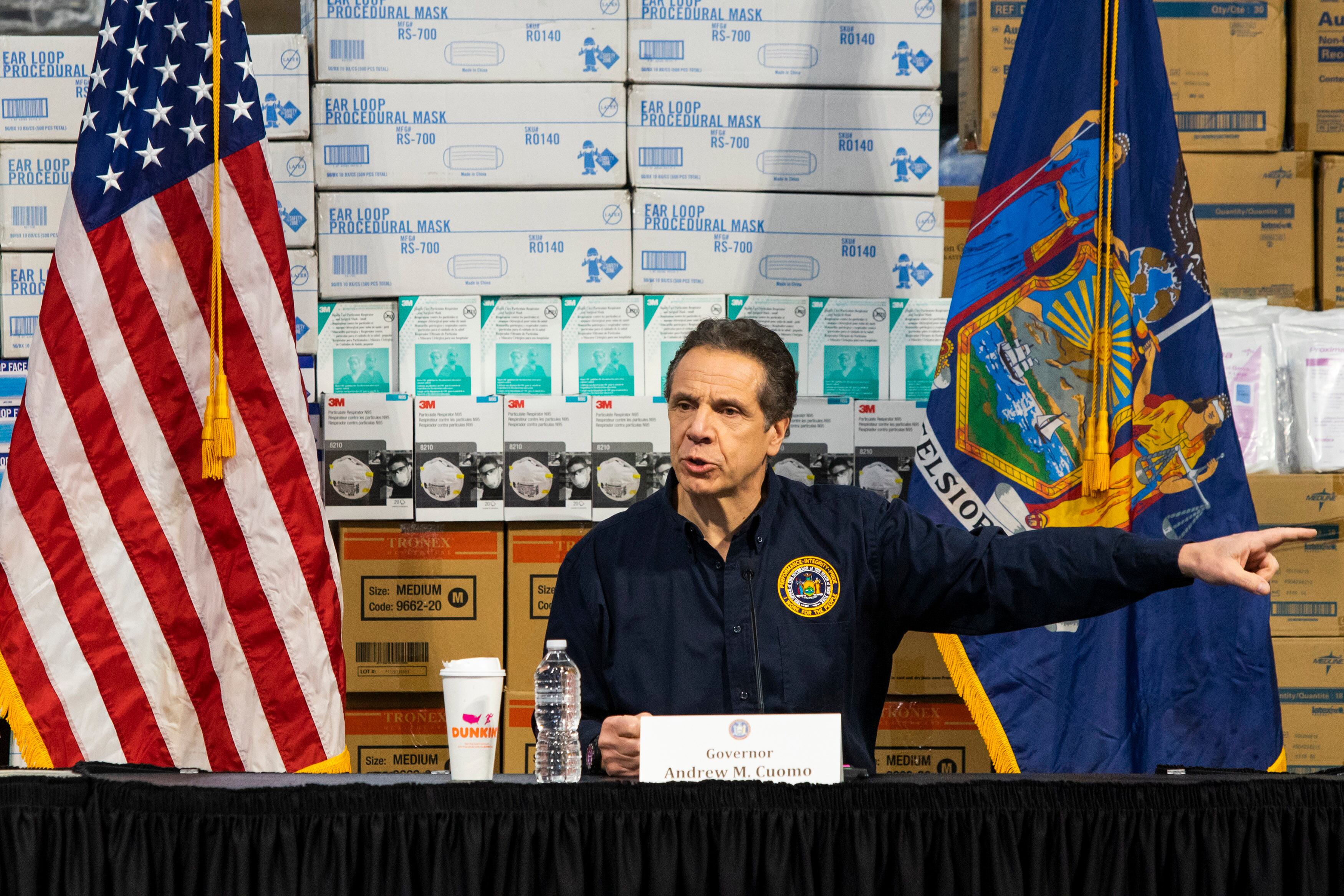
New York Governor Andrew Cuomo speaks to the media at the Javits Convention Center which is being turned into a hospital to help fight coronavirus cases on March 24, 2020 in New York City. New York City has about a third of the nation’s confirmed coronavirus cases, making it the center of the outbreak in the United States. (Photo by Eduardo Munoz Alvarez/Getty Images)
New York Governor Andrew Cuomo said new projections from health officials suggest instead of flattening, "the curve is increasing" and lambasted the federal government for its lack of action on distributing ventilators and for refraining from using the Defense Production Act.
The governor said the apex of the disease is approaching faster than anticipated and could come as soon as 14-21 days from now. He raised the number of hospital beds needed in the state to 140,000 beds and 40,000 ICU beds. New York currently has 3,000 ICU beds and 53,000 hospital beds. A few days ago, he said the state had projected it would need 110,000 beds.
Cuomo had previously included more hopeful notes of encouragement in his press conferences but on Tuesday delivered concerning news. "The apex is higher than we thought and the apex is sooner than we thought," he said.
Nearly half of the nationwide coronavirus cases are in New York state. Overnight, the case count rose by 5,000, bringing the total to more than 25,000 statewide.
"No one is testing more than we are testing," Cuomo said. "In many ways, we have exhausted every option available to us."
The governor noted that 23 percent of hospitalizations so far have needed ventilators and that 13 percent of positive diagnoses have required hospitalization as of Tuesday.
"We haven't flattened the curve, and the curve is actually increasing," Cuomo said from the Javits Center in Manhattan, which is being turned into a 1,000-bed emergency hospital by the Army Corps of Engineers.
On Monday, Dr. Deborah Birx, who is in charge of the White House response, said the attack rate in New York and New Jersey is five times higher than for the rest of the United States. The attack rate is the percentage of a population that catches the disease.
Cuomo was pointed in his criticism of the federal government for so far sending only a small fraction of needed ventilators to New York. "You want a pat on the back for sending 400 ventilators?" the governor demanded of the White House. "What are we going to do with 400 ventilators when we need 30,000 ventilators? You're missing the magnitude of the problem, and the problem is defined by the magnitude."
Cuomo said the state has so far procured 7,000 ventilators but needs 30,000 and, without more options for ventilators available, will start attempting the unusual plan to split them between people.
"If we don't have ventilators in 14 days, it does us no good," Cuomo assessed, again lamenting what he expressed was the lack of aid. "Not to exercise [the Defense Production Act] is inexplicable to me."
President Trump, during a Coronavirus Task Force town hall on Fox News Tuesday, struck back at the New York governor saying "I watch him on this show complaining."
"I'm not blaming him, but he shouldn't be talking about us," Trump said, referring to a claim that Gov. Cuomo neglected to purchase additional ventilators for the state in 2015. "He should be buying his own ventilators."
Still, citing New York's current 25,665 cases of the novel coronavirus, the governor called on Secretary of Health and Human Services Alex Azar to release 20,000 ventilators in the federal stockpile.
"The problem is the volume," he said. He asked the federal government to deploy ventilators around the country as needed as different states approach their own curve rates of infection while noting that New York has the greater need at the moment.
After passing its critical period, he said that the state would then move the ventilators to the next region addressing a crisis.
"I will take personal responsibility for transporting the 20,000 ventilators anywhere in this country that they want once we are past our apex," he said. "But don't leave them sitting in a stockpile."
With the Russian invasion of Ukraine raging on, millions have turned to TikTok to stay up-to-date on the latest developments and get a first-hand look. The social media platform has been so prominent that the war has been dubbed "the first TikTok war" by many publications — and even the White House has taken notice. The Biden administration held a virtual briefing with 30 social media creators to discuss their role in communicating to their followers by countering what it deems as being misinformation. Ellie Zeiler, an 18-year-old TikTok star who attended the briefing, joined Cheddar to talk about the conference and her responsibilities as a social media creator. "How could you not be a little nervous or scared when you're getting your information and media all from this app? But also then you think back to, I guess, when media was changing between newspapers and TV, and I'm sure people were nervous about that too," she said. "So the fact is, is that people do really look to Tiktok and social media for their news."
U.S. markets closed the day at session lows as the Dow marked its fifth straight week of losses. Investors continue to weigh inflation and the ongoing Russia-Ukraine war and growing economic risk factors. George Seay, CEO of Annandale Capital, joins Cheddar News' Closing Bell to discuss.
U.S. stocks ended Thursday's session lower as new CPI data show inflation continues to rise and the Russia-Ukraine war continues. Philip Palumbo, founder, CEO, & Chief Investment Officer of Palumbo Wealth Management, joins Cheddar News' Closing Bell to discuss.
It's been an eventful past few weeks for the WNBA. One of the league's top players, Brittney Griner, remains in Russian custody after being detained at an airport last month. The league is also dealing with a scandal after fining a team for providing charter flights to their players. Emily Caron, sports business reporter for Sportico, joined Cheddar News' Closing Bell to discuss.
School nutrition experts warn that millions of children could go hungry as soon as this summer, after Congress excluded waivers that would extend universal lunch for children in school from the $1.5 trillion omnibus spending bill. Cheddar News speaks with Jessica Gould, chair of the public policy and legislation committee at the School Nutrition Association, about the issue.
The ongoing semiconductor chip shortage has been impacting everything from the purchase of cars to smartphones. Deputy Commerce Secretary Don Graves spoke with Cheddar about the Biden administration's efforts to combat the issue and if the current crisis in Ukraine will have any impact on the global supply chain problems for semiconductors. "We're working very closely with all of our partners and allies around the globe, just as we have on the export controls and sanctions that we've applied to Russia to deal with that needless aggression," he said. "We're also working with them on the challenges of raw materials for a range of industries, including the semiconductor industry. We believe that we are going to be able to meet the demand for the for the near term."
Deputy Commerce Secretary Don Graves spoke to Cheddar's Alex Vuocolo about the ongoing semiconductor shortages and the push from the Biden administration to cover the supply chain problem as well as look ahead to future-proofing it.
President Maxx Fenning and Vice President CJ Walden of PRISM, a Florida non-profit providing resources for LGBTQ youth, joined Cheddar News to discuss the negative repercussions of a Florida bill banning discussions of sexuality and gender identity in some classrooms.