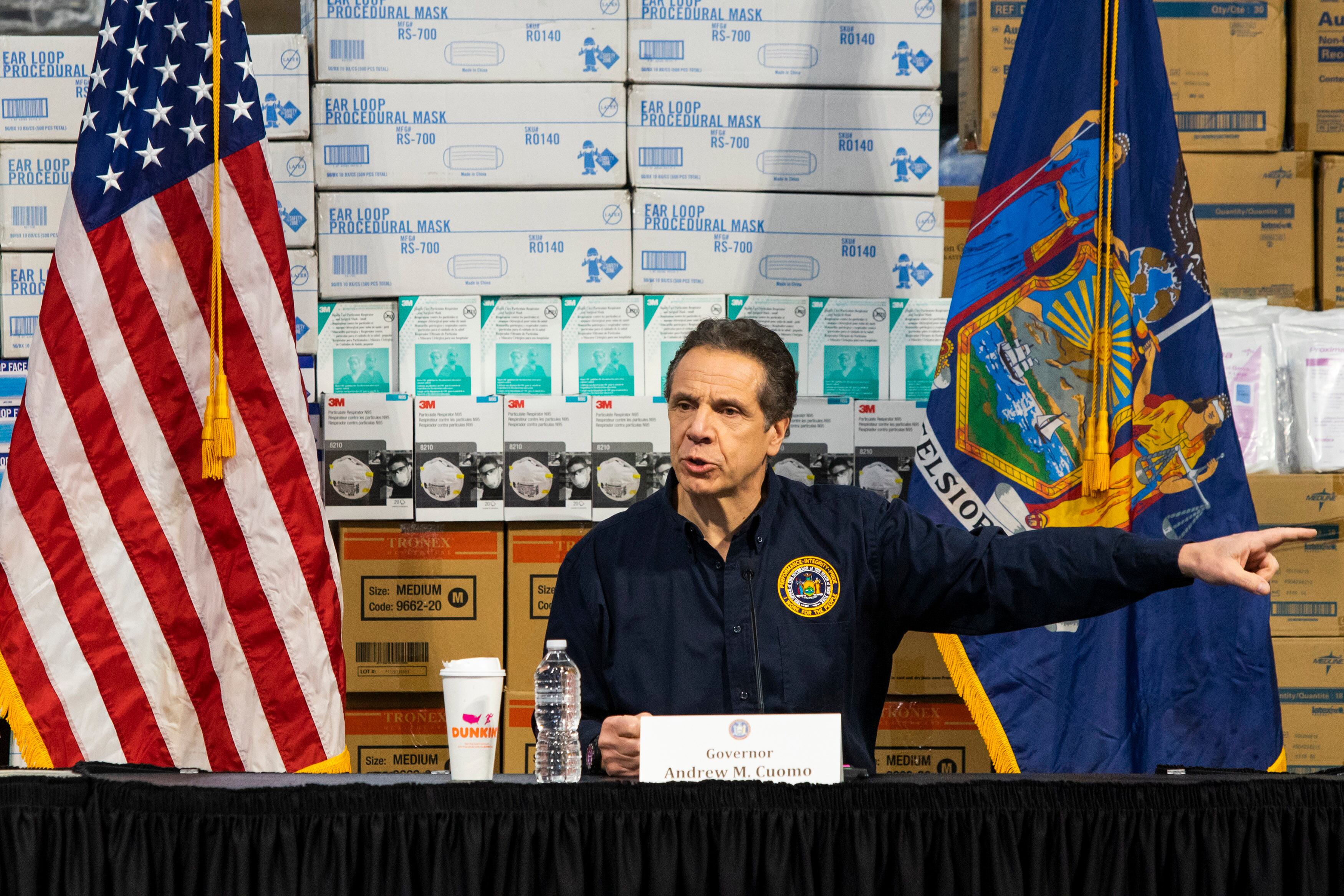
New York Governor Andrew Cuomo said new projections from health officials suggest instead of flattening, "the curve is increasing" and lambasted the federal government for its lack of action on distributing ventilators and for refraining from using the Defense Production Act. 

The governor said the apex of the disease is approaching faster than anticipated and could come as soon as 14-21 days from now. He raised the number of hospital beds needed in the state to 140,000 beds and 40,000 ICU beds. New York currently has 3,000 ICU beds and 53,000 hospital beds. A few days ago, he said the state had projected it would need 110,000 beds. 

Cuomo had previously included more hopeful notes of encouragement in his press conferences but on Tuesday delivered concerning news. "The apex is higher than we thought and the apex is sooner than we thought," he said. 

Nearly half of the nationwide coronavirus cases are in New York state. Overnight, the case count rose by 5,000, bringing the total to more than 25,000 statewide. 

"No one is testing more than we are testing," Cuomo said. "In many ways, we have exhausted every option available to us." 

The governor noted that 23 percent of hospitalizations so far have needed ventilators and that 13 percent of positive diagnoses have required hospitalization as of Tuesday. 

"We haven't flattened the curve, and the curve is actually increasing," Cuomo said from the Javits Center in Manhattan, which is being turned into a 1,000-bed emergency hospital by the Army Corps of Engineers. 

On Monday, Dr. Deborah Birx, who is in charge of the White House response, said the attack rate in New York and New Jersey is five times higher than for the rest of the United States. The attack rate is the percentage of a population that catches the disease. 

Cuomo was pointed in his criticism of the federal government for so far sending only a small fraction of needed ventilators to New York. "You want a pat on the back for sending 400 ventilators?" the governor demanded of the White House. "What are we going to do with 400 ventilators when we need 30,000 ventilators? You're missing the magnitude of the problem, and the problem is defined by the magnitude."

Cuomo said the state has so far procured 7,000 ventilators but needs 30,000 and, without more options for ventilators available, will start attempting the unusual plan to split them between people.

"If we don't have ventilators in 14 days, it does us no good," Cuomo assessed, again lamenting what he expressed was the lack of aid. "Not to exercise [the Defense Production Act] is inexplicable to me." 

President Trump, during a Coronavirus Task Force town hall on Fox News Tuesday, struck back at the New York governor saying "I watch him on this show complaining." 

"I'm not blaming him, but he shouldn't be talking about us," Trump said, referring to a claim that Gov. Cuomo neglected to purchase additional ventilators for the state in 2015.  "He should be buying his own ventilators."

Still, citing New York's current 25,665 cases of the novel coronavirus, the governor called on Secretary of Health and Human Services Alex Azar to release 20,000 ventilators in the federal stockpile. 

"The problem is the volume," he said. He asked the federal government to deploy ventilators around the country as needed as different states approach their own curve rates of infection while noting that New York has the greater need at the moment.

After passing its critical period, he said that the state would then move the ventilators to the next region addressing a crisis. 

"I will take personal responsibility for transporting the 20,000 ventilators anywhere in this country that they want once we are past our apex," he said. "But don't leave them sitting in a stockpile."

Share:
More In Politics
Inflation Among Biggest Concern for CEOs in 2022
Concerns over inflation have become one of the biggest worries for executives. A survey from The Conference Board shows that more than 900 CEOs consider inflation a top tier concern, a major shift from last year's survey that had it as a low-level concern. Rebecca Ray, Executive Vice President, Human Capital, The Conference Board joined Cheddar's Opening Bell for more.
Beijing Olympics Sponsors Accused of Indifference Amid Human Rights Concerns
With the 2022 Winter Olympics in Beijing rapidly approaching, clouds of controversy continue to swirl around China's treatment of the Uyghur Muslim minority population, its surveillance state, and security for visiting athletes. Phelim Kine, China correspondent for Politico, joined Cheddar to break down the big storylines surrounding the Beijing Games and highlight what he saw as the complete disregard by top corporate sponsors like P&G, Airbnb, Intel, Visa, and Coca-Cola, for the controversies. "They spend $100 million for every Olympics that they sponsor, and they have frankly shown absolute willful indifference to any type of entreaty to essentially be more vocal about their concerns about human rights in China," he said. Kine also touched on the data privacy fears for athletes as visiting contingents are being told to carry burner phones to avoid security risks.
Texas's Six-Week Abortion Ban Remains in Effect
Texas's six-week abortion ban remains in effect after a federal appeals court ruling on Monday. The U.S. court of appeals for the fifth circuit temporarily transferred the case to the Texas Supreme Court, which is expected to leave the dispute in limbo for months to come. Katie Barlow, attorney and media editor of SCOTUSblog, joins Cheddar News to discuss.
Breaking Down the 5G Deployment Disconnect Between Airlines and Telecoms
Hugh Odom, founder and president of Vertical Consultants, shared his expertise on telecommunications with Cheddar on the safety issue raised about 5G deployment by airlines. The installation was partially delayed again on Tuesday as the airlines warned of potentially catastrophic delays in a letter to the Biden administration. Later, both Verizon and AT&T relented and put a pause on some of the implementations. "The first thing the Biden administration needs to do is get everybody in the room and say, look, aviation industry, identify the problem — wireless industry, come up with a solution," said Odom.
Federal Appeals Court Rules Restrictive Texas Abortion Law to Stay in Place
Women's March ATX rally, Saturday, Oct., 2, 2021, at the Texas State Capitol in Austin, Texas. An expected decision by the U.S. Supreme Court in the coming year to severely restrict abortion rights or overturn Roe v. Wade entirely is setting off a renewed round of abortion battles in state legislatures. (AP Photo/Stephen Spillman, File)
Inflation Surges to 39-Year High in December
Inflation in the U.S. is only getting hotter. The 12-month inflation rate for December 2021 was the highest in nearly 40 years - continuing the trend seen at the close of 2021. The Consumer Price Index increased 7% in the 12-month period ending in December, marking the fastest increase since 1982. Scott Wren, Senior Global Market Strategist at Wells Fargo Investment Institute, joined Cheddar's Movers for more.
RNC Releases Letter to Committee on Presidential Debates
If President Biden runs for re-election in 2024, he may not have anyone to debate. The Republican National Committee sent a letter to the commission on presidential debates, saying the RNC will require candidates to pledge not to participate in those general election debates. Paris Dennard, RNC national spokesperson, joins Cheddar News to discuss.
Load More