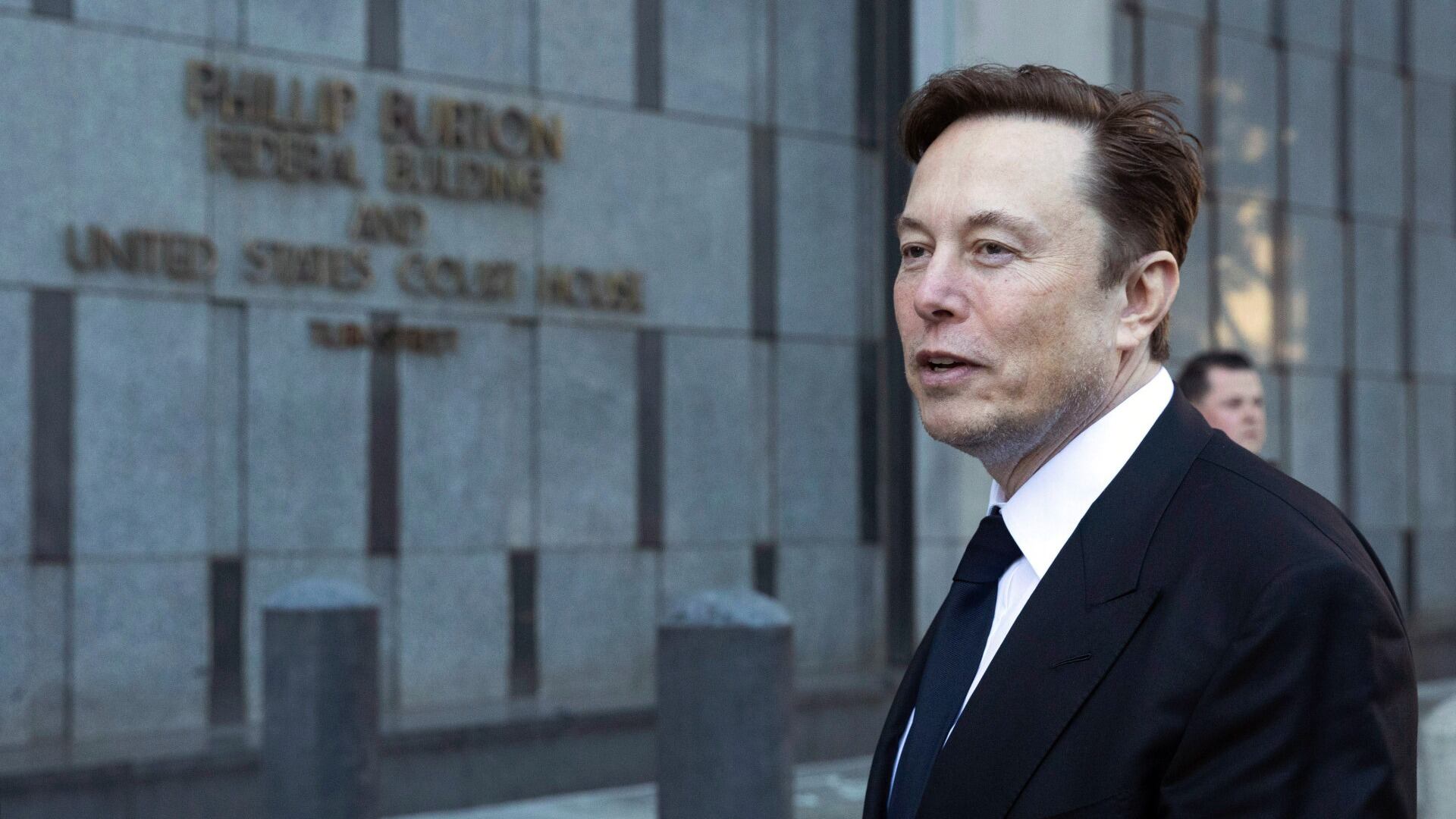
Elon Musk departs the Phillip Burton Federal Building and United States Court House in San Francisco, on Tuesday, Jan. 24, 2023. Tesla has received requests from the Justice Department for documents related to its Autopilot and “Full Self-Driving” features, according to a regulatory filing. (AP Photo/ Benjamin Fanjoy, File)
A 2018 Twitter post by Tesla CEO Elon Musk unlawfully threatened Tesla employees with the loss of stock options if they decided to be represented by a union, a federal appeals court ruled Friday.
The ruling by a three-judge panel of the 5th U.S. Circuit Court of Appeals upheld a March 2021 order by the National Labor Relations Board, which ordered that the tweet be deleted. The case arose from United Auto Workers' organizing efforts at a Tesla facility in Fremont, California.
Also upheld was the board's order that Tesla reinstate and provide back pay to an employee who was fired for union-organizing activity.
Musk tweeted on May 20, 2018: “Nothing stopping Tesla team at our car plant from voting union. Could do so tmrw if they wanted. But why pay union dues and give up stock options for nothing? Our safety record is 2X better than when plant was UAW & everybody already gets healthcare.”
The ruling said that "because stock options are part of Tesla’s employees’ compensation, and nothing in the tweet suggested that Tesla would be forced to end stock options or that the UAW would be the cause of giving up stock options, substantial evidence supports the NLRB’s conclusion that the tweet is as an implied threat to end stock options as retaliation for unionization.”
Neither Tesla nor the UAW has responded to emailed requests for comment Friday afternoon.
Dan Niles, Founder and Portfolio Manager at Niles Investment Management, breaks down NVIDIA’s blowout earnings, 70% growth forecast and AI spending boom.
Edwin Cywinski, CEO of SunScout Holding Limited, explains how solar-powered robotic mowers are transforming lawn care and the company’s plans to scale.
Nathan Bomey, Business Reporter at Axios and author of The Axios Closer newsletter, explains why Wall Street is turning NVIDIA’s AI chips into financial assets.
Jamie Siminoff, Founder and Chief Inventor of Ring, explains the company’s new TAKE encryption standard and its push to put privacy and video data control first
Xavier Martinez, News Associate at The Wall Street Journal, breaks down Moderna’s mRNA ambitions, its pipeline beyond COVID-19 and the challenges ahead.
Dena Jalbert, CEO of Align Advisory Services, breaks down the M&A outlook for 2026 as AI costs, debt, valuations and economic uncertainty reshape deal-making.
LSEG Consumer Research Director Jharonne Martis breaks down retail earnings, the K-shaped consumer and what inflation and rising costs mean for spending.
Serve Robotics CEO Ali Kashani discusses expanding beyond Uber, adding new delivery partners and scaling autonomous robots as delivery moves into the mainstream