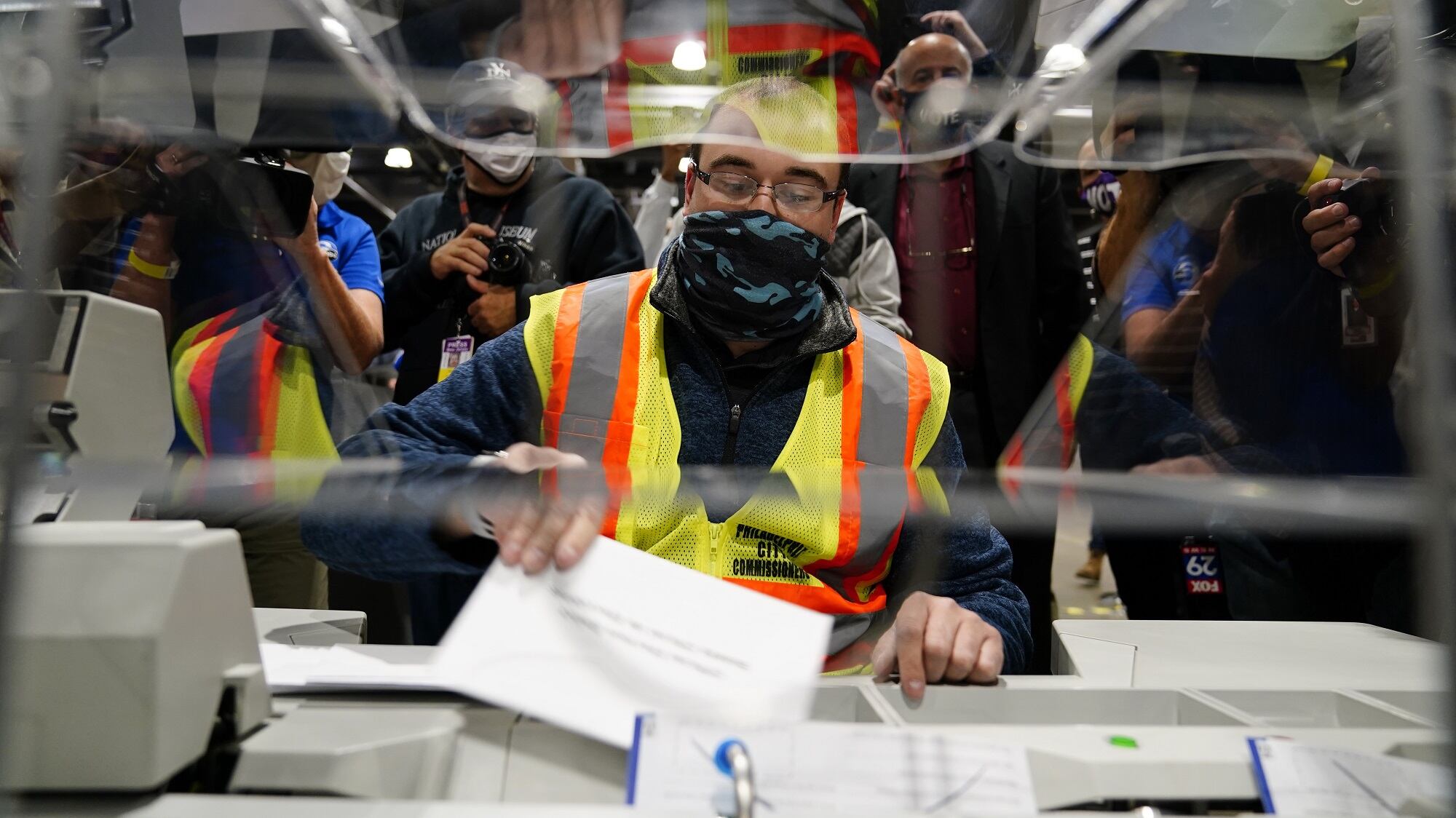
John Hansberry, with the Philadelphia City Commissioners office, demonstrates an extraction machine at the city's mail-in ballot sorting and counting center in preparation for the 2020 General Election in the United States, Monday, Oct. 26, 2020, in Philadelphia. (AP Photo/Matt Slocum)
HOW WILL VARIOUS BALLOTS BE COUNTED, AND WHAT RESULTS WILL BE KNOWN ON ELECTION NIGHT?
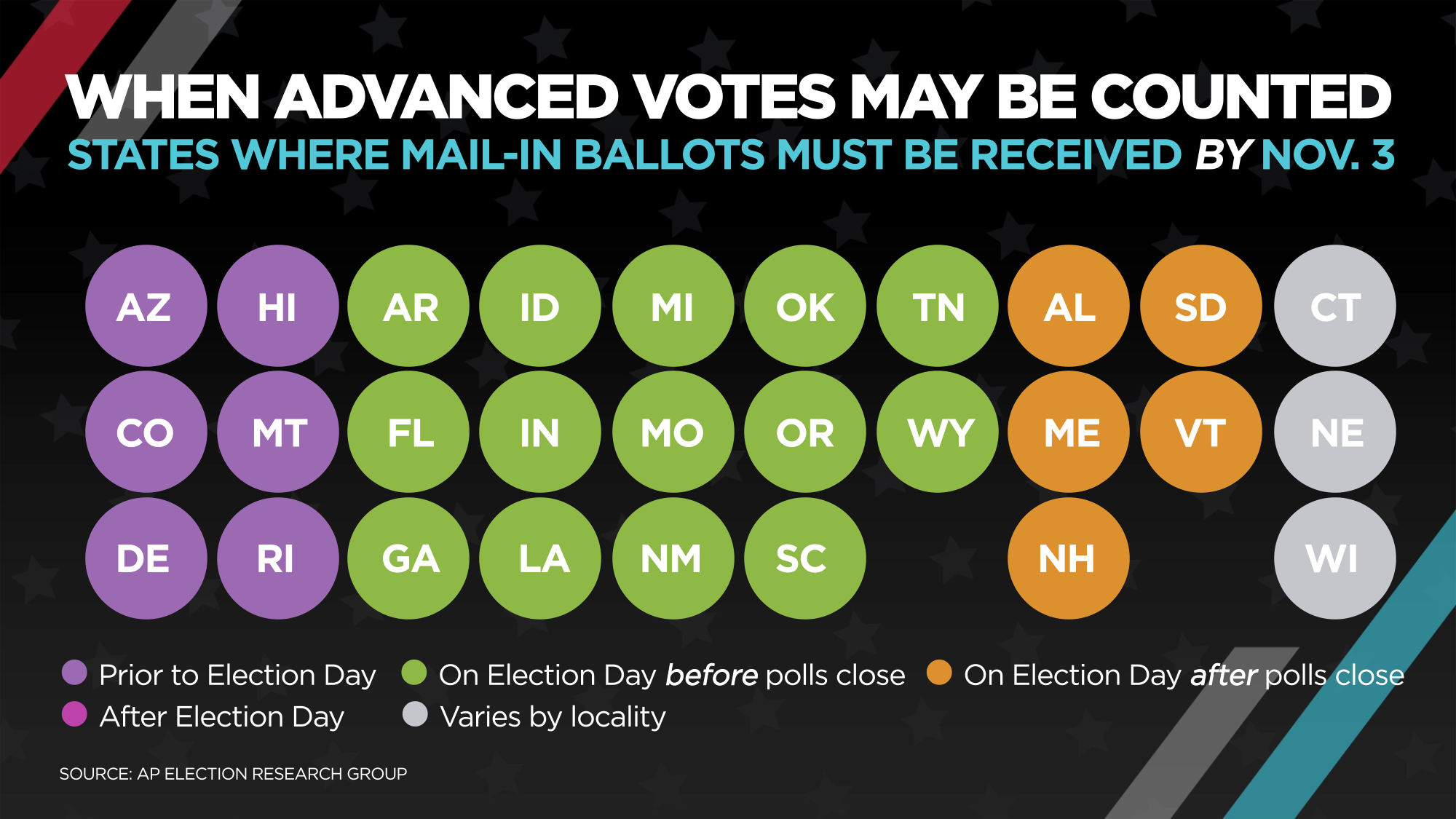
Millions of Americans have already voted, but each state has different rules on when it's allowed to actually start counting those ballots. That is going to produce results coming in at very different times — perhaps days or even weeks after Election Day.
In some places, election officials can begin processing ballots weeks before Election Day. That means workers can start verifying voter information while also removing ballots from their envelopes to physically get them ready for tabulation. Doing so readies ballots for counting on Election Day and will speed up the release of results.
But it's not that simple.
In some of the most critical battleground states, laws prevent the early processing of ballots. So on Nov. 3, Election Day, officials will have to run an in-person election while also working through the unprecedented number of mail-in votes. This dynamic is likely to delay results and heighten the potential for big shifts if in-person vote tallies are upended by the counting of mail-in ballots.
President Donald Trump has repeatedly warned of voting fraud without offering any evidence. Because of that, there are concerns that he will use delays in vote-counting to declare results illegitimate. While results might come in later than usual this year, that's because of a change in how people are voting, not malfeasance or fraud.
Here is another wrinkle: Nationwide delivery delays at the U.S. Postal Service are sparking fears that ballots might not arrive in time to be counted. Republicans, including Trump's campaign, have been filing lawsuits to stop election officials from counting ballots that are delivered after Election Day.
For example: As of right now in Pennsylvania, votes that arrive by mail three days after Nov. 3 will be counted, after an intense legal battle that went all the way to the U.S. Supreme Court last week. Republicans have filed another suit against the extension. Also, Pennsylvania doesn’t allow early processing of mail-in ballots, further complicating matters.
In Michigan, another hotly contested state, an appeals court has struck down a 14-day ballot-counting extension, leading the state's top election official to urge voters to drop off their ballots in person rather than use the Postal Service. Courts have also nixed similar extensions in Wisconsin and Indiana.
This story is part of a series dedicated to answering commonly asked questions from AP's audience about the 2020 U.S. presidential election.
Pfizer has asked the FDA to expand authorization of COVID booster shots for all adults. The agency is expected to grant the request in the coming weeks, allowing vaccinated Americans as young as 18 to get boosted before the holidays. Dr. Bayo Curry-Winchell, Regional Clinical Director at Carbon Health, joined Cheddar to discuss.
The Justice Department has filed a lawsuit to block Penguin Random House from acquiring its rival Simon & Schuster. The DOJ hopes this will block the merger, which it says would ultimately hurt authors and consumers nationwide. Barry C. Lynn, executive director of the Open Markets Institute, joined Cheddar to explain what the lawsuit signals about the Biden administration's approach to cracking down on antitrust, and why Amazon might be next.
The major markets took a breather Tuesday, with the Dow, S&P, Nasdaq, and Russell 2000 all finishing lower after notching record closes on Monday. Rhys Williams, Chief Strategist at Spouting Rock Asset Management, joins Cheddar News' Closing Bell, where he provides his biggest takeaways from the day's activity.
The U.S. economy added 531,000 jobs in the month of October, painting a better picture of the economy that analysts had expected. Jared Bernstein, Council of Economic Advisers Member for President Biden joined Cheddar's Opening Bell to discuss.
Election Day 2021 is in the books, and it wasn't a pretty picture for Democrats. Governor Phil Murphy narrowly won re-election in New Jersey and Republican Glenn Youngkin upset Democrat Terry McAuliffe in Virginia, with many other disappointing losses for the left. Meridith McGraw, national correspondent for Politico, breaks down the key takeaways from this year as the nation looks ahead to the 2022 midterms.
Markets opened higher to kick off the week as investors continue to digest the better-than-expected jobs report, which showed 531,000 new jobs created in October. Ken Johnson, CFA, Investment Strategy Analyst joined Cheddar's Opening Bell to break down his early market insights.
Almost 2 years into the pandemic, supply chain woes continue to wreak havoc on our everyday lives.
From groceries to chip shortages, both consumers and retailers are feeling the strain with prices only climbing as a result. Data intelligence company Morning Consult is out with its U.S. Economic Outlook for November revealing just how much of a threat these hold-ups could pose to the greater economic recovery. John Leer, Chief Economist at Morning Consult joined Cheddar's Opening Bell.
After many years and at least two presidents hoping to overhaul America's infrastructure, congress finally came to an agreement. The House passed the bipartisan infrastructure bill late Friday, receiving thirteen republican votes but failing to earn votes from the six progressive squad members. Joseph Zeballos-Roig, Economics Reporter at Insider joined Cheddar's Opening Bell to discuss the economic impact of the bill.