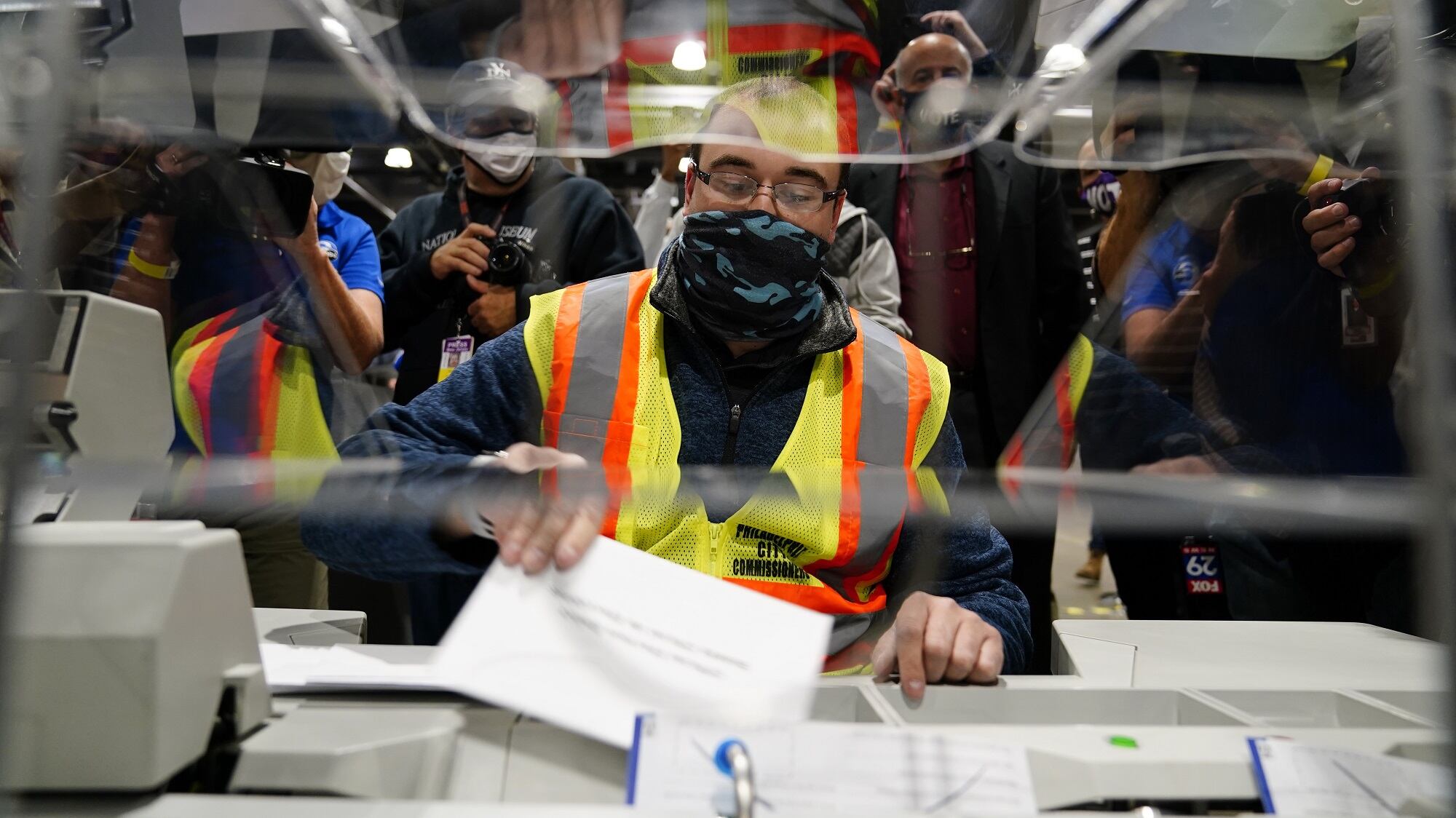
John Hansberry, with the Philadelphia City Commissioners office, demonstrates an extraction machine at the city's mail-in ballot sorting and counting center in preparation for the 2020 General Election in the United States, Monday, Oct. 26, 2020, in Philadelphia. (AP Photo/Matt Slocum)
HOW WILL VARIOUS BALLOTS BE COUNTED, AND WHAT RESULTS WILL BE KNOWN ON ELECTION NIGHT?
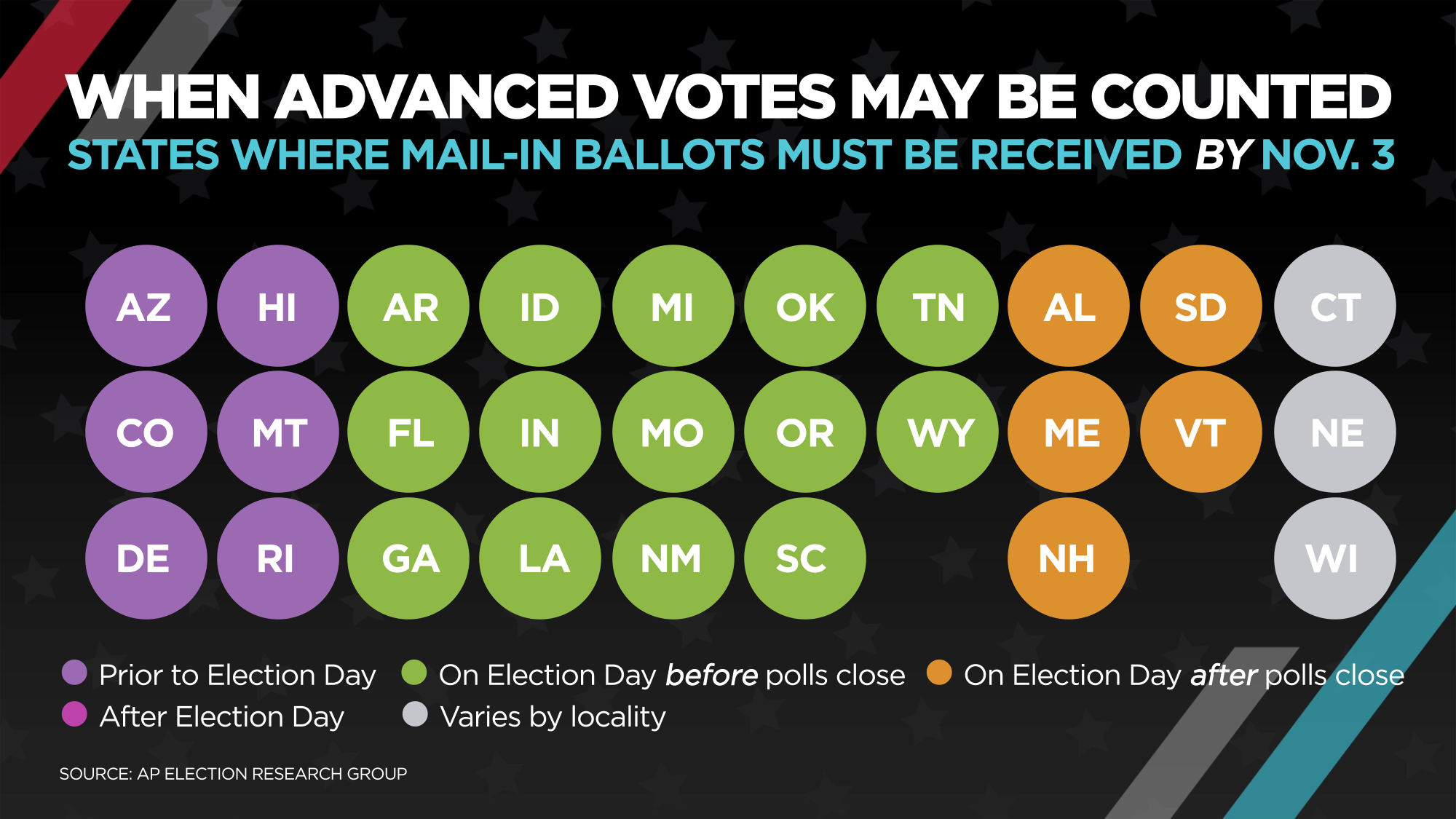
Millions of Americans have already voted, but each state has different rules on when it's allowed to actually start counting those ballots. That is going to produce results coming in at very different times — perhaps days or even weeks after Election Day.
In some places, election officials can begin processing ballots weeks before Election Day. That means workers can start verifying voter information while also removing ballots from their envelopes to physically get them ready for tabulation. Doing so readies ballots for counting on Election Day and will speed up the release of results.
But it's not that simple.
In some of the most critical battleground states, laws prevent the early processing of ballots. So on Nov. 3, Election Day, officials will have to run an in-person election while also working through the unprecedented number of mail-in votes. This dynamic is likely to delay results and heighten the potential for big shifts if in-person vote tallies are upended by the counting of mail-in ballots.
President Donald Trump has repeatedly warned of voting fraud without offering any evidence. Because of that, there are concerns that he will use delays in vote-counting to declare results illegitimate. While results might come in later than usual this year, that's because of a change in how people are voting, not malfeasance or fraud.
Here is another wrinkle: Nationwide delivery delays at the U.S. Postal Service are sparking fears that ballots might not arrive in time to be counted. Republicans, including Trump's campaign, have been filing lawsuits to stop election officials from counting ballots that are delivered after Election Day.
For example: As of right now in Pennsylvania, votes that arrive by mail three days after Nov. 3 will be counted, after an intense legal battle that went all the way to the U.S. Supreme Court last week. Republicans have filed another suit against the extension. Also, Pennsylvania doesn’t allow early processing of mail-in ballots, further complicating matters.
In Michigan, another hotly contested state, an appeals court has struck down a 14-day ballot-counting extension, leading the state's top election official to urge voters to drop off their ballots in person rather than use the Postal Service. Courts have also nixed similar extensions in Wisconsin and Indiana.
This story is part of a series dedicated to answering commonly asked questions from AP's audience about the 2020 U.S. presidential election.
David Daley, author of the book 'Unrigged: How Americans Are Battling Back to Save Democracy,' joins Cheddar News to discuss redistricting battles taking place across the U.S.
Andrew Cuomo is reportedly planning his comeback. According to the Wall Street Journal, the former New York governor and his aides are considering how to make his first public appearance since he abruptly resigned last August amid sexual harassment allegations. Jake Lahut, politics reporter for Insider, joined Cheddar's Opening Bell to discuss Cuomo's potential return to politics.
The pressure is on for UK Prime Minister Boris Johnson - after his closest aides handed in their resignations this week.
It comes after a report found that 16 parties had taken place at Downing Street while Covid lockdown protocols were in place in the region. Ari Aramesh, Attorney & National Security/Foreign Policy Analyst joined Cheddar's Opening Bell to discuss.
President Biden has ordered about 3,000 U.S. troops to Eastern Europe as Russia refuses to back off its pressure on Ukraine. The deployments to Poland, Germany, and Romania are a show of support to NATO allies concerned about a potential Russian invasion of Ukraine. This is in addition to the 8,500 troops put on high alert. David Tafuri, former Obama campaign foreign policy advisor and former State Department official, joined Cheddar to discuss what this move means for U.S.-Russia relations.
After tennis player Peng Shuai made an explicit sexual assault allegation toward a former Chinese government official, she disappeared from the public eye. Her recent reappearance with the IOC alongside a Chinese Olympic committee official raised eyebrows and renewed concerns for her safety. Asian affairs expert Gordon Chang, author of "The Coming Collapse of China," joined Wake Up With Cheddar to discuss Peng Shuai's retraction and the various human rights controversies swirling at the Beijing games. "It's clear that the IOC was working with Beijing to make sure that she did not express herself freely," Chang said. "So really this is the IOC being complicit in these mechanisms of control over Peng."
The opening ceremony of the 2022 winter Olympics has kicked off at the Beijing national stadium. 150,000 spectators are in attendance for the games inside the 'closed loop' system separating Olympic personnel from the public. Cheddar News spoke with Brian Cazenueve, Sports Illustrated contributor, to share the highlights you may have missed and much more.
The Biden Administration is set to revise federal rules to address potential security risks from foreign-owned apps, mainly Tiktok. This comes after the White House opted not to pursue a forced shutdown of the Chinese-owned video sharing platform. Under these new rules, federal oversight would be expanded to explicitly include apps that could be used by foreign adversaries to steal or otherwise obtain data. Senior Fellow at the Foundation for Defense of Democracies, Craig Singleton, joined Cheddar to discuss more.
Although this week's weather is predicted to be less severe than the 2021 storm, Texans are preparing for the worst - stocking up on supplies and emptying shelves in grocery stores, once again. Some Texans still have not recovered from last year's tragedy, and are heading into the next few weeks with anxiety for what's to come. Leslie Beyer, CEO of the Houston-based energy workforce & technology council, joins Cheddar News to discuss if the Texas grid will fail again.