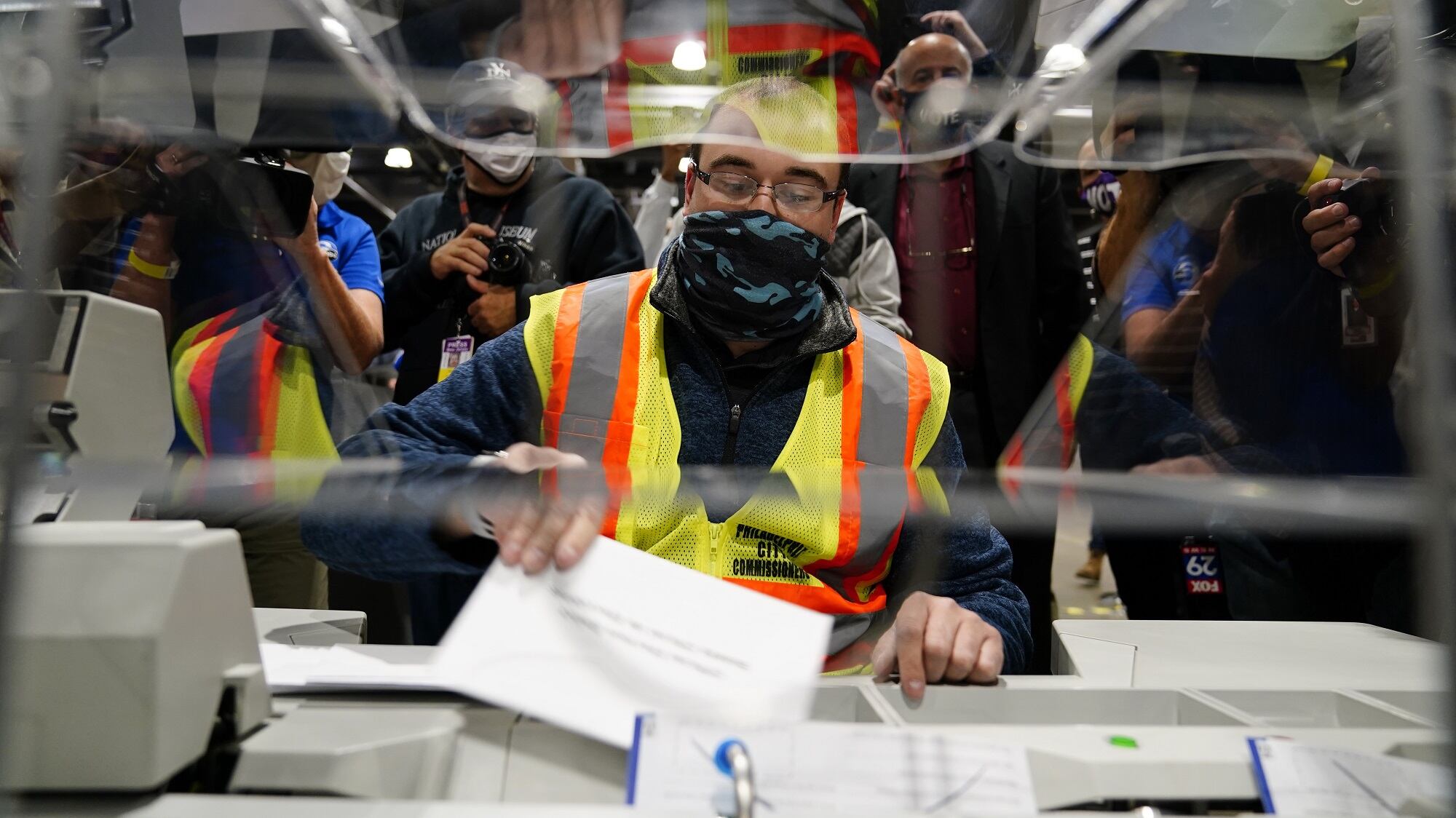
John Hansberry, with the Philadelphia City Commissioners office, demonstrates an extraction machine at the city's mail-in ballot sorting and counting center in preparation for the 2020 General Election in the United States, Monday, Oct. 26, 2020, in Philadelphia. (AP Photo/Matt Slocum)
HOW WILL VARIOUS BALLOTS BE COUNTED, AND WHAT RESULTS WILL BE KNOWN ON ELECTION NIGHT?
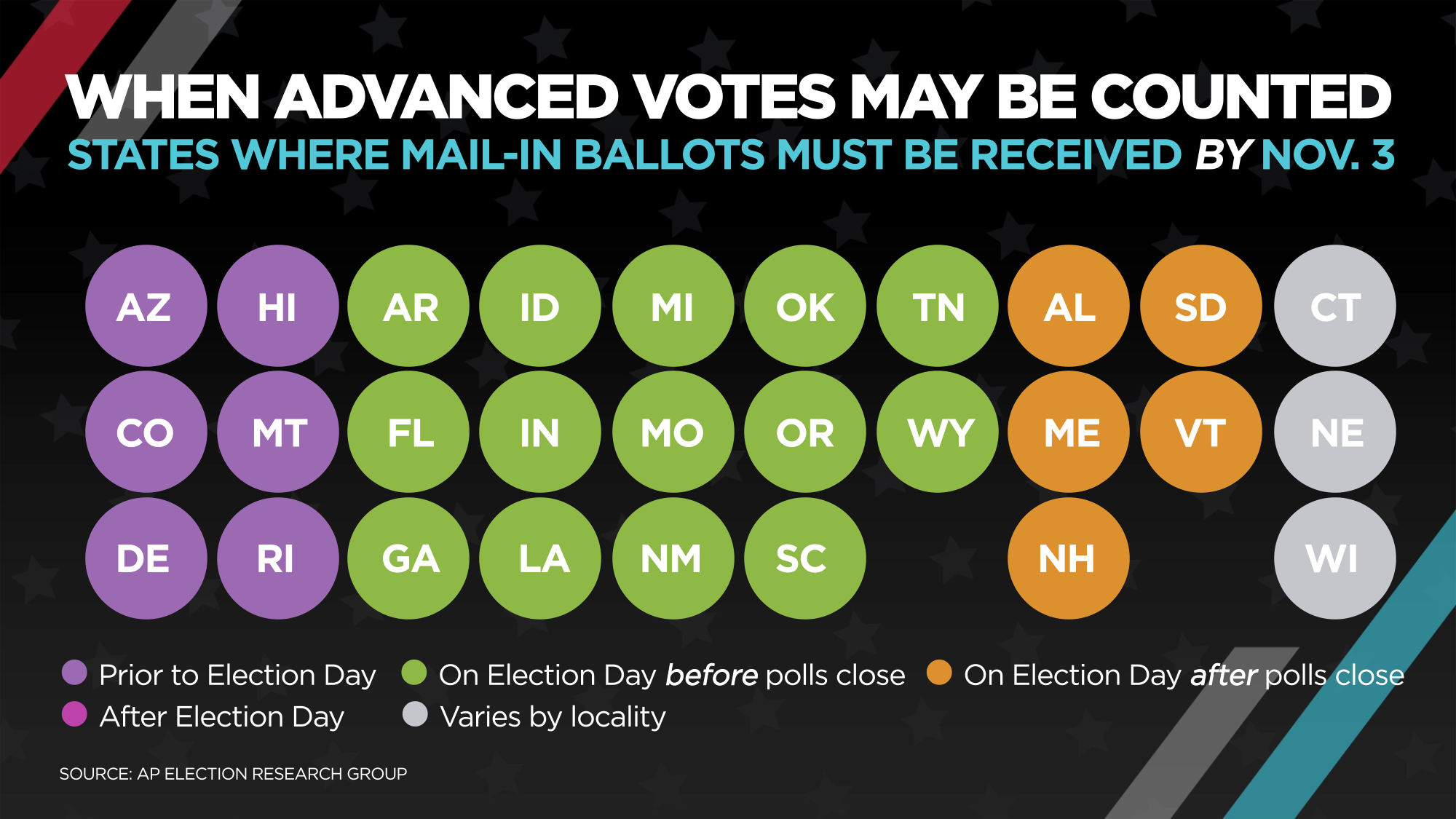
Millions of Americans have already voted, but each state has different rules on when it's allowed to actually start counting those ballots. That is going to produce results coming in at very different times — perhaps days or even weeks after Election Day.
In some places, election officials can begin processing ballots weeks before Election Day. That means workers can start verifying voter information while also removing ballots from their envelopes to physically get them ready for tabulation. Doing so readies ballots for counting on Election Day and will speed up the release of results.
But it's not that simple.
In some of the most critical battleground states, laws prevent the early processing of ballots. So on Nov. 3, Election Day, officials will have to run an in-person election while also working through the unprecedented number of mail-in votes. This dynamic is likely to delay results and heighten the potential for big shifts if in-person vote tallies are upended by the counting of mail-in ballots.
President Donald Trump has repeatedly warned of voting fraud without offering any evidence. Because of that, there are concerns that he will use delays in vote-counting to declare results illegitimate. While results might come in later than usual this year, that's because of a change in how people are voting, not malfeasance or fraud.
Here is another wrinkle: Nationwide delivery delays at the U.S. Postal Service are sparking fears that ballots might not arrive in time to be counted. Republicans, including Trump's campaign, have been filing lawsuits to stop election officials from counting ballots that are delivered after Election Day.
For example: As of right now in Pennsylvania, votes that arrive by mail three days after Nov. 3 will be counted, after an intense legal battle that went all the way to the U.S. Supreme Court last week. Republicans have filed another suit against the extension. Also, Pennsylvania doesn’t allow early processing of mail-in ballots, further complicating matters.
In Michigan, another hotly contested state, an appeals court has struck down a 14-day ballot-counting extension, leading the state's top election official to urge voters to drop off their ballots in person rather than use the Postal Service. Courts have also nixed similar extensions in Wisconsin and Indiana.
This story is part of a series dedicated to answering commonly asked questions from AP's audience about the 2020 U.S. presidential election.
Michelle Bond, CEO of the Association for Digital Asset Markets, joins Closing Bell, where she breaks down the Responsible Financial Innovation Act, which would not only establish a regulatory structure for digital assets, but hand over crypto oversight to the CFTC instead of the SEC.
Sarah Warbelow, legal director for Human Rights Campaign, joins Cheddar News to discuss why advocates want to overturn the FDA's rule restricting gay and bisexual men from donating blood.
David Levine, elections integrity fellow with Alliance for Securing Democracy, joins Cheddar News to discuss Politico's bombshell finding revealing the RNC's plan to contest the elections.
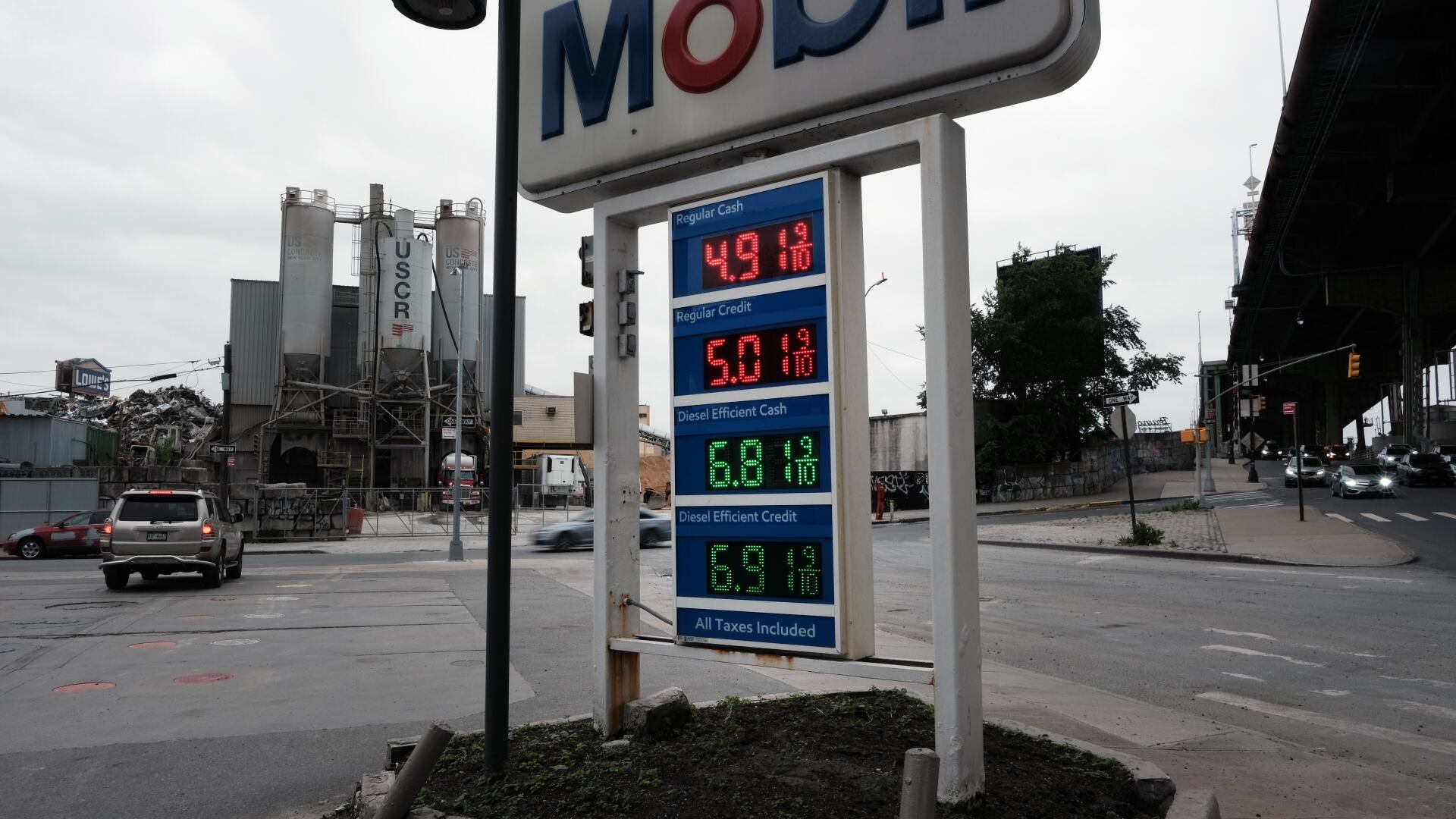
A survey by the BMO Real Financial Progress Index found that 25 percent of Americans are pulling back on retirement contributions to offset the cost of inflation. This comes as market volatility reduced retirement savings with the S&P 500 shedding more than 12 percent this year alone.
As abortion rights take center stage in courts around the country, so do discussions about reproductive health. Signs and social media posts say things like "protect women's rights" and "her body, her choice," leaving others who need and receive abortions completely out of the picture. The potential end to Roe v. Wade would impact far more people and facilities than you may think. Cheddar News' Baker Machado breaks it all down.
Arkansas is planning to reshape itself by putting a strong emphasis on technology through computer science in the classroom. Governor Asa Hutchinson joined Cheddar News Buffa to discuss the state's efforts to promote itself as a future tech hub. “It gives young people such a huge opportunity for success," he noted. The term-limited governor also touched on the issue of gun ownership, offering up the idea of possibly raising the age limit to obtain rifles like the AR-15 to 21 instead of 18 as it currently stands.
The dating app Bumble has sponsored bills and pushed lawmakers to criminalize the online practice of sending unsolicited nudes or “cyberflashing." Payton Iheme, Bumble's head of public policy for the Americas, joined Cheddar News to discuss why the app was going after the harassing behavior beyond its own platform. "Now, while we went to work internally in the company, and we created something called private detector to automatically blur those images so the user can decide if they want to see them, there's nothing for the rest of the internet," she said. "And so that's why we went to work with these laws."