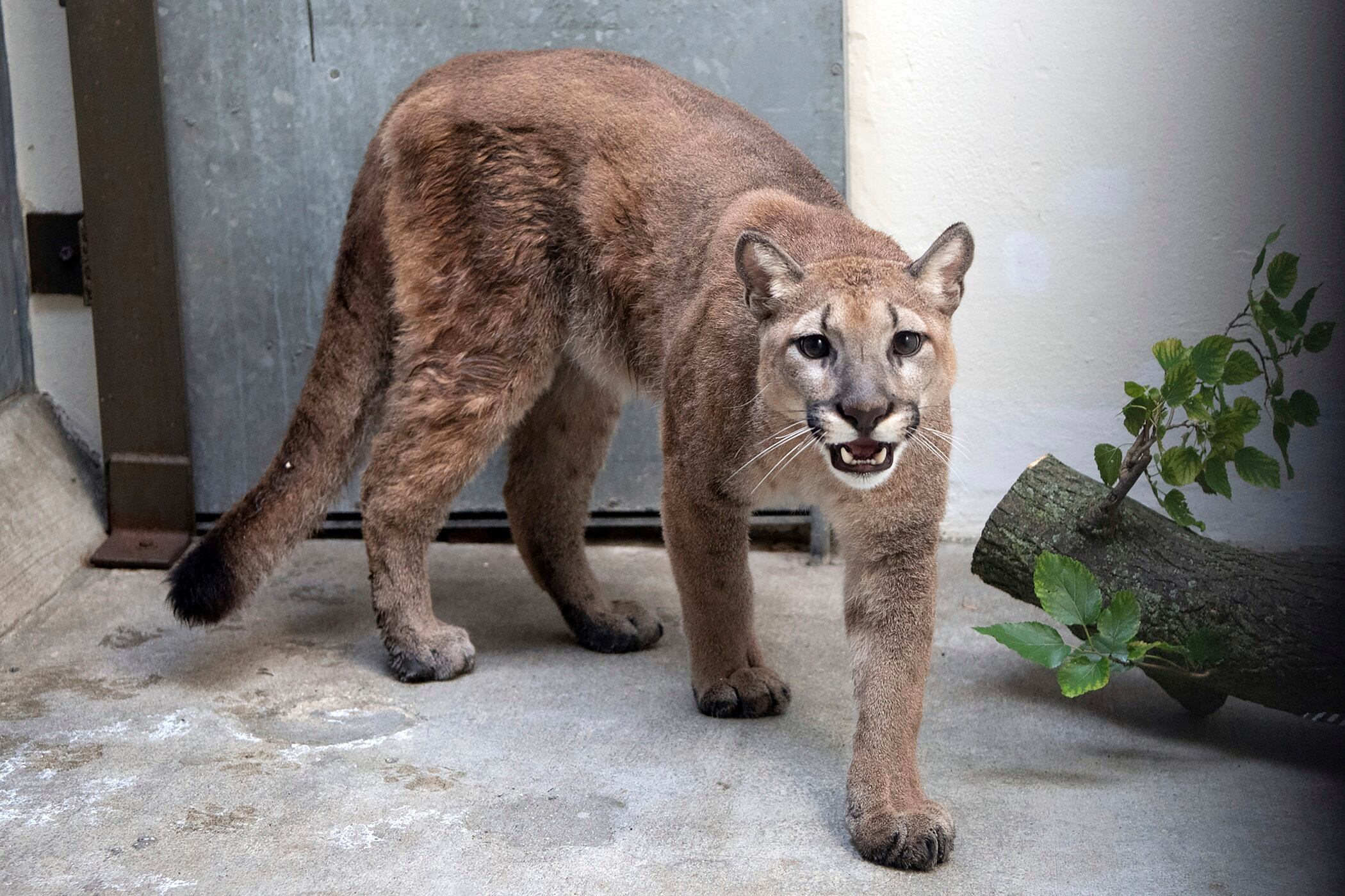
This photo provided by New York's Bronx Zoo shows an 11-month-old, 80-pound cougar that was removed from an apartment, in the Bronx borough of New York, where she was being kept illegally as a pet, animal welfare officials said Monday, Aug. 30, 2021. The cougar, nicknamed Sasha, spent the weekend at the Bronx Zoo receiving veterinary care and is now headed to the Turpentine Creek Wildlife Refuge in Arkansas, officials said. (Courtesy of The Bronx Zoo via AP)
An 80-pound cougar was removed from a New York City apartment where she was being kept illegally as a pet, animal welfare officials said Monday.
The owner of the 11-month-old female cougar surrendered the animal on Thursday, Kelly Donithan, director of animal disaster response for the Humane Society of the United States, said in a news release.
The cougar, nicknamed Sasha, spent the weekend at the Bronx Zoo receiving veterinary care and is now headed to the Turpentine Creek Wildlife Refuge in Arkansas, officials said.
The Humane Society coordinated with zoo officials, the state Department of Environmental Conservation and the New York Police Department on the big cat's removal.
“I’ve never seen a cougar in the wild, but I’ve seen them on leashes, smashed into cages, and crying for their mothers when breeders rip them away," the Humane Society’s Donithan said. “I’ve also seen the heartbreak of owners, like in this case, after being sold not just a wild animal, but a false dream that they could make a good ‘pet.’”
Donithan said this cougar was relatively lucky because her owners, who live in the Bronx, recognized that a wild cat is not fit to live in an apartment and surrendered her.
“The owner’s tears and nervous chirps from the cougar as we drove her away painfully drives home the many victims of this horrendous trade and myth that wild animals belong anywhere but the wild," Donithan said.
Department of Environmental Conservation Commissioner Basil Seggos said that while cougars "may look cute and cuddly when young, these animals can grow up to be unpredictable and dangerous."
Bronx Zoo director Jim Breheny said the exotic pet trade makes no contribution to the conservation of endangered species.
“These animals often end up in very bad situations, kept by private individuals who don’t have the resources, facilities, knowledge, or expertise to provide for the animals’ most basic needs,” Breheny said. "In addition to these welfare concerns for the animals, the keeping of big cats by private people poses a real safety hazard to the owner, the owner’s family and the community at large.”
New York has seen other notable cases involving dangerous animals in private residences, including Ming, a 400-pound tiger that was removed from a Harlem apartment in 2003.
Ming’s owner, Antoine Yates, was arrested and sentenced to five months in prison for reckless endangerment. Ming died in 2019 at the Noah’s Lost Ark Exotic Animal Rescue Center in Ohio.
Police Commissioner Dermot Shea said the cougar's case “is currently under investigation and no further information is available at this time.”
James Tattersall, director of sales and marketing for Lake Nona Wave Hotel, talks about the hotel's initiatives to foster diversity and how these amenities champion inclusivity in the Orlando area.
Ben Armstrong, founder of Bitboy Crypto, joins Cheddar News to discuss Bitcoin's downward trend and what's next for crypto after protests in Kazakhstan cause crypto miners to shut down.
Jake Carbone, senior data analyst at InfluenceMap joins Cheddar News to talk about a new report by The Guardian and InfluenceMap that reveals how companies are creating fossil fuel ads designed to look like Google search results.
Desmond Howard, former NFL wide receiver and Modelo college football playoff ambassador, joins Cheddar News to talk about the Modelo sweepstakes honoring the 30th anniversary of his iconic punt return.
The highly transmissible omicron variant of COVID-19 has forced school districts nationwide to return to virtual instruction, but there remain concerns about the quality of education students are receiving online. Andy Bird, CEO of Pearson, an education publisher and assessment service provider, joined Cheddar's "Opening Bell" to talk about steps educators and parents can take to make the remote learning experience an easier one, noting that one of the biggest advantages teachers can have is flexibility. "You cannot take a rigid timetable that works in the analog world and replicate that in the digital world. You need to have flexibility. Asynchronous learning, I think, is a very important part," he told Cheddar.
On this episode of ChedHER: Chief Product Officer at Mathison breaks down how she's building tech to advance diversity, equity, and inclusion in the workplace; Co-Founder and CEO of Carewell.com explains how her platform is easing the pressures that come with caregiving; Founder and CEO of Mentor Agility discusses what goals business owners should set in the new year.
Bianca Padilla, Co-Founder and CEO of Carewell.com, joins ChedHER to discuss how her platform is easing the pressures that come with caregiving, and how she's breaking barriers for women in venture capital.
Elizabeth Spenko, Chief Product Officer at Mathison, joins ChedHER to discuss how she's building tech to advance diversity, equity, and inclusion in the workplace, and an outlook on DEI in 2022.
Julie Elledge, Founder and CEO of Mentor Agility, joins ChedHER to discuss what goals business owners should set in the new year, and what tools are out there for emerging entrepreneurs.
Rob Dongoski, EY Food and Agriculture Leader, joins Cheddar News to discuss what advancements in tech will shape the future of food, and how we are going to see more and more personalization in the food system.