A news alert is displayed on a mobile phone in Christchurch, New Zealand, Tuesday, Aug. 11, 2020. New Zealand Prime Minister Jacinda Ardern said Tuesday that authorities have found four cases of the coronavirus in one Auckland household from an unknown source, the first cases of local transmission in the country in 102 days. (AP Photo/Mark Baker)
By Nick Perry
New Zealand Prime Minister Jacinda Ardern said Tuesday that authorities have found four cases of the coronavirus in one Auckland household from an unknown source, the first reported cases of local transmission in the country in 102 days.
Ardern said Auckland, the nation's largest city, will be moved to Alert Level 3 from midday Wednesday through midnight Friday, meaning that people will be asked to stay at home, while bars and many other businesses will be closed.
"These three days will give us time to assess the situation, gather information, make sure we have widespread contact tracing so we can find out more about how this case arose and make decisions about how to respond to it once we have further information," Ardern said at a hastily called news conference late Tuesday.
"I know that this information will be very difficult to receive," Ardern said. "We had all hoped not to find ourselves in this position again. But we had also prepared for it. And as a team, we have also been here before."
She said that traveling into Auckland will be banned unless people live there and are traveling home.
She said the rest of the country will be raised to Level 2 through Friday, meaning that mass gatherings will be limited to 100 attendees and people would need to socially distance themselves from each other.
Director-General of Health Ashley Bloomfield said the infections were confirmed after a person in their 50s went to their doctor on Monday with symptoms and was swabbed twice, testing positive both times. Six other people in the person's household were then tested, with three more positive results.
"Importantly, the person has no history of overseas travel," Bloomfield said, adding that the source of the infections remains unknown.
Until Tuesday, the only known cases of the virus in New Zealand were 22 travelers who had recently returned from abroad and were being held in quarantine at the border.
The country has been praised globally for its virus response.
New Zealand initially got rid of the virus by imposing a strict lockdown in late March when only about 100 people had tested positive for the disease. That stopped its spread.
Life had returned to normal for many people in the South Pacific nation of 5 million, as they attended rugby games at packed stadiums and sat down in bars and restaurants without fear of getting infected. But some had warned that the country had become complacent.
New Zealanders have never routinely worn masks, but authorities have been urging people to buy them just in case.
The outbreak comes less than six weeks before New Zealanders are due to go to the polls in a general election.
On December 25, 2021, NASA got into the holiday spirit by launching the James Webb Space Telescope, the largest and most powerful space science observatory in history.
It is intended to succeed the Hubble Space Telescope as NASA's flagship mission in astrophysics and is able to view objects too old and distant for Hubble. Gregory Robinson, director of NASA's James Webb Space Telescope program, joins Cheddar News' Closing Bell to discuss the mission. "I think a lot of what we don't know today is what I'm expecting to find and certainly really understand what took place more than 13.5 billion years ago and see the formation of some of the first galaxies in our universe," said Robinson.
Every few years, the Olympics roll around to prove that, yes, the world’s best athletes can jump farther, swim faster, and generally crush records that would’ve been impossible just a few decades ago. Take ski jumping - the world record has increased by well over 200 meters in fewer than 100 years. Responsible for this is a lot of intentional engineering of equipment and hills, but perhaps the biggest change is thanks to one act of human daring. Watch to find out how!
YouTube creator platform Spotter recently announced $200 million in Series D financing at a valuation of $1.7 billion, led by SoftBank Vision Fund 2. Spotter allows YouTubers to license the rights to their video catalogs in exchange for large sums of cash paid upfront. The company's clients include some of YouTube's most popular personalities, with a combined total of more than 1.2 billion subscribers. Aaron Debevoise, founder and CEO of Spotter, joins Cheddar News' Closing Bell to discuss.
What if we added the equivalent of over 1300 football fields to the tip of Manhattan? This was the proposal of a recent op-ed in The New York Times - increasing the size of the borough by about 12% in order to mitigate two of its most pressing problems. There’s evidence from all over the world that doing this can be a useful technique for crowded ocean-side cities. But the process to do so - reclaiming land from the ocean - is rife with potential downsides. So is this a proportional response to gigantic problems? Or a zany harebrained scheme that’ll do more harm than good?
Marti Bledsoe Post, executive director of On Our Sleeves, joins Cheddar News to discuss the latest study finding the impact children's mental health can have on working parents.
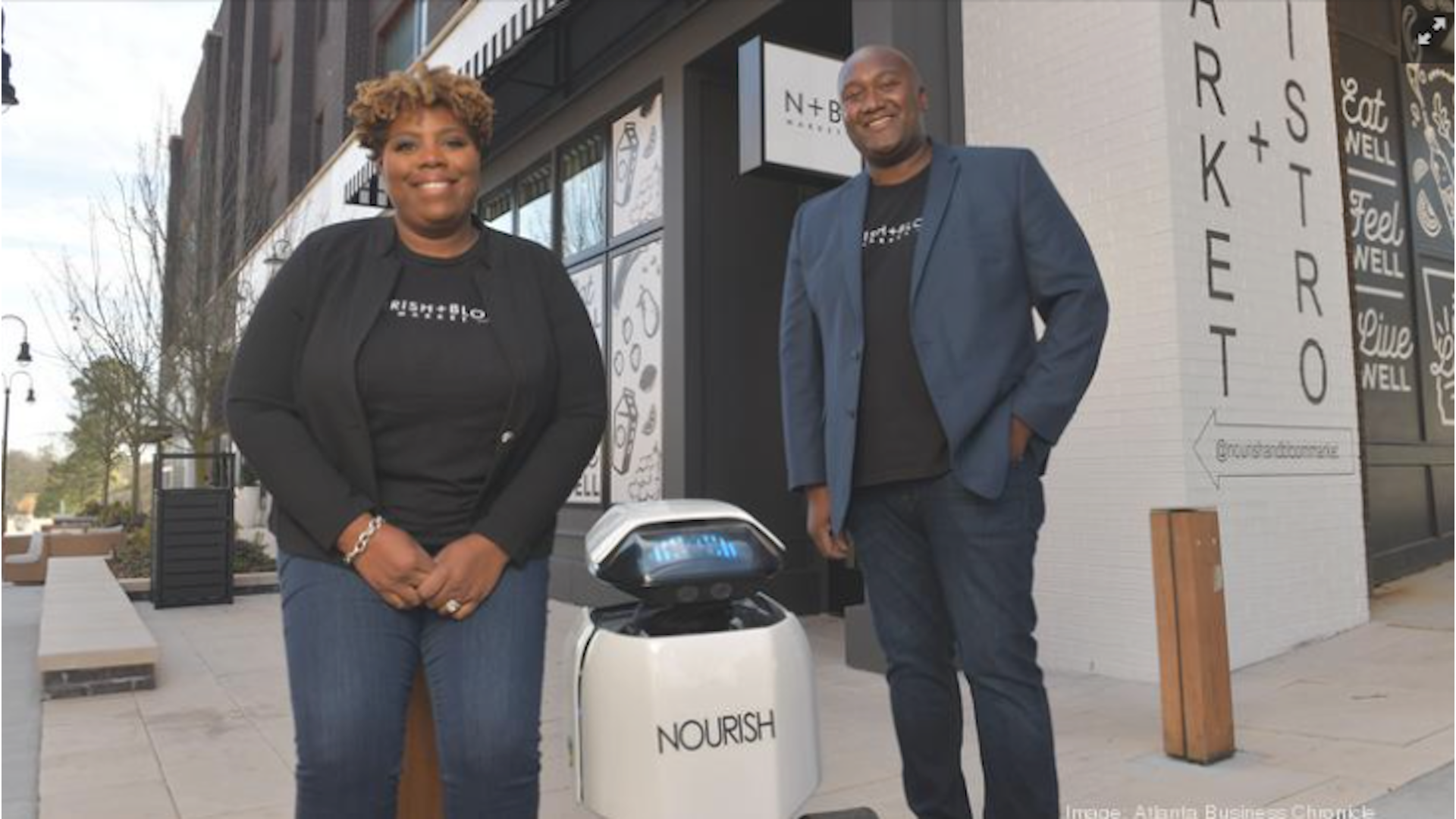
Jamie Hemmings and Jilea Hemmings, owners and founders of Nourish + Bloom Market, join Cheddar News to talk about the inspiration behind creating their cashierless grocery store.
Bartholomew Jones and Renata Henderson, co-owners of Cxffeeblack, join Cheddar News to discuss how they are merging Black culture with coffee in Memphis.
Dr. Daniel Bober, psychiatrist and certified addiction medicine physician, joins Cheddar News to offer tips on how parents and guardians can talk to their children about what's happening in Ukraine.
Abigail Pringle serves as president, international and chief development officer at Wendy’s. She joins Cheddar News to discuss the company's Q4 earnings and its diversity initiative for franchise owners.