ROBERT BURNS and JONATHAN LEMIRE Associated Press
WASHINGTON (AP) — President Donald Trump insists that Iranian cultural sites are fair game for the U.S. military, dismissing concerns within his own administration that doing so could constitute a war crime under international law. He also warned Iraq that he would levy punishing sanctions if it expelled American troops in retaliation for a U.S. airstrike in Baghdad that killed a top Iranian official.
But Congress is pushing back, in what's expected to be a pivotal week as lawmakers return from a holiday recess. On Monday, two top Senate Democrats called on Trump to immediately declassify the administration's reasoning for the strike on the Iranian official, Gen. Qassem Soleimani, saying there is "no legitimate justification" for keeping the information from the public.
And House Speaker Nancy Pelosi said late Sunday the House would introduce and vote this week on a war powers resolution to limit the president's military actions regarding Iran. In a letter to House Democrats, Pelosi called the airstrike "provocative and disproportionate" and said it had "endangered our servicemembers, diplomats and others by risking a serious escalation of tensions with Iran." A similar resolution was introduced in the Senate.
Congress, which has the sole power to declare war, has complained that Trump did not provide advance notice of his airstrike on Soleimani in Baghdad. Trump did meet the 48-hour deadline required by the War Powers Act to notify Congress after the deadly drone strike, though the document was classified and no public version was released.
The administration is expected to brief lawmakers on its actions this week.
In their letter to Trump, Senate Minority Leader Chuck Schumer of New York and the Senate Foreign Relation Committee's Sen. Robert Menendez of New Jersey said the White House's classified notification sent to Congress late Saturday under the War Powers Act was insufficient and inappropriate.
"It is critical that national security matters of such import be shared with the American people in a timely manner, they wrote. "An entirely classified notification is simply not appropriate in a democratic society." They asked that the notification be declassified "in full." White House counselor Kellyanne Conway, speaking Monday on "Fox & Friends," dismissed the letter as a "partisan action."
Pelosi said the notification "raises more questions than it answers. This document prompts serious and urgent questions about the timing, manner and justification of the Administration's decision to engage in hostilities against Iran."
Iran has vowed to retaliate for Trump's targeted killing of Soleimani, the head of Iran's elite Quds force. It has sparked outrage in the Middle East, including in Iraq, where more than 5,000 American troops are still on the ground 17 years after the U.S. invasion. Iraq's parliament voted Sunday in favor of a nonbinding resolution calling for the expulsion of the American forces.
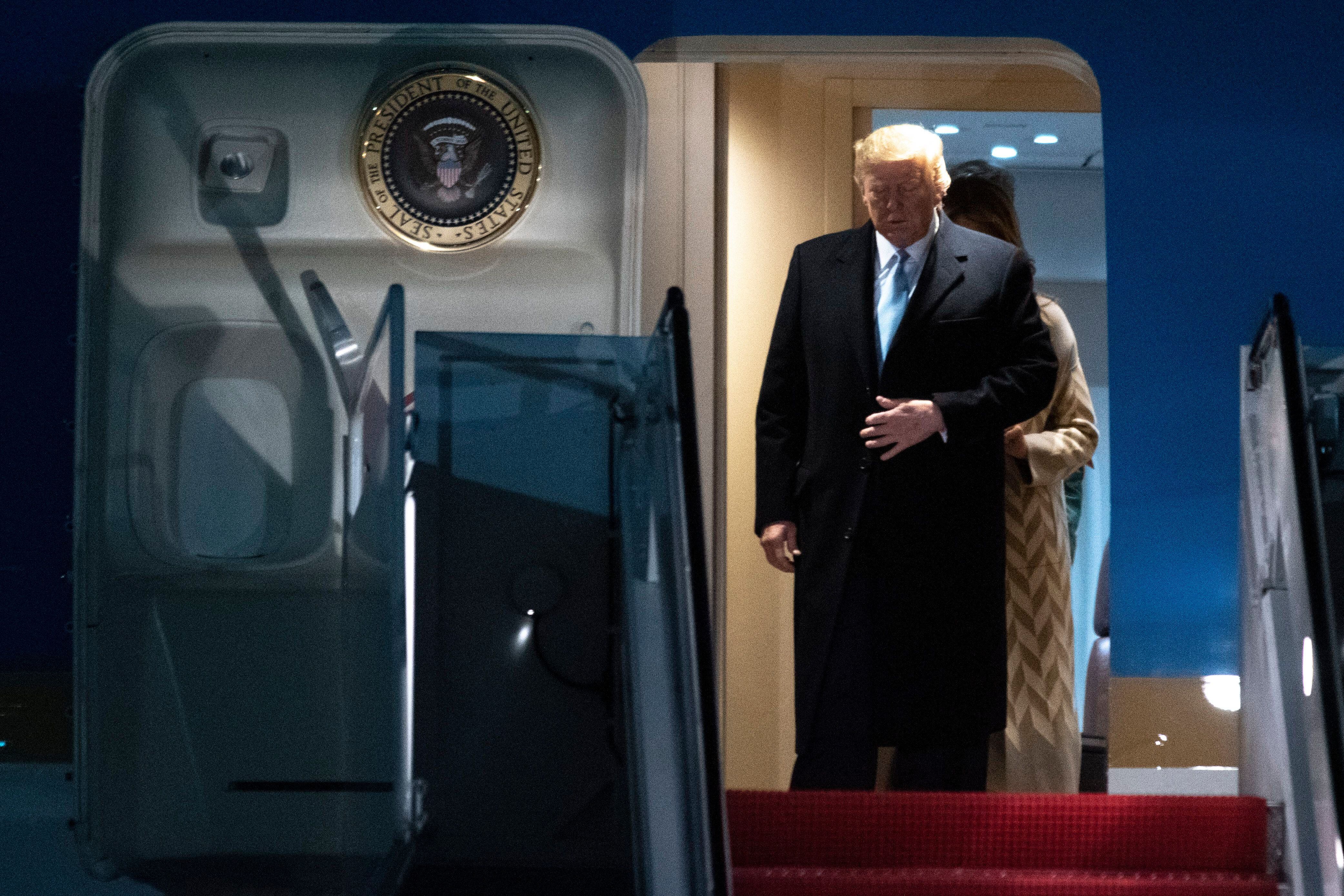
Trump first raised the prospect of targeting Iranian cultural sites Saturday in a tweet. Speaking with reporters Sunday as he flew back to Washington from his holiday in Florida, he refused to back down, despite international prohibitions.
"They're allowed to kill our people. They're allowed to torture and maim our people. They're allowed to use roadside bombs and blow up our people. And we're not allowed to touch their cultural sites? It doesn't work that way," Trump said.
On Iraq, Trump said the U.S. wouldn't leave Iraq without being paid for its military investments there over the years — then said if the troops do have to withdraw, he would hit Baghdad with economic penalties.
"We will charge them sanctions like they've never seen before ever. It'll make Iranian sanctions look somewhat tame," he said. "If there's any hostility, that they do anything we think is inappropriate, we are going to put sanctions on Iraq, very big sanctions on Iraq." He added: "We're not leaving until they pay us back for it."
The administration has scrambled to contend with the backlash to the killing of Soleimani, which marked a stark escalation in tensions between Washington and Tehran.
Secretary of State Mike Pompeo said the U.S. military may well strike more Iranian leaders if the Islamic Republic retaliates. He tip-toed around questions about Trump's threat to attack Iranian cultural sites, a military action that likely would be illegal under the laws of armed conflict and the U.N. charter.
Pompeo defended the targeted killing of Soleimani, saying the administration would have been "culpably negligent" in its duty to protect the United States if it had not killed him.
He did not provide evidence for his previous claims that Soleimani was plotting imminent attacks on Americans. Instead of arguing that an attack had been imminent, Pompeo said it was inevitable.
Trump's threat to attack cultural sites, rattled some administration officials. One U.S. national security official said the president had caught many in the administration off guard and prompted internal calls for others in the government to clarify the matter. The official, who was not authorized to speak publicly to the issue, said clarification was necessary to affirm that the U.S. military would not intentionally commit war crimes.
Oona Hathaway, an international law professor at Yale and a former national security law official in the Defense Department's legal office, said Trump's threat amounted to "a pretty clear promise of commission of a war crime."
The president's threats to Iran did little to quell Tehran's furor over the death of Soleimani. Iranian state television reported that the country would no longer abide by any limits of the 2015 nuclear deal it signed with the United States and other world powers. Trump withdrew the U.S. from the deal in 2018 and stepped up economic sanctions on Tehran, actions that accelerated a cycle of hostilities leading to the last week's killing.
Schumer said he worried that "the actions the president took will get us into what he calls another endless war in the Middle East. He promised we wouldn't have that."
Schumer said Trump lacks the authority to engage militarily with Iran and Congress needs a new war powers resolution "to be a check on this president." To which Pompeo said: "We have all the authority we need to do what we've done to date."
Trump made clear Sunday that he saw little reason to give Congress advanced warning if he orders the military to carry out further actions against Iran.
"These Media Posts will serve as notification to the United States Congress that should Iran strike any U.S. person or target, the United States will quickly & fully strike back, & perhaps in a disproportionate manner," he wrote on Twitter. "Such legal notice is not required, but is given nevertheless!"
In response, the House Foreign Affairs Committee tweeted: "This Media Post will serve as a reminder that war powers reside in the Congress under the United States Constitution. And that you should read the War Powers Act. And that you're not a dictator."
Some Democrats running to challenge Trump in November questioned whether he had a long-term plan for the Mideast.
Former Vice President Joe Biden said Trump was ill-prepared for the repercussions of the strike on Soleimani and had alienated allies by not alerting them of the plans. Pete Buttigieg, the former mayor of South Bend, Indiana, said, "When you're dealing with the Middle East, you need to think about the next and the next and the next move. This is not checkers."