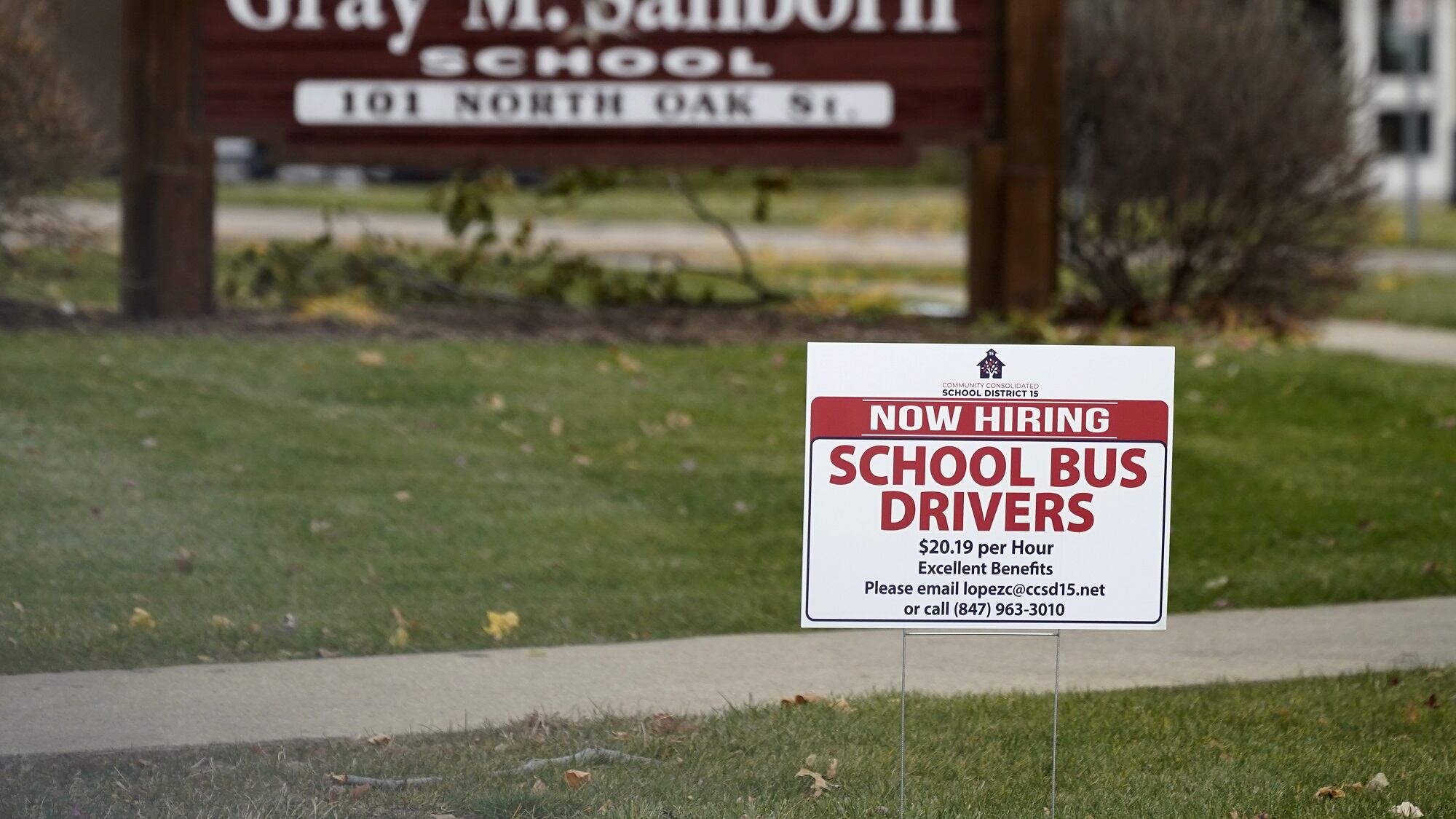
A hiring sign shows outside of Gray M. Sanborn Elementary School in Palatine, Ill., Thursday, Nov. 5, 2020. (AP Photo/Nam Y. Huh)
By Martin Crutsinger
The number of Americans seeking unemployment benefits fell by 19,000 last week to still historically high 787,000 as a resurgent coronavirus grips the U.S. economy.
While at the lowest level in four weeks, the new figures released Thursday by the Labor Department are nearly four times higher than last year at this point before the coronavirus struck. Employers continue to cut jobs as rising coronavirus infections keep many people at home and state and local governments re-impose restrictions.
Jobless claims were running around 225,000 a week before the pandemic struck with force last March, causing weekly jobless claims to surge to a high of 6.9 million in late March as efforts to contain the virus sent the economy into a deep recession.
The government said that the total number of people receiving traditional unemployment benefits fell by 103,000 to 5.2 million for the week ending Dec. 19, compared with the previous week.
The four-week average for claims which smooths out weekly variations rose last week to 836,750, an increase of 17,750 from the previous week.
Economists believe that the holidays, in addition to broad confusion over the status of a Covid-19 relief package, suppressed applications for benefits last week.
Congress finally passed a $900 billion relief bill that would boost benefit payments and extend two unemployment assistance programs tied to job losses from the pandemic. However, President Donald Trump called the measure a “disgrace” because in his view it did not provide enough in direct payments to individuals.
Trump eventually signed the measure on Sunday but sought to pressure Congress to boost the stimulus payments to individuals from the $600 in the bill to $2,000. The Democratic-controlled House quickly passed legislation to meet Trump's demand, but the Republican-led Senate checked that momentum.
Senate Majority Leader Mitch McConnell said Wednesday that the proposal to boost payments to $2,000 has “no realistic path to quickly pass the Senate.”
Meanwhile, the government has begun sending out the smaller payments to millions of Americans. The $600 payment is going to individuals with incomes up to $75,000.
Analysts believe the $900 billion package as it now stands will give the economy a boost, but only as long there are no major problems with the rollout of COVID-19 vaccinations.
Earlier this month, Trump administration officials said they planned to have 20 million doses of the vaccine distributed by the end of the year. But according to data provided by the Centers for Disease Control, just over 11.4 million doses have been distributed and only 2.1 million people have received their first dose.
President Donald Trump deflected criticism about the pace of the vaccine program, saying that it's “up to the States to distribute the vaccines.”
Most economists believe the U.S. economy will rebound at some point next year.
“While prospects for the economy later in 2021 are upbeat, the economy and labor market will have to navigate some difficult terrain between now and then and we expect (jobless) claims to remain elevated,” said Nancy Vanden Houten, lead U.S. economist at Oxford Economics.
Updated on December 31, 2020, at 11:12 a.m. ET with the latest details.
David Stryzewski, CEO of Sound Planning Group, joins Cheddar News' Closing Bell, where he says that rate hikes are driving the market right now and outlines what must be in place for a stock rally.
Andrew Arons, Founder and Partner at Synergy Advisory Management Group, joins Cheddar News' Closing Bell, where he breaks down Tuesday's market action and provides his insight on Snap's historic slide after the comments made by CEO Evan Spiegel.
Peter Andersen, CIO at Andersen Capital Management, joins Cheddar News' Closing Bell, where he breaks down Monday's trading action and discusses whether this could be the start of a new rally or a blip in an otherwise disappointing stretch.
The crypto industry is still reeling from Terra's recent crash. The company's blockchain was temporarily halted earlier this month after the collapse of its cryptocurrency Luna (LUNA) and its stablecoin TerraUSD (UST), which led to almost $45 billion being wiped from the tokens' market caps within a week. Now, many are left wondering what Terra's struggles mean for the broader crypto market. Reeve Collins, CEO of the NFT platform BLOCKv, joins Cheddar News' Closing Bell from Davos 2022 to discuss.
China's largest ride-hailing company will no longer be listed on the world's largest stock exchange. Didi shareholders voted on Monday to delist from the New York Stock Exchange, less than a year after launching a $4.4 billion IPO with the most significant U.S. share offering by a Chinese company since Alibaba debuted in 2014. Since going public in June of last year, around $70 billion has been wiped from Didi's market value and shares of the company have dropped nearly 90%. Now, Didi is expected to begin preparations to list in Hong Kong. Kevin T. Carter, founder and Chief Investment Officer of EMQQ Global, joins Cheddar News' Closing Bell to discuss.
Ahead of the Meta shareholder meeting, more than five hundred doctors have jointly sent a letter to investors to hold the Facebook parent accountable for the risks its platforms have posed to the public and mental health. Dr. Rob Davidson, a West Michigan ER physician and executive director of the Committee to Protect Health Care, joined Cheddar News to discuss how medical professionals are coming together to highlight the social media giant's spread of misinformation, especially during the pandemic. "We've seen the direct impacts of misinformation and disinformation that spreads like wildfire on the social media platforms," he said. "Our goal with this letter is to try to get the shareholders of Meta to convince leadership that they need to do a better job."
Snap downgraded its earnings and revenue expectations for the second quarter, saying the "macroeconomic environment" has deteriorated faster than the company anticipated. The warning sent shockwaves through the digital ad industry, dragging down a handful of other tech stocks, including Pinterest, Meta, and Twitter. Daniel Cobb, CEO and Chief Strategy Officer of Daniel Brian Advertising, joined Cheddar to discuss the reason behind this warning, and why it's bringing so many social media stocks down.
Pamela Rucker, CIO Advisor and Instructor for Harvard Professional Development, joins Cheddar to discuss how perceptions of Environmental, Social, and Governance–or ESG–changed over the past couple of years, and how using machine learning and artificial intelligence could pave the way to a more sustainable future.