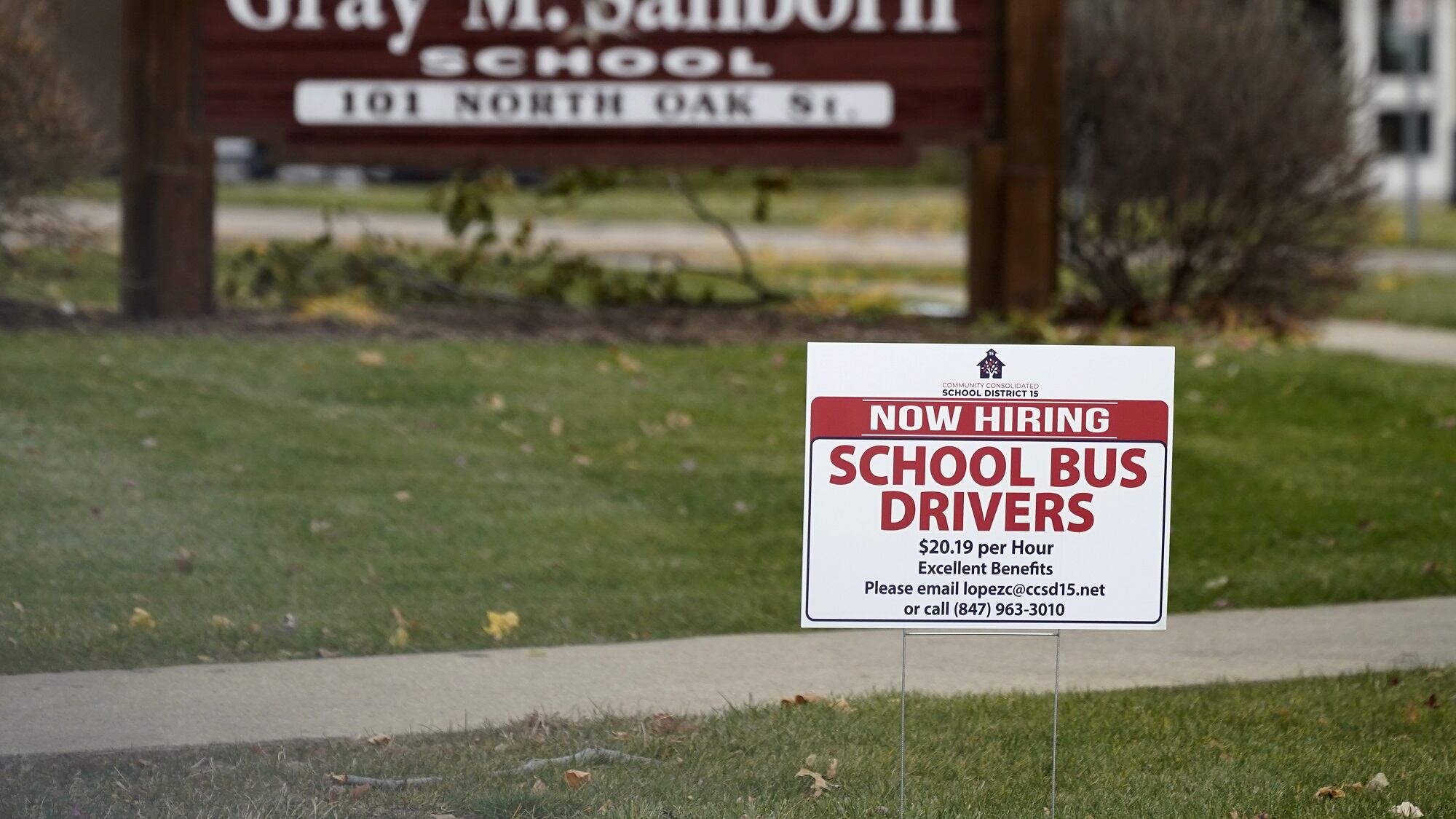
A hiring sign shows outside of Gray M. Sanborn Elementary School in Palatine, Ill., Thursday, Nov. 5, 2020. (AP Photo/Nam Y. Huh)
By Martin Crutsinger
The number of Americans seeking unemployment benefits fell by 19,000 last week to still historically high 787,000 as a resurgent coronavirus grips the U.S. economy.
While at the lowest level in four weeks, the new figures released Thursday by the Labor Department are nearly four times higher than last year at this point before the coronavirus struck. Employers continue to cut jobs as rising coronavirus infections keep many people at home and state and local governments re-impose restrictions.
Jobless claims were running around 225,000 a week before the pandemic struck with force last March, causing weekly jobless claims to surge to a high of 6.9 million in late March as efforts to contain the virus sent the economy into a deep recession.
The government said that the total number of people receiving traditional unemployment benefits fell by 103,000 to 5.2 million for the week ending Dec. 19, compared with the previous week.
The four-week average for claims which smooths out weekly variations rose last week to 836,750, an increase of 17,750 from the previous week.
Economists believe that the holidays, in addition to broad confusion over the status of a Covid-19 relief package, suppressed applications for benefits last week.
Congress finally passed a $900 billion relief bill that would boost benefit payments and extend two unemployment assistance programs tied to job losses from the pandemic. However, President Donald Trump called the measure a “disgrace” because in his view it did not provide enough in direct payments to individuals.
Trump eventually signed the measure on Sunday but sought to pressure Congress to boost the stimulus payments to individuals from the $600 in the bill to $2,000. The Democratic-controlled House quickly passed legislation to meet Trump's demand, but the Republican-led Senate checked that momentum.
Senate Majority Leader Mitch McConnell said Wednesday that the proposal to boost payments to $2,000 has “no realistic path to quickly pass the Senate.”
Meanwhile, the government has begun sending out the smaller payments to millions of Americans. The $600 payment is going to individuals with incomes up to $75,000.
Analysts believe the $900 billion package as it now stands will give the economy a boost, but only as long there are no major problems with the rollout of COVID-19 vaccinations.
Earlier this month, Trump administration officials said they planned to have 20 million doses of the vaccine distributed by the end of the year. But according to data provided by the Centers for Disease Control, just over 11.4 million doses have been distributed and only 2.1 million people have received their first dose.
President Donald Trump deflected criticism about the pace of the vaccine program, saying that it's “up to the States to distribute the vaccines.”
Most economists believe the U.S. economy will rebound at some point next year.
“While prospects for the economy later in 2021 are upbeat, the economy and labor market will have to navigate some difficult terrain between now and then and we expect (jobless) claims to remain elevated,” said Nancy Vanden Houten, lead U.S. economist at Oxford Economics.
Updated on December 31, 2020, at 11:12 a.m. ET with the latest details.
Jay Hatfield, Chief Investment Officer at Infrastructure Capital Management, joined Closing Bell to break down the big factors leading to this latest market meltdown, as inflation and an upcoming Fed policy decision affect investor sentiment.
Tech apprenticeship platform Multiverse became a unicorn with a $1.7 billion valuation, after raising $220 million in a Series D round. As companies across the country face challenges in hiring and retaining tech talent, Multiverse says it's trying to offer a solution with a new way to train and hire workers that can serve as an alternative to college and corporate training. Sophie Ruddock, VP and GM North America of Multiverse, joins Cheddar News' Closing Bell to discuss.
Bitcoin's price has fallen below $24,000, its lowest level since December 2020. Matt Hougan, CIO at Bitwise Asset Management, joined Cheddar News to discuss the future of crypto amid the latest high-profile point of concern, the halting of withdrawals at Celsius Network. "Last month we saw Luna collapse. This month we're seeing Celsius possibly collapsing," he said. "So this stress test is finding weaknesses in the crypto ecosystem and it will continue until we get to a strong foundation from which crypto can recover."
An analyst at JP Morgan is predicting massive future growth for Apple in its music and gaming divisions — to the tune of more than $8 billion in revenue by 2025. Cheddar News anchors Kristen Scholer and Hena Doba discuss the glowing forecast for the tech giant.
Catching you up on today’s top headlines with Bitcoin falling below $24,000, U.S. gas prices reaching above $5 on average, Tesla shareholders voting on a 3-for-1 stock split, and more.
On this episode of On The Job presented by ADP: Gemma Burgess, CEO of Ferguson Partners, explains what people are looking for in an employer, and how to convey positive work culture to potential employees; Amy Leschke-Kahle, Vice President of Performance Acceleration at The Marcus Buckingham Company, an ADP company, breaks down how encouraging employee engagement and empowering employee voices can benefit every workplace and busts a myth about employee engagement while working from home; Jim Huether, CEO of Hyperice, discusses Hyperice's new employee mental health initiative, known as the Workplace Alliance, with 100-plus companies to combat the ongoing mental health crisis and how they're taking a hands-on, data-driven approach to the mental health crisis.
Amy Leschke-Kahle, Vice President of Performance Acceleration at The Marcus Buckingham Company, an ADP company, joins Cheddar to discuss how encouraging employee engagement and empowering employee voices can benefit every workplace and busts a myth about employee engagement while working from home.
Jim Huether, CEO of Hyperice, joins Cheddar to discuss Hyperice's new employee mental health initiative, known as the Workplace Alliance, with 100-plus companies to combat the ongoing mental health crisis and how they're taking a hands-on, data-driven approach to the mental health crisis.
Consumer prices saw an 8.6 percent jump in May, with fuel prices showing the biggest surge, climbing 17 percent last month. As inflation continues to climb to levels not seen in 40 years, President Biden took to calling out ExxonMobil and other major oil companies, accusing them of holding back production while continuing to collect huge profits at the cost of the consumer. Mark Avallone, the president of Potomac Wealth Advisors, joined Cheddar's Opening Bell to discuss. “They have reduced long-term expenditures. But why? Because the world is going to alternative energy and as consumers, if we thought that that welcome change to alternatives was going to happen without pain, we might have been mistaken," he said. "The less investment they make in oil because they're getting ready for a new world of electric vehicles, the less we're going to be prepared for oil shocks such as the one we got when Russia invaded Ukraine."