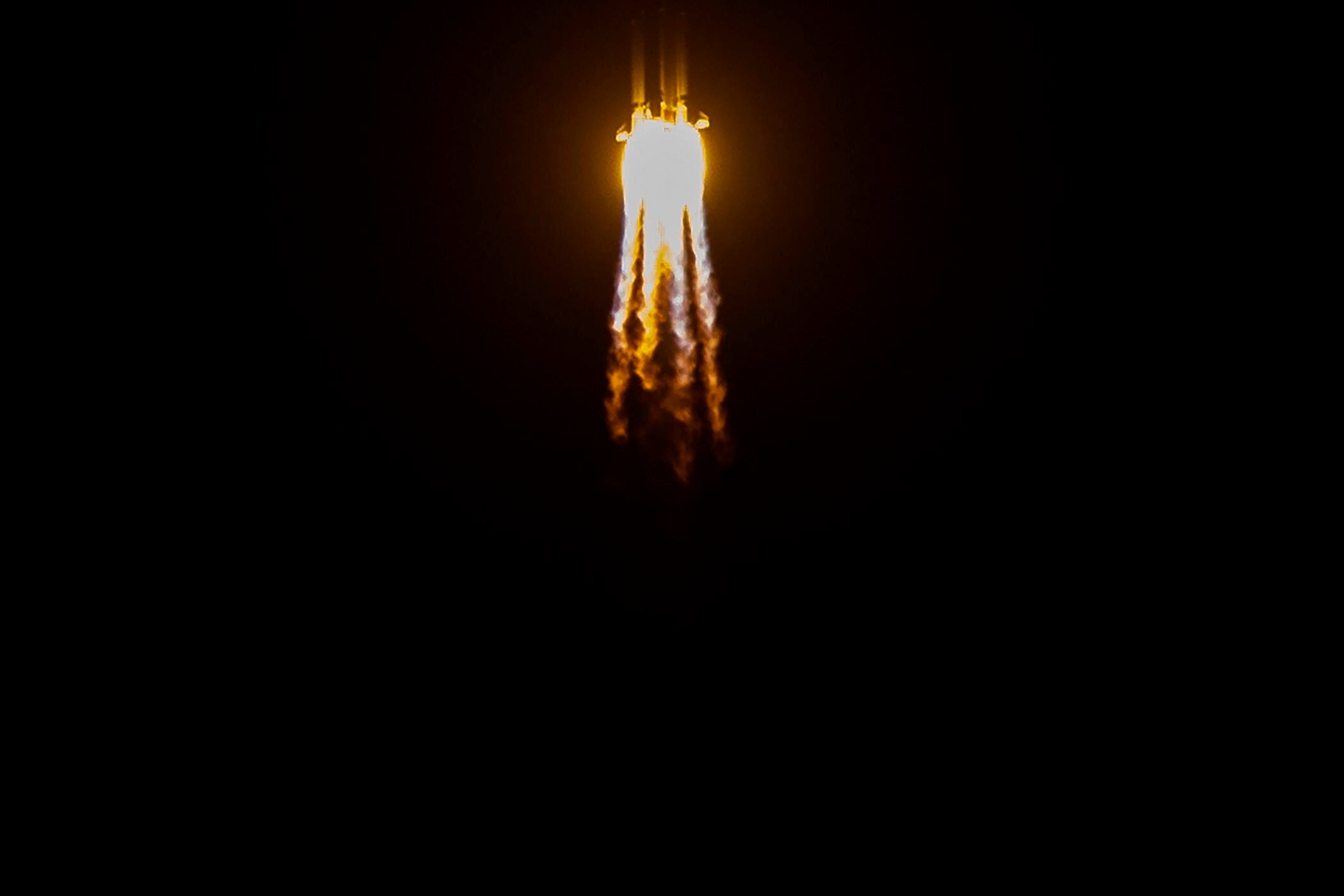
Flames and exhaust trail behind a Long March-5 rocket carrying the Chang'e 5 lunar mission after it lifted off at the Wenchang Space Launch Center in Wenchang in southern China's Hainan Province, early Tuesday, Nov. 24, 2020. China launched an ambitious mission on Tuesday to bring back material from the moon's surface for the first time in more than 40 years — an undertaking that could boost human understanding of the moon and of the solar system more generally. (AP Photo/Mark Schiefelbein)
By Joe McDonald
A Chinese robot probe sent to return lunar rocks to Earth for the first time since the 1970s landed on the moon Tuesday, the government announced, adding to a string of increasingly bold space missions by Beijing.
The Chang’e 5 probe “successfully landed” at its planned site, state TV and news agencies reported, citing the China National Space Administration. They didn’t immediately announce any more details.
The probe, launched Nov. 24 from the tropical southern island of Hainan, is the latest venture by a Chinese space program that fired a human into orbit in 2003, has a probe en route to Mars, and aims eventually to land a human on the moon.
Plans call for the robot lander to drill into the lunar surface and load 2 kilograms (4.4 pounds) of rocks and debris into an ascent stage that will blast off to return them to Earth.
If it succeeds, it will be the first time scientists have obtained fresh samples of lunar rocks since a Soviet probe in the 1970s.
The Chang'e 5 flight is China's third successful lunar landing. Its predecessor, Chang'e 4, became the first probe to land on the moon's little-explored far side.
The latest flight includes collaboration with the European Space Agency, which is helping to monitor the mission.
China's space program has proceeded more cautiously than the U.S.-Soviet space race of the 1960s, which was marked by fatalities and launch failures.
In 2003, China became the third country to fire an astronaut into orbit on its own after the Soviet Union and the United States. It also launched a crewed space station.
Space officials say they hope eventually to land a human on the moon but no timeline or other details have been announced.
China, along with neighbors Japan and India, also has joined the growing race to explore Mars.
The Tianwen 1 probe launched in July is en route to the red planet carrying a lander and a robot rover to search for water.
Brightseed Co-Founder Sofia Elizondo breaks down what plant bioactives are, and how they're using the latest technology to study human's biological connections with plants.
On this episode of Cheddar Innovates: Brightseed Co-Founder breaks down what plant bioactives are, and how they're using the latest technology to study human's biological connections with plants; Esper Bionics CEO breaks down how they re creating a mind-controlled bionic hand that guest smarter the more you use it; Cheddar gets a look at Curiosity Stream's 'Capturing A Black Hole In Our Milky Way.'
Hilary Kearney, Founder of Girl Next Door Honey, joined Closing Bell to discuss her partnership with Comvita to save the important pollinators, as bee colonies are on the decline across the United States.
Hurricane climatologist Jill Trepanier joined Cheddar News to discuss NOAA's announced prediction for an above-normal hurricane season and what it might mean for people in the United States. "I think it's important that people who maybe haven't been used to having extreme weather events related to say tropical cycles and tropical systems, like thinking New Jersey, Northeastern seaboard, that area may get more action than they're used to in the past," she said.
Dr. Jarrad Aguirre, Co-Founder and CEO of Miga Health, joins Cheddar News' Closing Bell, where he says his company is looking to establish the future of heart health and points to how 80% of premature heart attacks and strokes are preventable.
On this episode of Cheddar Reveals, David Keith, Professor of Applied Physics at the Harvard School of Engineering and Applied Sciences and Professor of Public Policy at the Harvard Kennedy School, and founder of Carbon Engineering outlines the viability of solar geoengineering as a solution to help reverse the effects of global warming; Lena Geraghty, Sustainability & Urban Innovation Director at National League of Cities, discusses which U.S. cities are safest from global warming and how the real estate market will be impacted from the effects of climate change; Cheddar gets a look at Curiosity Stream's 'Changing Ocean Asia.'
David Keith, Professor of Applied Physics at the Harvard School of Engineering and Applied Sciences and Professor of Public Policy at the Harvard Kennedy School, and founder of Carbon Engineering joins Cheddar Reveals to outline the viability of solar geoengineering as a solution to help reverse the effects of global warming.
Lena Geraghty, Sustainability & Urban Innovation Director at National League of Cities, joins Cheddar News to discuss which U.S. cities are safest from global warming and how the real estate market will be impacted from the effects of climate change.
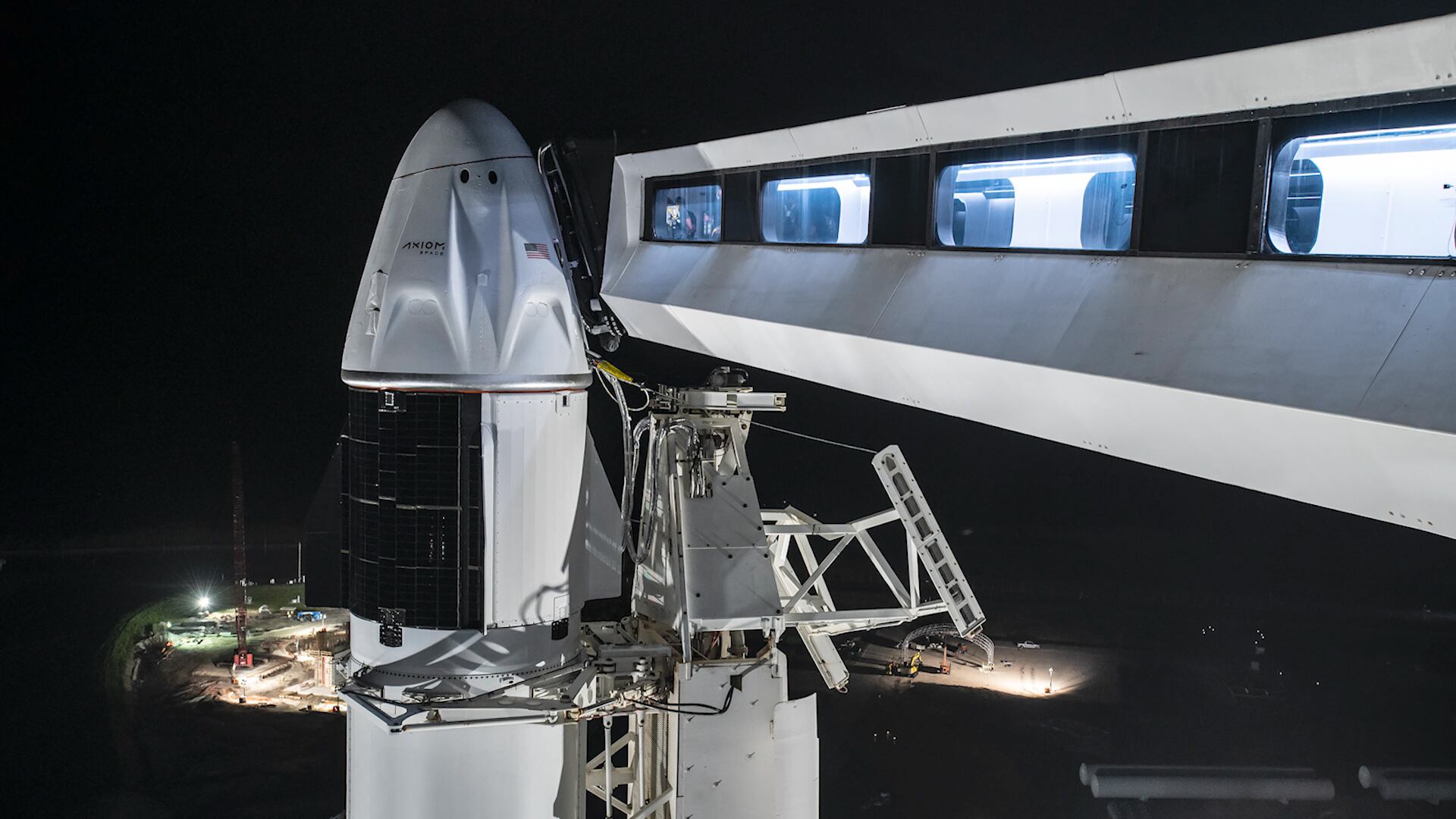
Peggy Whitson, Director of Human Space Flight, Axiom Space, joins Cheddar Innovates to discuss Axiom's involvement in the first fully-private mission to the ISS, and her experience spending 665 days in space.
On this episode of Cheddar Innovates, Peggy Whitson, Director of Human Space Flight, Axiom Space, breaks down Axiom's involvement in the first fully-private mission to the ISS, and her experience spending 665 days in space; William Li and Danielle Chang, co-founders of The Hao Life, discuss how they're shaking up the $71 billion supplement industry by putting a modern spin on traditional natural Chinese remedies; Cheddar gets a look at Curiosity Stream's 'Sagrada Familia: Gaudi's Challenge.'