By Sara Burnett
CHICAGO (AP) — Paul Vallas and Brandon Johnson will meet in a runoff to be the next mayor of Chicago after voters on Tuesday denied incumbent Lori Lightfoot a second term, issuing a rebuke to a leader who made history as head of the nation’s third-largest city.
Vallas, a former schools CEO backed by the police union, and Johnson, a Cook County commissioner endorsed by the Chicago Teachers Union, advanced to the April 4 runoff after none of the nine candidates was able to secure over 50% of the vote to win outright.
Lightfoot, the first Black woman and first openly gay person to lead the city, won her first term in 2019 after promising to end decades of corruption and backroom dealing at City Hall. But opponents blamed Lightfoot for an increase in crime that occured in cities across the U.S. during the pandemic and criticized her as being a divisive, overly contentious leader.
She is the first elected Chicago mayor to lose a reelection bid since 1983, when Jane Byrne, the city’s first female mayor, lost her Democratic primary.
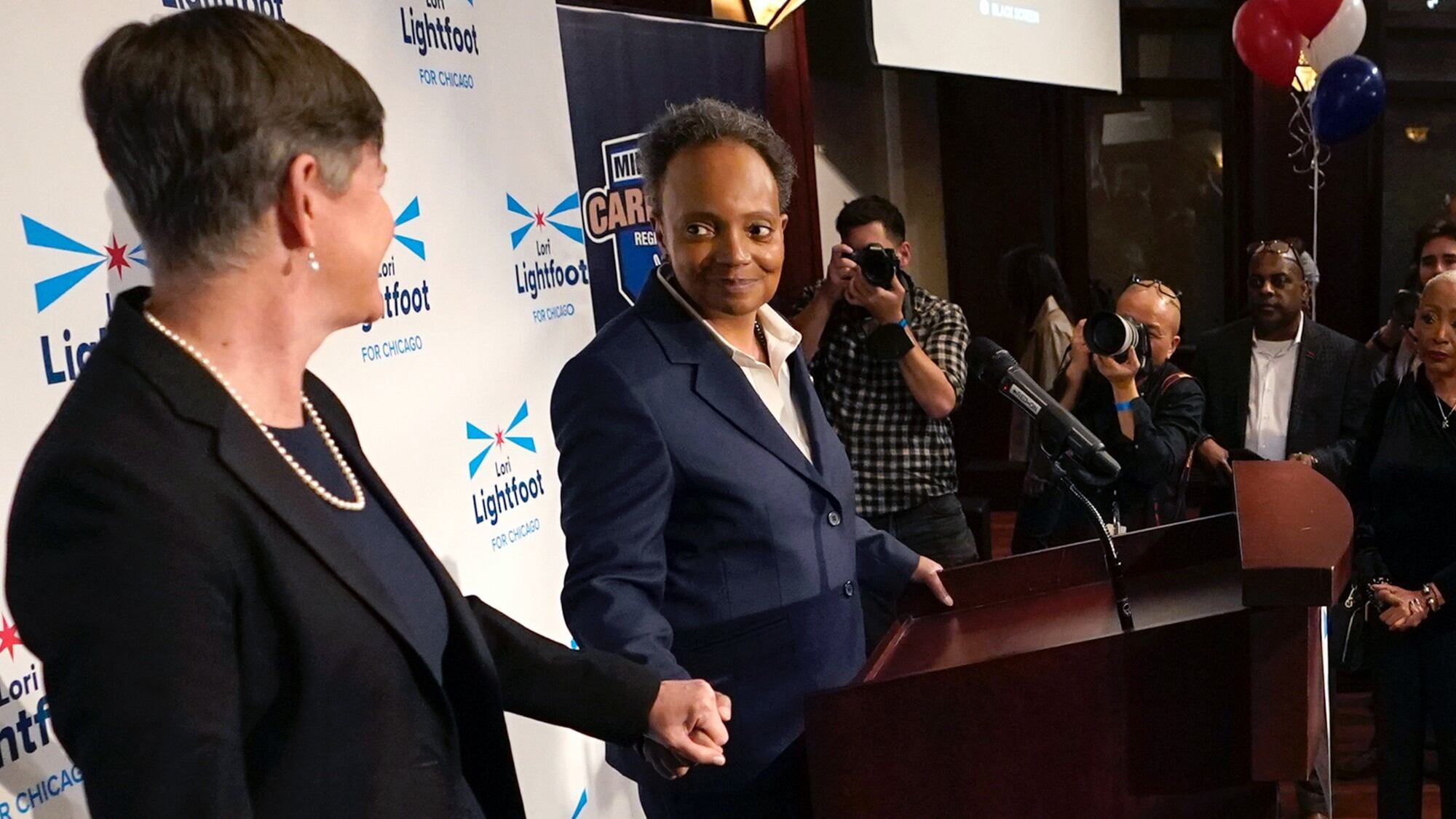
Speaking to supporters Tuesday night, Lightfoot called being Chicago's mayor “the honor of a lifetime.”
“Regardless of tonight’s outcome, we fought the right fights and we put this city on a better path,” Lightfoot said. She told her fellow mayors around the country not to fear being bold.
At his victory party, Vallas noted that Lightfoot had called to congratulate him and asked the crowd to give her a round of applause. In a nod to his campaign promise to combat crime, he said that, if elected, he would work to address public safety issues.
“We will have a safe Chicago. We will make Chicago the safest city in America,” Vallas said.
Johnson on Tuesday night noted the improbability that he would make the runoff, considering his low name recognition at the start of the race.
“A few months ago they said they didn’t know who I was. Well, if you didn’t know, now you know," Johnson said. He thanked the unions that supported him and gave a special shout-out to his wife, telling the crowd, “Chicago, a Black woman will still be in charge.”
Lightfoot’s loss is unusual for mayors in large cities, who have tended to win reelection with relative ease. But it’s also a sign of the turmoil in U.S. cities following the COVID-19 pandemic, with its economic fallout and spikes in violent crime in many places.
Public safety has been an issue in other recent elections, including the recall of a San Francisco district attorney who was criticized for progressive policies. The pandemic also may shape elections for mayor in other cities this year, such as Philadelphia and Houston, where incumbents cannot run again due to term limits.
There are clear contrasts between Vallas and Johnson.
Vallas served as an adviser to the Fraternal Order of Police during its negotiations with Lightfoot’s administration. He has called for adding hundreds of police officers to patrol the city, saying crime is out of control and morale among officers sunk to a new low during Lightfoot’s tenure.
Vallas' opponents have criticized him as too conservative to lead the Democratic stronghold. Lightfoot blasted him for welcoming support from the police union’s controversial leader, who defended the Jan. 6 insurrectionists at the Capitol and equated Lightfoot’s vaccine mandate for city workers to the Holocaust.
Johnson received about $1 million from the Chicago Teachers Union for his campaign and had support from several other progressive organizations, including United Working Families. The former teacher and union organizer has argued that the answer to addressing crime is not more money for police but more investment in mental health care, education, jobs and affordable housing, and he was accused by rivals such as Lightfoot of wanting to defund the police.
Johnson has avoided the word “defund” during the race, and his campaign says he does not want to cut the number of police officers. But in a 2020 radio interview, Johnson said defunding is not just a slogan but “an actual real political goal,” and he sponsored a nonbinding resolution on the county board to redirect money from policing and jails to social services.
Crime was an issue that resonated with voters.
Rita DiPietro, who lives downtown, said she supported Lightfoot in 2019. But she voted for Vallas on Tuesday, saying she was impressed by his detailed strategy to address public safety.
“The candidates all talk about what they’d like to do,” she said. “This guy actually has a plan. He knows how he’s going to do it.”
Lindsey Hegarty, a 30-year-old paralegal who lives on Chicago’s North Side, said she backed Johnson because “he seemed like the most progressive candidate on issues like policing, mental health” and public transit.
Race also was a factor as candidates courted votes in the highly segregated city, which is closely divided in population among Black, Hispanic and white residents. Vallas was the only white candidate in the field. Lightfoot, Johnson and five other candidates are Black, though Lightfoot argued she was the only Black candidate who could win. U.S. Rep. Jesus “Chuy” Garcia was the only Latino in the race.
Lightfoot accused Vallas of using “the ultimate dog whistle” by saying his campaign is about “taking back our city,” and of cozying up to the president of the Fraternal Order of Police, whom she calls a racist. A recent Chicago Tribune story also found Vallas' Twitter account had liked racist tweets and tweets that mocked Lightfoot's appearance and referred to her as masculine.
Vallas denied his comments were related to race and says his police union endorsement is from rank-and-file officers. He also said he wasn't responsible for the liked tweets, which he called “abhorrent," and suggested someone had improperly accessed his account.
Lightfoot touted her record of investing in neighborhoods and supporting workers, such as by increasing the minimum wage to $15 an hour. She also noted that the city had navigated unprecedented challenges such as the pandemic and its economic and public safety fallout to protests over policing.
Asked if she was treated unfairly because of her race and gender, Lightfoot said: “I'm a black woman in America. Of course.”
Vallas, who has led school systems in Chicago, New Orleans and Philadelphia, lost a 2019 bid for mayor. This time, he was laser-focused on public safety, saying police officers who left the force under Lightfoot's administration will return if he's elected.
The other candidates were businessman Willie Wilson, Chicago City Council members Sophia King and Roderick Sawyer, activist Ja’Mal Green and state Rep. Kambium “Kam” Buckner.
Associated Press writers Claire Savage and Teresa Crawford in Chicago contributed to this report.