By Amy Forliti
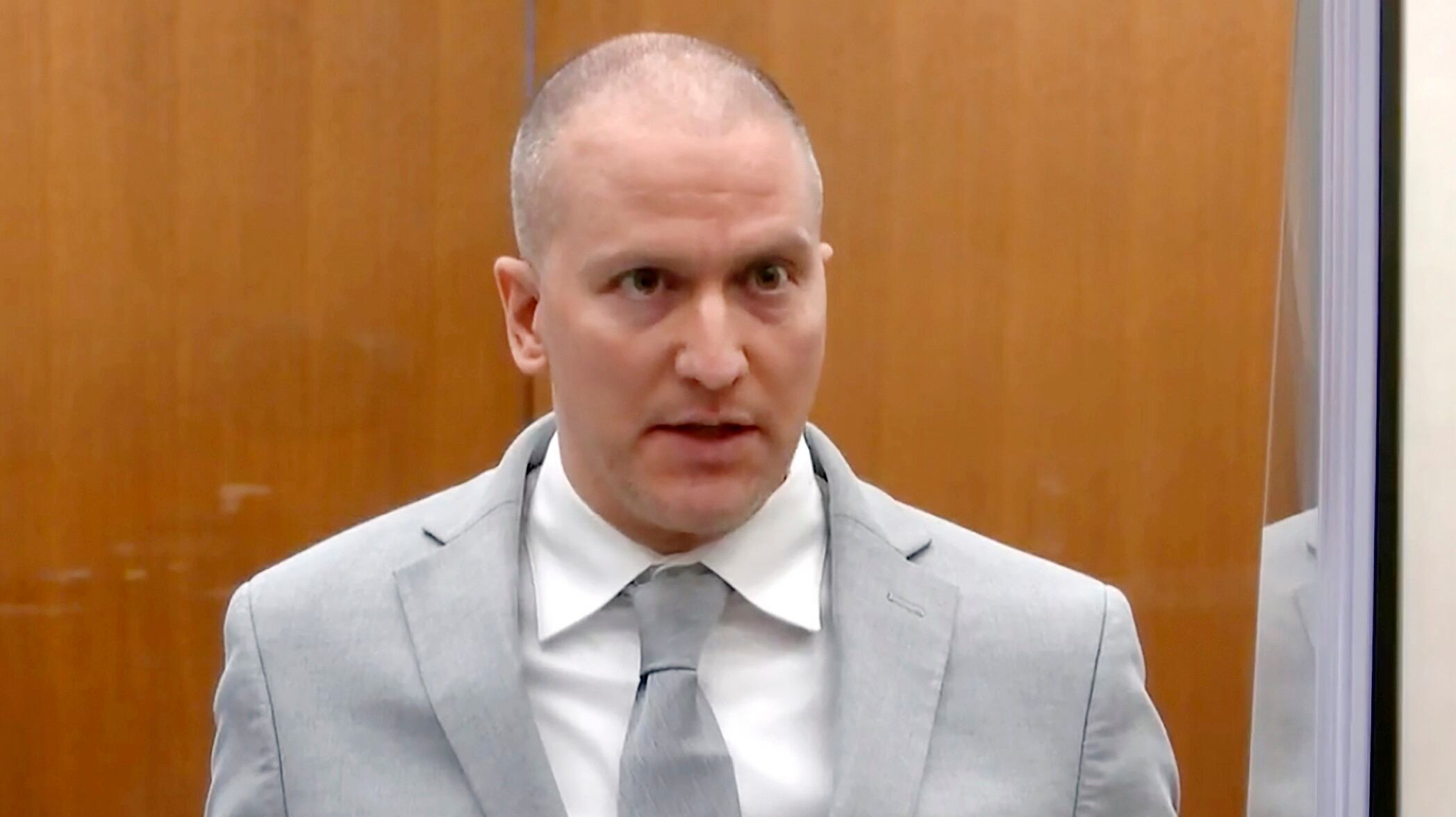
Former Minneapolis police Officer Derek Chauvin pleaded guilty Wednesday to a federal charge of violating George Floyd’s civil rights, admitting for the first time that he kept his knee on Floyd’s neck — even after he became unresponsive — resulting in the Black man’s death.
Chauvin, who is white, was convicted this spring of state murder and manslaughter charges in Floyd's May 25, 2020, death, and was sentenced to 22 1/2 years in that case.
In his federal plea Wednesday, Chauvin admitted he willfully deprived Floyd of his right to be free from unreasonable seizure, including unreasonable force by a police officer, by kneeling on Floyd's neck even though he was handcuffed and not resisting. A second federal count in Floyd’s death was dismissed, but Chauvin pleaded guilty to another count in an unrelated 2017 case.
Chauvin appeared in person Wednesday for the change of plea hearing in an orange short-sleeve prison shirt and was led into and out of the court in handcuffs. He said “Guilty, your honor” to confirm his pleas, and acknowledged that he committed the acts alleged.
Chauvin had faced a possible maximum of life in prison on the federal count in Floyd's death. Under the plea agreement, both sides agreed Chauvin should face a sentence ranging from 20 to 25 years, with prosecutors saying they would seek 25. The final sentence will be up to U.S. District Judge Paul Magnuson, and Chauvin will likely face more time behind bars than he would on the state charges alone.
In the federal system, defendants who get credit for good behavior typically serve about 85% of their sentences. For Chauvin, a 25-year sentence could lead to him spending 21 years and three months in prison. If he’s sentenced to 20 years, he would spend 17 years behind bars. Both are higher than the 15 he was expected to serve in a state prison, before he would have become eligible for parole.
Under the plea agreement, any federal sentence would run at the same time as the state sentence and he would get credit for time already served.
Three other former officers — Thomas Lane, J. Kueng and Tou Thao — were also indicted on federal charges alongside Chauvin. They are still on course for trial early next year on those charges, with a state trial still to come.
Floyd’s arrest and death, which a bystander captured on cellphone video, sparked mass protests nationwide calling for an end to racial inequality and police mistreatment of Black people.
Chauvin also pleaded guilty to violating the rights of a 14-year-old boy during a 2017 arrest in which he held the boy by the throat, hit him in the head with a flashlight and held his knee on the boy’s neck and upper back while he was prone, handcuffed and not resisting.
The 2017 case was one of several mentioned in state court filings that prosecutors said showed Chauvin used neck or head and upper body restraints seven times dating back to 2014, including four times state prosecutors said he went too far and held the restraints “beyond the point when such force was needed under the circumstances.”
Several members of Floyd's family were present Wednesday, as was the teenager involved in the 2017 arrest. As they left the courtroom, Floyd's brother Philonise said to Chauvin's 2017 victim: “It’s a good day for justice.”
Nine people came to support Chauvin, including family members. He waved and smiled at them as he entered and left the courtroom.
George Floyd's nephew, Brandon Williams, afterward called Chauvin a “monster” who should have been arrested in 2017.
“Had he been held accountable for what he did in 2017 to that minor, George Floyd would still be here,” Williams said. "Today he had a chance to blow kisses and give air hugs to his family. We can’t do that.”
An attorney for Floyd's family, Jeff Storms, said they planned to head to Minneapolis later Wednesday to support the family of Daunte Wright, a 20-year-old Black man who was fatally shot in a traffic stop during Chauvin's state trial. The police officer in that case, Kim Potter, is on trial on manslaughter charges.
To bring federal charges in deaths involving police, prosecutors must believe an officer acted under the “color of law,” or government authority, and willfully deprived someone of their constitutional rights. That’s a high legal standard. An accident, bad judgment or negligence on the officer’s part isn’t enough to support federal charges. Prosecutors have to prove the officer knew what he was doing was wrong in that moment but did it anyway.
Chauvin admitted that he knew what he did to Floyd was wrong and he had a “callous and wanton disregard” for Floyd’s life, the plea agreement said. It also said Chauvin “was aware that Mr. Floyd not only stopped resisting, but also stopped talking, stopped moving, stopped breathing, and lost consciousness and a pulse.”
According to evidence in the state case against Chauvin, Kueng and Lane helped restrain the 46-year-old Floyd as he was on the ground — Kueng knelt on Floyd’s back and Lane held down Floyd’s legs. Thao held back bystanders and kept them from intervening during the 9 1/2-minute restraint.
All four former officers were charged broadly in federal court with depriving Floyd of his rights while acting under government authority.
The other three former officers are still expected to go to trial on federal charges in January, and they face state trial on aiding and abetting counts in March.
___
This story has been corrected throughout to show that Chauvin plea in Floyd's death was to a single charge, with a second count dismissed.
Updated on December 15, 2021, at 2:44 p.m. ET with the latest details.