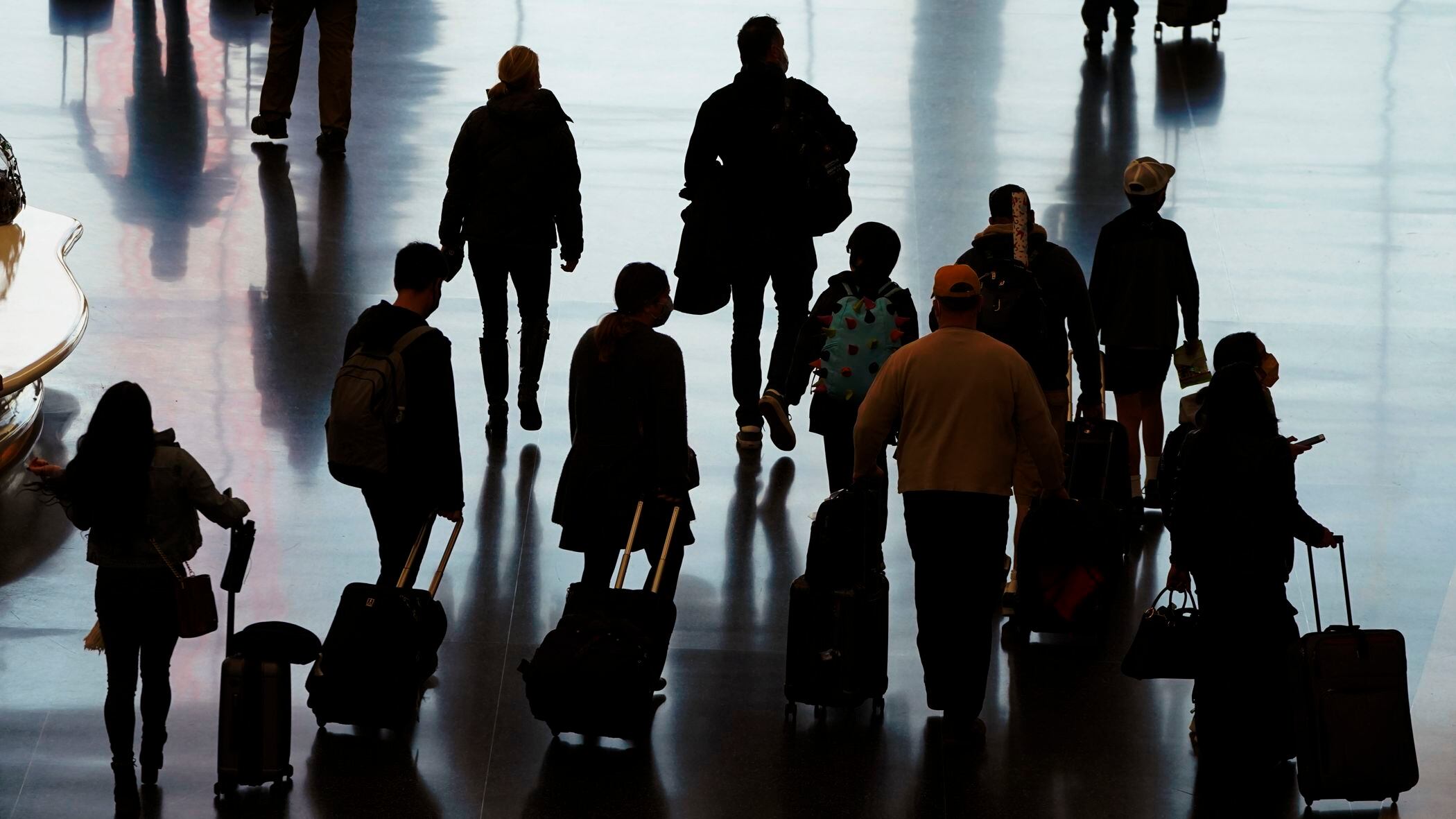
In this Wednesday, Nov. 25, 2020 file photo, travelers walk through the Salt Lake City International Airport in Salt Lake City, a day before Thanksgiving. On Wednesday, Dec. 2, 2020, the U.S. Centers for Disease Control and Prevention are urging Americans to stay home over the upcoming holiday season and consider getting tested before and after if they do decide to travel. (AP Photo/Rick Bowmer)
By Lindsey Tanner
Don’t travel over the upcoming holidays. But if you must, consider getting coronavirus tests before and after, U.S. health officials urged Wednesday.
The agency also announced new guidelines that shorten recommended quarantines after close contact with someone infected with coronavirus. The agency said the risk in a shorter quarantine is small, but that the change makes following the guidance less of a hardship.
The no-travel advice echoes recommendations for Thanksgiving but many Americans ignored it. With COVID-19 continuing to surge, the CDC added the testing option.
“Cases are rising, hospitalizations are increasing, deaths are increasing. We need to try to bend the curve, stop this exponential increase,” the CDC's Dr. Henry Walke said during a briefing.
He said any travel-related surge in cases from travel would likely be apparent about a week to 10 days after Thanksgiving.
The virus has infected more than 13.5 million Americans and killed at least 270,000 since January.
“The safest thing to do is to postpone holiday travel and stay home," said Dr. Cindy Friedman, another CDC official. "Travel volume was high over Thanksgiving,'' and even if small numbers were infected, that could result in ’’hundreds of thousands of new infections.”
‘’Travel is a door-to-door experience that can spread the virus during the journey and also into communities that travelers visit or live," she added.
For those who decide to travel, COVID-19 tests should be considered one to three days before the trip and again three to five days afterward, the CDC said. The agency also recommended travelers reduce non-essential activities for a full week after they return or for 10 days if not tested afterward. And it emphasized the importance of continuing to follow precautions including masks, social distancing, and frequent hand-washing.
The revised quarantine guidance says people who have been in contact with someone infected with the virus can resume normal activity after 10 days, or seven days if they receive a negative test result. That’s down from the 14-day period recommended since the pandemic began.
The change is based on extensive modeling by CDC and others, said the agency's Dr. John Brooks..
Matt Hayden, vice president of govtech solutions at Exiger and a former assistant secretary of cyber at Department of Homeland Security, joined Cheddar to discuss the surprise phone call initiated by Russian President Vladimir Putin to President Joe Biden, ahead of January security talks about the rising tensions over Ukraine. "We're hoping to hear that we're able to talk about the aggression and the leadup of the Ukrainian militarization," Hayden said. "But we're also looking to hear is how the Kremlin leveraged their talking points to try to test their negotiation stance with the United States leading into this January 10th meeting."
The No Surprises Act begins implementation on January 1, 2022. The legislation is meant to curb the practice of unexpected billing for care from providers the patient was unaware were out-of-network from their insurance. Patricia Kelmar, director of health care campaigns for U.S. PIRG joined Cheddar to describe the hundreds, sometimes thousands, of dollars charged to unsuspecting patients and how things will change under the new law. "If we are picking an in-network doctor and an in-network hospital, we should not see those added costs from anesthesiologists, radiologists, scrub-in surgeons," she said. "The other area it protects you is in air ambulances — not ground ambulances, unfortunately — but the helicopters or the airplanes you might need to transport you in an emergency situation."
President Joe Biden and Russian President Vladmir Putin are expected to have another conversation surrounding escalating tensions between Russia and Ukraine. Ariel Cohen, senior fellow at the Atlantic Council, joined Cheddar's Ken Buffa to discuss the ongoing tensions and why Putin's request for a conversation with Biden comes now. "This is very serious. This is the worst security crisis we had since the collapse of the Soviet Union," Cohen told Cheddar.
Stocks closed mixed on Wednesday, but two indexes - the Dow and the S&P 500 - ended the session with a new record. Akshata Bailkeri, Equity Analyst at Bruderman Asset Management, joins Cheddar News' Closing Bell, where she says there is a consensus for robust consumer spreading in 2022, especially as the Omicron variant is proving to be milder than other COVID-19 strains.
John Quelch, Dean of Miami Herbert Business School, joins Cheddar News' Closing Bell, where he says the retail giant is acting in accordance to President Biden's new law banning goods from China's Xinjiang region. Quelch also elaborates on the importance of China in Walmart's overall strategy.