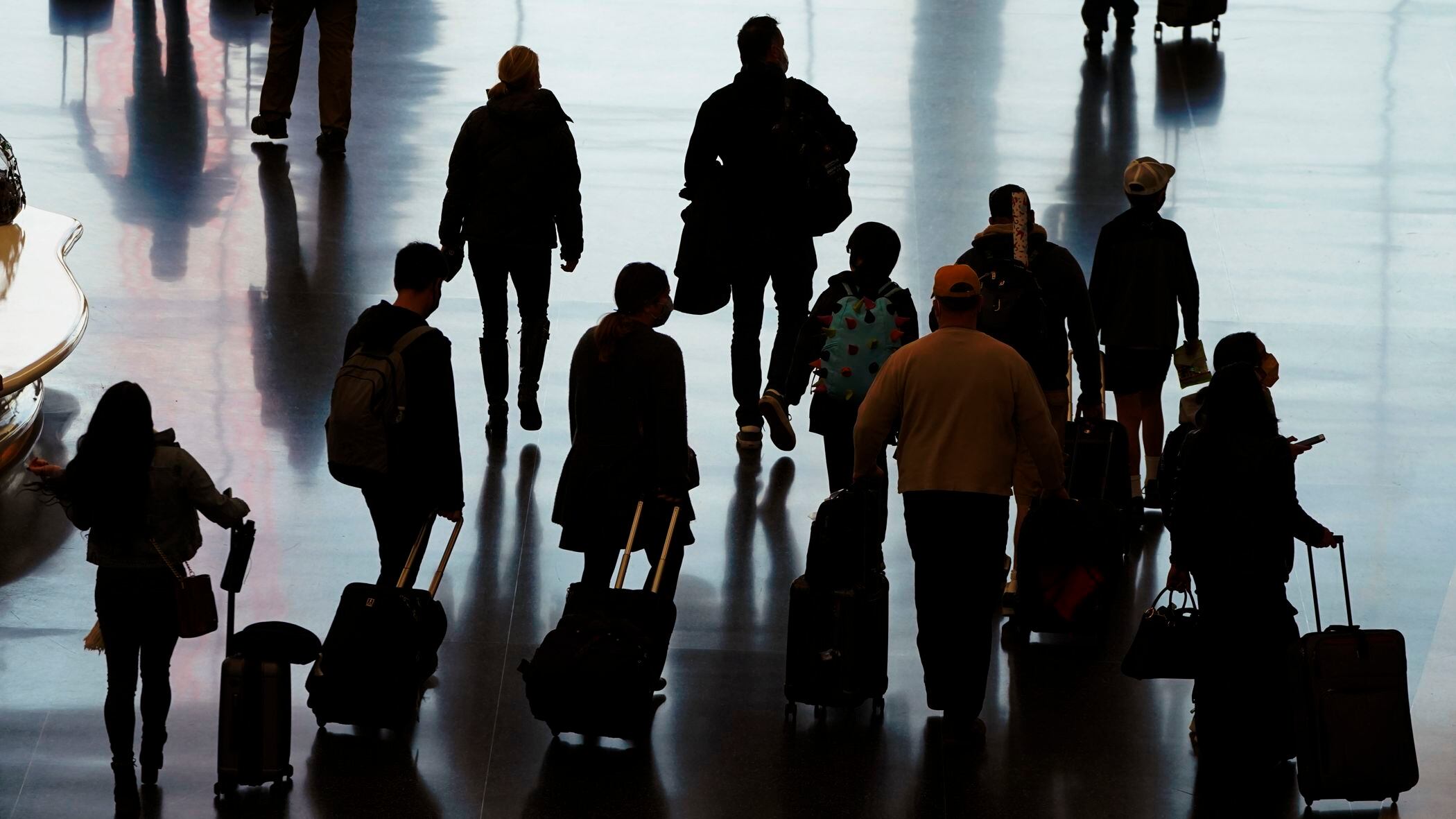
In this Wednesday, Nov. 25, 2020 file photo, travelers walk through the Salt Lake City International Airport in Salt Lake City, a day before Thanksgiving. On Wednesday, Dec. 2, 2020, the U.S. Centers for Disease Control and Prevention are urging Americans to stay home over the upcoming holiday season and consider getting tested before and after if they do decide to travel. (AP Photo/Rick Bowmer)
By Lindsey Tanner
Don’t travel over the upcoming holidays. But if you must, consider getting coronavirus tests before and after, U.S. health officials urged Wednesday.
The agency also announced new guidelines that shorten recommended quarantines after close contact with someone infected with coronavirus. The agency said the risk in a shorter quarantine is small, but that the change makes following the guidance less of a hardship.
The no-travel advice echoes recommendations for Thanksgiving but many Americans ignored it. With COVID-19 continuing to surge, the CDC added the testing option.
“Cases are rising, hospitalizations are increasing, deaths are increasing. We need to try to bend the curve, stop this exponential increase,” the CDC's Dr. Henry Walke said during a briefing.
He said any travel-related surge in cases from travel would likely be apparent about a week to 10 days after Thanksgiving.
The virus has infected more than 13.5 million Americans and killed at least 270,000 since January.
“The safest thing to do is to postpone holiday travel and stay home," said Dr. Cindy Friedman, another CDC official. "Travel volume was high over Thanksgiving,'' and even if small numbers were infected, that could result in ’’hundreds of thousands of new infections.”
‘’Travel is a door-to-door experience that can spread the virus during the journey and also into communities that travelers visit or live," she added.
For those who decide to travel, COVID-19 tests should be considered one to three days before the trip and again three to five days afterward, the CDC said. The agency also recommended travelers reduce non-essential activities for a full week after they return or for 10 days if not tested afterward. And it emphasized the importance of continuing to follow precautions including masks, social distancing, and frequent hand-washing.
The revised quarantine guidance says people who have been in contact with someone infected with the virus can resume normal activity after 10 days, or seven days if they receive a negative test result. That’s down from the 14-day period recommended since the pandemic began.
The change is based on extensive modeling by CDC and others, said the agency's Dr. John Brooks..
A Gallup poll finds that now 7.1% of American adults identify as LGBTQ, jumping from 3.5% in 2012. The increase is driven by Generation-Z – those born between 1997 and 2003 – of whom one out of five identify as LGBTQ. Cheddar News speaks with Washington Blade reporter Chris Johnson about the significant shift.
As the Biden administration continues to see the potential for an imminent invasion of Ukraine after contradictory reports of a Russian troop pullback or buildup, Rep. Ami Bera (D-Calif. 7th District), a member of the House Committee on Foreign Affairs, joined Cheddar News to give his insight into the tense situation. "When I was in Ukraine a couple of weeks ago and we were talking with the Ukrainian leadership with President Zelensky, they said we ought to approach Vladimir Putin as though he was a poker player," he said. "So this could be one of those head fakes where he's saying one thing and doing another thing."
The Biden Administration has now issued new guidelines when it comes to carbon capture. The new guidelines handed down this week encouraged the widespread use of climate attacks that traps and stores carbon emissions. The goal here is the process would help keep carbon out of the atmosphere without requiring a whole lot of change by big companies and manufacturing plants. Several scientists say that this method would be crucial to help us decrease the use of carbon emissions by the year 2050. Professor of Civil and Environmental Engineering at Stanford University, Mark Jacobson, joined Cheddar to discuss more.
Natalie Fertig, federal cannabis policy reporter for Politico Pro, joins Cheddar News to discuss the latest in marijuana legalization in the United States.
The Biden administration is launching a new task force to promote the use of 'cleaner' construction materials with lower life cycle emissions. This comes as the White House works to speed up government purchases of greener products. Sweta Chakraborty, climate change expert and U.S. president of "We Don't Have Time," joins Cheddar News to discuss.
Due to the staffing shortages of teachers in New Mexico, the state has been encouraging its National Guard members to fill in as licensed substitutes to keep schools open. Kurt Steinhaus, New Mexico secretary of education, joined Cheddar News to explain the state's stopgap measure amid its lack of teaching professionals. "The first thing they have to go through a fingerprint background check, just like any other substitute new Mexico. The second thing they have to do is go through some online training, and then we provided some in-person professional development about classroom management," Steinhaus explained about the qualifications process.
With contradictory reports about Russian troops pulling back or being added to the border with Ukraine and the expulsion of a U.S. diplomat from Russia, tensions in the region appear to be escalating. Jack Detsch, a Pentagon and national security reporter for Foreign Policy, joined Cheddar News to break down the situation. "Certainly a different tone out of Moscow today and a different tone out of the West. Even as the Kremlin has made the case that troops are moving back, the U.S. is saying that is certainly not the case with the satellite imagery that we have pouring in," he said.
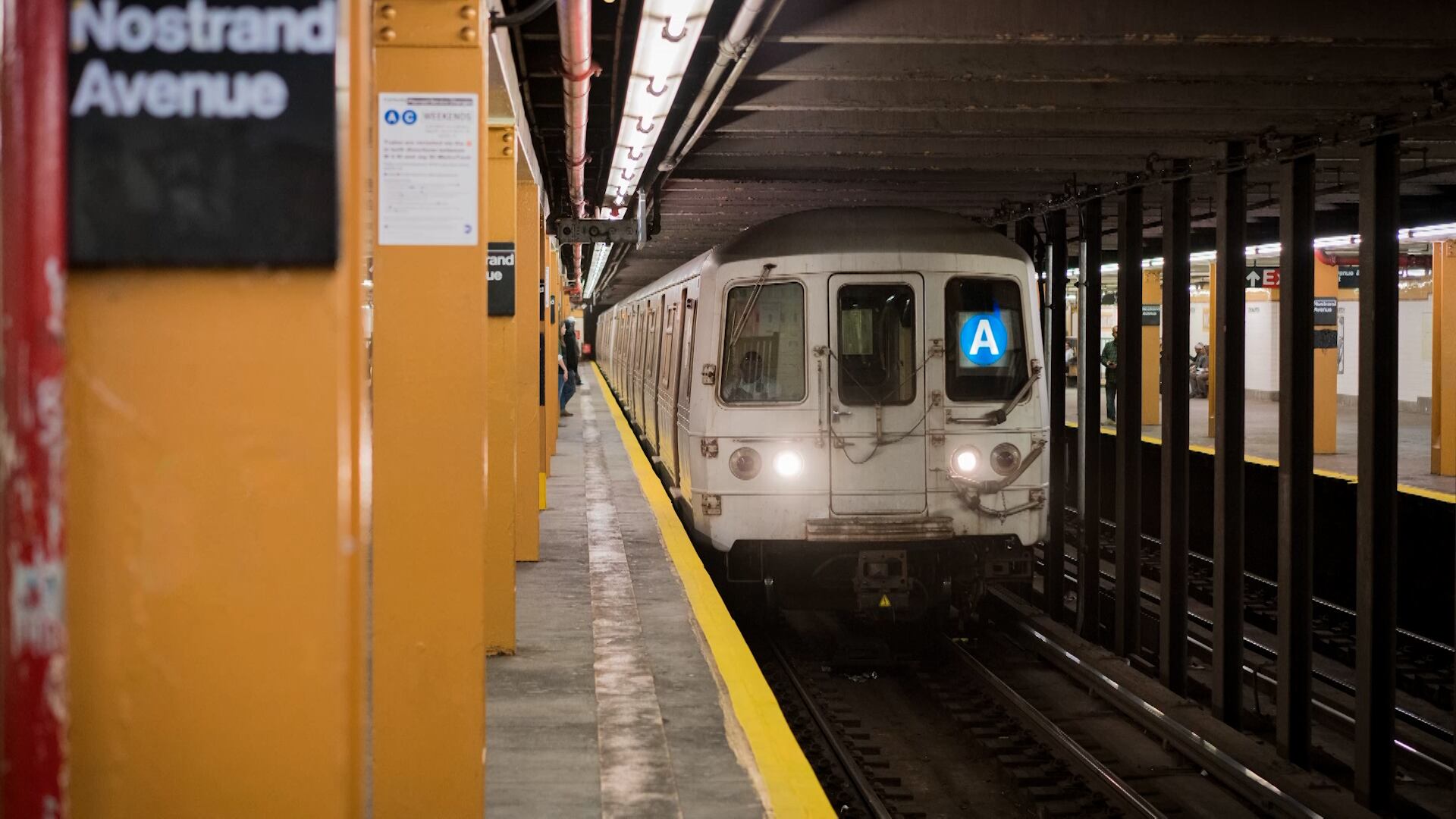
New York City's famous subway system is currently facing scrutiny after several recent attacks on platforms. Now, local leaders in the Big Apple are calling on the MTA. To step in and take action.