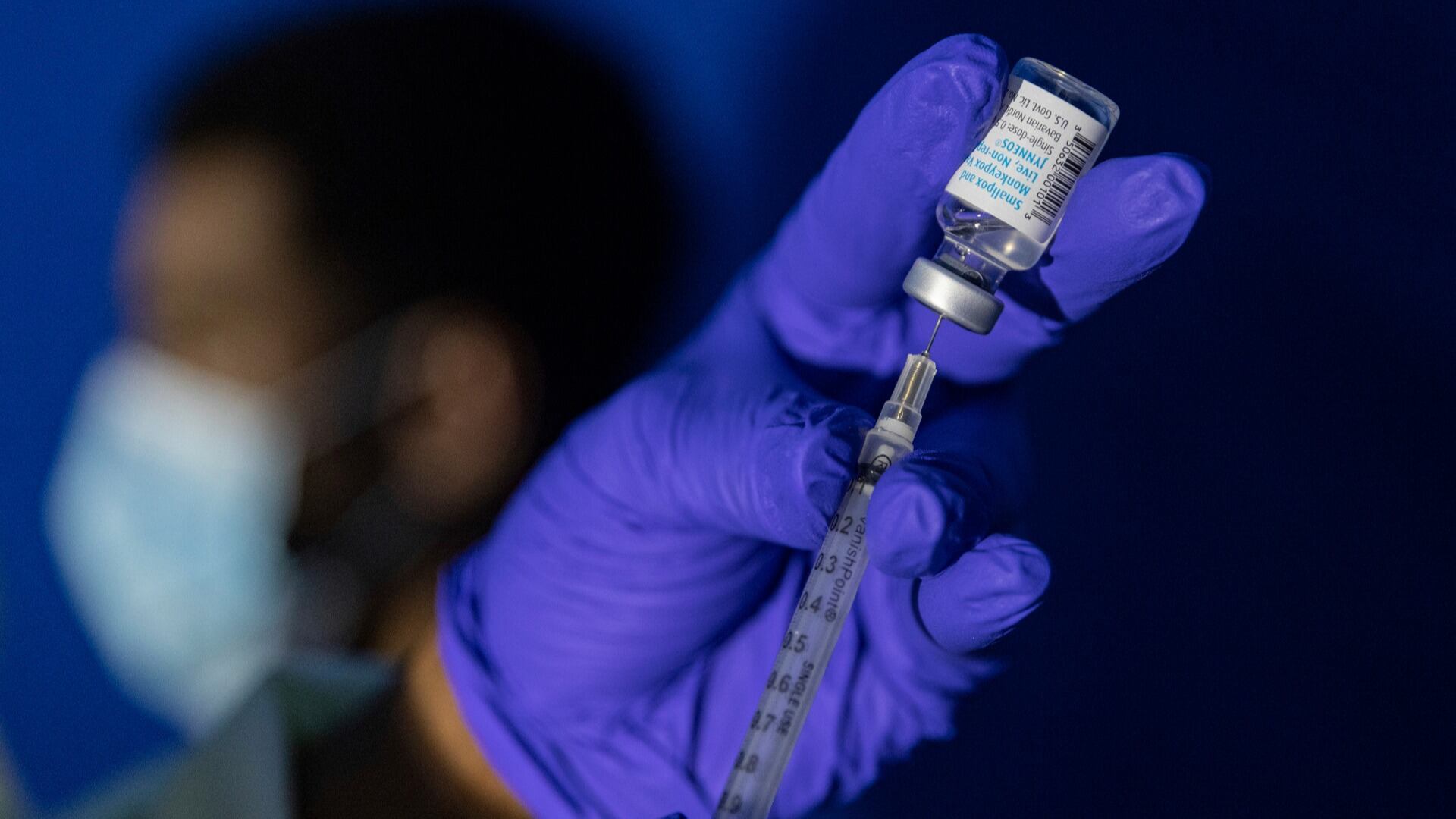
Family nurse practitioner Carol Ramsubhag-Carela prepares a syringe with the Mpox vaccine before inoculating a patient at a vaccinations site on Tuesday, Aug. 30, 2022, in the Brooklyn borough of New York. Africa's public health body said Thursday, Feb. 16, 2023 it hopes Mpox vaccines will finally arrive on the continent "in another two weeks, tops" after months of seeking doses. (AP Photo/Jeenah Moon, File)
An 18-member panel has recommended that adults at risk of contracting mpox should be vaccinated as a precaution.
The Centers for Disease and Control still needs to decide whether or not the agency will accept the recommendation, but if it does, adults over the age of 18 would be advised to get vaccinated.
"The recent outbreak has highlighted again the risks that infectious diseases can present to our communities, the importance of a robust public health response at the state and local level, the value of engaged partners and communities in responding to public health threats and the impact that a vaccine can have in helping bring an outbreak under control," Dr. Melinda Wharton, the CDC associate director for vaccine policy, told CNN.
The vote comes after an mpox outbreak swept the U.S. in the summer of 2022 and popped up in other countries where no cases had been reported for decades.
The Jynneos mpox vaccine, which is a two-dose treatment, has an efficacy rate of 83 percent and was approved for emergency use in August when nearly 450 new cases were being reported daily. The highest reported cases were among sexually active gay and bisexual men.
While the amount of daily reported cases has dwindled drastically since the previous summer — down to just two per day — it is still higher than what the U.S. reported in recent years.
"We do not think that this outbreak is over, and that's very important to keep in mind," Dr. Agam Rao, medical officer in the CDC's Division of High Consequence Pathogens and Pathology, said.
Experts say that at some point next year, the pandemic will officially drop its pandemic status, becoming endemic. While this is a milestone to acknowledge, it does not mean we're free of infections, illnesses, and deaths. Dr. Rajeev Fernando, infectious disease specialist, Beth Israel Hospital and fellow, joins Cheddar News' Closing Bell to discuss.
Chicago-based Internist Dr. Vivek Cherian joined Wake Up With Cheddar to break down the unprecedented surge in U.S. COVID-19 as many prepare to celebrate the new year.
Dr. Soumi Eachempati, co-founder and CEO of Cleared4 and former professor of surgery and public health at Weill Cornell Medical College, joined Cheddar to breakdown what people should know about the recently FDA-approved emergency use of Merck and Pfizer's COVID-19 treatment pills. He noted that not only do people need to be aware of other medications they are taking that could cause adverse effects if coupled with COVID-19 pill treatments, he also talked about the intense in-take regiment. "The Merck pills are actually about 40 pills over five days. The Pfizer ones are three pills over five days, so people have to be prepared for that because it is a lot of pills you'll have to take to get full value from these drugs," Eachempati told Cheddar.
Twitter is exploding with a new meme after the CDC revised its Covid-19 guidelines, shortening the recommended isolation period to five days instead of 10 for when you test positive and are asymptomatic. The change came amid a skyrocketing surge of new cases is the U.S. due to the Omicron variant, drawing criticism from experts and Twitter --with users claiming the government agency is giving funny advise on a variety of issues. But what does the meme say about the public’s trust in the agency? Cheddar News speaks with political strategist Hastie Afkhami.
The list of questions should be getting shorter as we enter the pandemic's third year, but that isn't the case. There's another question to add to that list: is the U.S. doing enough to track the virus and its variants? Lawrence Gostin, faculty director of the O'Neill Institute for national and global health law at Georgetown University, joins Cheddar News.
As we prepare to ring in the new year, COVID cases are hitting an all-time high. Dr. Anthony Fauci has said the safest way to celebrate would be a small gathering with vaccinated family members only... far from the large, flashy parties from a few years ago. Dr. Christina Johns, senior medical advisor at PM Pediatrics, joins Cheddar News to discuss how to celebrate safely.