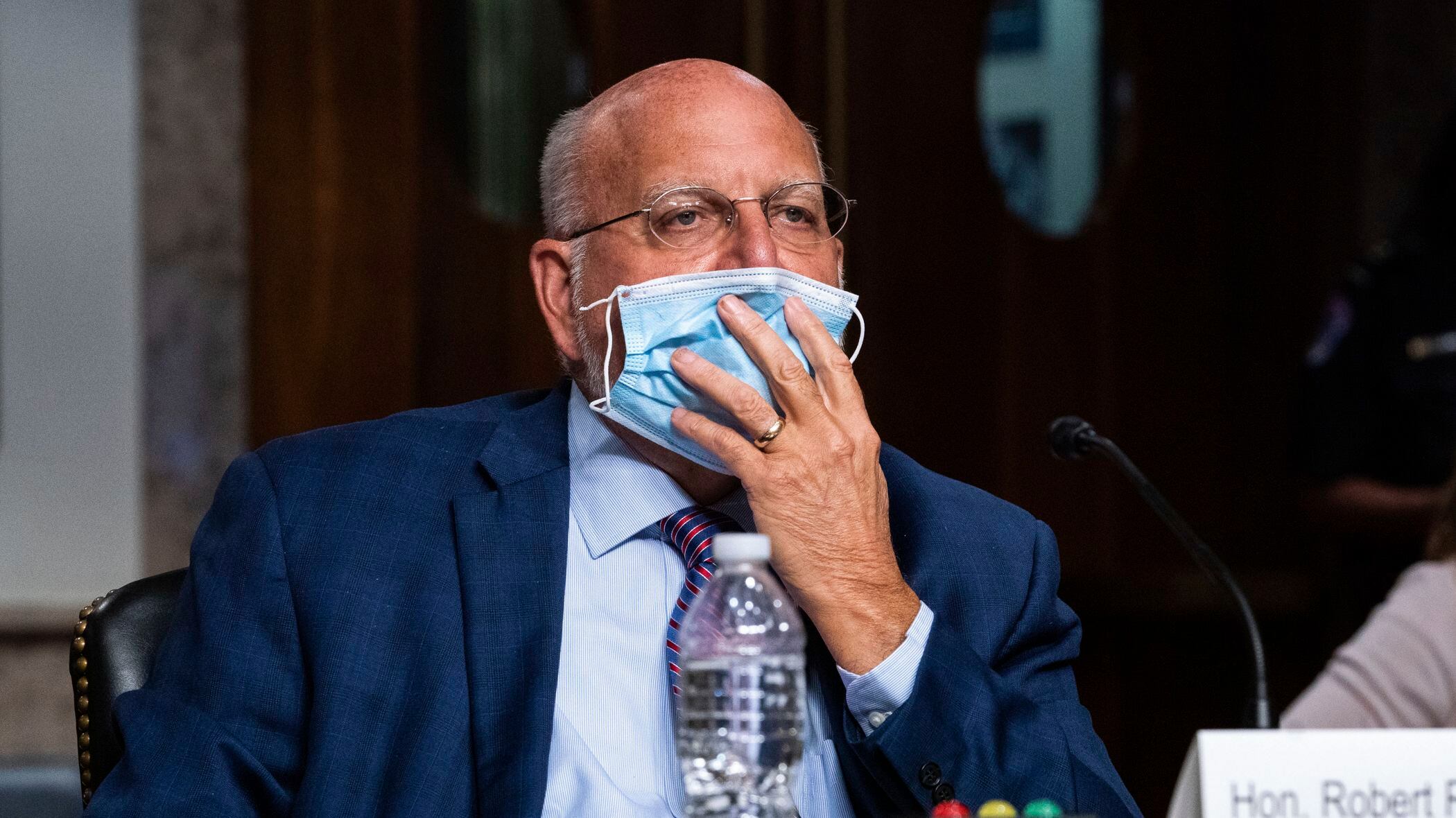
Dr. Robert Redfield, director of the Centers for Disease Control and Prevention testifies at a hearing with the Senate Appropriations Subcommittee on Labor, Health and Human Services, Education, and Related Agencies, on Capitol Hill in Washington, Wednesday, Sept. 16, 2020. (Anna Moneymaker/New York Times, Pool via AP)
By Mike Stobbe
U.S. health officials on Friday dropped a controversial piece of coronavirus guidance and said anyone who has been in close contact with an infected person should get tested.
The Centers for Disease Control and Prevention essentially returned to its previous testing guidance, getting rid of language posted last month that said people didn't need to get tested if they didn't feel sick. That change had set off a rash of criticism from health experts who couldn't fathom why the nation's top public health agency would say such a thing amid the pandemic.
It was "not consistent with the basic principles of controlling an epidemic," said Dr. Silvia Chiang, a pediatric infectious diseases expert at Brown University who applauded the change announced Friday.
The CDC now says anyone who has been within 6 feet of an infected person for at least 15 minutes should get a test. In a statement, the agency called the changes a "clarification" that was needed "due to the significance of asymptomatic and pre-symptomatic transmission."
Agency officials declined additional comment.
Health officials were evasive about why they had made the change in August, and some outside observers speculated it was forced on the CDC by political appointees within the Trump administration.
At the time, administration officials said the language originated at the CDC but the decision came out of meetings of the White House coronavirus task force. Dr. Brett Giroir, an assistant secretary at the Department of Health and Human Services, said many federal leaders outside the agency were involved in "lots of editing, lots of input." He said it was difficult to attribute the final language to any one source.
The New York Times, citing internal federal documents and unnamed sources, on Thursday reported that the guidance was placed on the CDC's website over the objections of agency scientists.
Public health experts have noted that testing the contacts of infected people is a core element of efforts to keep outbreaks in check and that a large percentage of those infected with the coronavirus exhibit no COVID-19 symptoms.
The CDC's chief, Dr. Robert Redfield, issued a statement shortly after the controversy erupted that did little to clarify why the change was deemed necessary. The main intent seemed to be to assure state health officials that they could continue to recommend that all close contacts be tested if they felt that was wisest, despite the website language that said it was not necessary.
During a U.S. Senate hearing on Wednesday, Redfield continued to defend the language that was dropped Friday. He said the August changes had been "misinterpreted" and were part of an effort to increase engagement by doctors and local health officials in the handling of potential illness clusters.
___
The Associated Press Health and Science Department receives support from the Howard Hughes Medical Institute's Department of Science Education. The AP is solely responsible for all content.
David Nelson, Chief Strategist at Belpointe, joins Cheddar News' Closing Bell, where he says that Wednesday's market movement shows a rotation back into the industries that were hit hard in January, but says his eyes are firmly fixed on the January CPI data set to be released Thursday.
Russia is preparing alongside Belarus for reportedly one of the largest joint military exercises ever held. Some analysts are concerned this could be a disguise for a real attack, while the Kremlin contends that the exercise is meant to confront potential "unprecedented security threats." Christian Whiton, a former State Department senior advisor, joined Cheddar News to break down the still tense situation. "While it could of course be a prelude to invasion, it seems like the Biden administration is signaling that if you look at Europeans, the Germans and Macron … who just met with Putin, they seem to be thinking that maybe this is a show of force by Russia intended at political intimidation, not actual invasion," said Whiton.
Truckers in Canada have blockaded the Ambassador Bridge, the busiest border crossing between Canada and the U.S. protesting a COVID-19 vaccine mandate. Cheddar News spoke with Samir Kapadia, head of trade practice at the Vogal Group, about how this impacts trade between the two countries.
New York City is not only dealing with the ongoing pandemic, it’s also facing a surge in crime. President Biden recently traveled to New York to meet with the city’s new mayor, Eric Adams, to discuss the rise in crime and gun violence.
The president praised Mayor Adams' crimefighting agenda and unveiled a new federal initiative to curb the flow of illegal weapons from the south. Josefa Velásquez, Senior Reporter for THE CITY, joined Cheddar's Fast Forward to talk about how the mayor is battling this increase in crime in his first weeks in office.
The Democratic governors of New Jersey, Connecticut, Delaware, and Oregon say they will lift mask requirements for schools in the coming weeks, reflecting a nationwide shift away from restrictions. Cheddar News speaks with internist Dr. Vivek Cherian whether it's safe to relax the regulation.
Amazon warehouse workers in Alabama are set to begin voting to unionize for a second time after workers at the facility in the town of Bessemer overwhelmingly voted against forming a union during an election early last year; but in November, the National Labor Relations Board overturned the vote, upholding a union challenge of the results which argued that Amazon undermined the conditions for a fair election. Another round of ballots will now be mailed out to works at the warehouse for a so-called re-run election. Director of Labor and Employment Studies at San Francisco State University John Logan and National Field Director for Our Revolution Mike Oles joined Cheddar News' Closing Bell to discuss.
David Daley, author of the book 'Unrigged: How Americans Are Battling Back to Save Democracy,' joins Cheddar News to discuss redistricting battles taking place across the U.S.