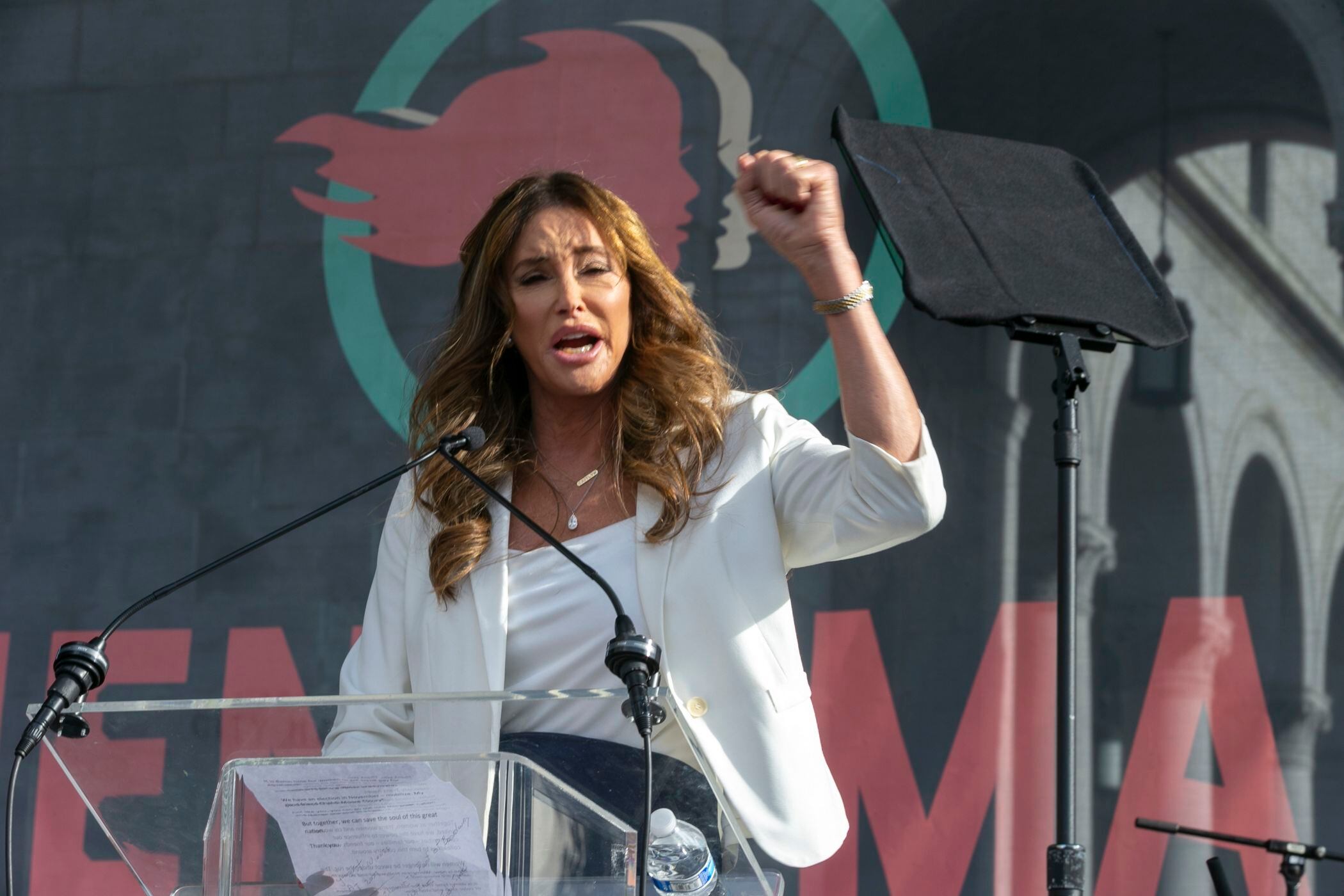
In this Jan. 18, 2020, file photo Caitlyn Jenner speaks at the 4th Women's March in Los Angeles. Jenner has been an Olympic hero, a reality TV personality and a transgender rights activist. Jenner has been consulting privately with Republican advisers as she considers joining the field of candidates seeking to replace Democratic Gov. Gavin Newsom in a likely recall election later this year. (AP Photo/Damian Dovarganes, File)
By Michael R. Blood
Republican Caitlyn Jenner said Friday she will run for governor of California, injecting a jolt of celebrity into an emerging campaign that threatens to oust Democratic Gov. Gavin Newsom from office.
Jenner — an Olympic hero, reality TV personality and a transgender rights activist — said in statement posted on Twitter and on an accompanying website that she has filed initial paperwork to run for the post.
Democratic Gov. Gavin Newsom is facing a likely recall election this year, though election officials are still reviewing petition signatures required to qualify the recall for the ballot. Several other Republicans have also announced plans to run.
In a statement, Jenner called herself “a proven winner” and the only candidate “who can put an end to Gavin Newsom's disastrous time as governor.”
The 71-year-old celebrity activist described herself as “economically conservative, socially progressive” in a People magazine interview last year.
She immediately stands out in an emerging field that so far has failed to attract a nationally known contender. However, Jenner is untested as a candidate and little is known about her positions on critical issues facing the state, from the coronavirus pandemic to managing the economy.
Her run would come nearly two decades after the ascendancy of Arnold Schwarzenegger, another Republican who used his Hollywood fame as a springboard to California's highest office in a 2003 recall election.
If the recall qualifies for the ballot, as expected, voters would be asked two questions: first, whether Newsom should be removed from office. The second would be a list of replacement candidates to choose from, if more than 50% of voters support removing Newsom from office.
The effort largely has been fueled by criticism of Newsom’s handling of the pandemic.
Other Republicans who have announced their intention to run include former San Diego Mayor Kevin Faulconer, former U.S. Rep. Doug Ose and businessman John Cox, who lost to Newsom in the 2018 governor’s race.
Jenner made headlines in recent years with her ties to former President Donald Trump, who remains broadly unpopular in California outside his GOP base. Trump lost the heavily Democratic state to Joe Biden in November by over 5 million votes.
Jenner supported Trump in 2016 but later criticized his administration’s reversal of a directive on transgender access to public school bathrooms. She also criticized Trump after he said transgender people would not be allowed to serve in the U.S. military.
Although still early in development, blockchain technology, Web3, also known as Web 3.0 has been getting a lot of attention from some top tech names lately. Web3 is based on blockchain technology, which powers NFT’s and cryptocurrencies such as bitcoin. With Web3, users would ideally control their own data, rather than have it be controlled by a few large companies. But, Tesla CEO Elon musk isn't buying into Web3 just yet, tweeting over the weekend that the decentralized iteration of the internet seems more like a marketing "buzzword" right now than reality. Twitter co-founder Jack Dorsey also chiming in to the conversation, expressing doubt over whether or not Web3 would actually be decentralized if ownership still belonged to venture capital firms. Parker McCurley, co-founder & CEO of Decent Labs explains the significance of Web3 catching the eye of the tech giants, and what Web3 could mean for the future of the internet.
Carlo and Baker cover the heartening news on the Covid front ahead of the holiday, plus President Biden punting student loan repayments again, a new space telescope and Love, Hate, Ate: Christmas Eve Eve Edition!
This year's worldwide semiconductor shortage limited the supply of everything from new cars to smartphones; and now, many in the chip industry expect the shortage to continue deep into 2022, and maybe even 2023. Semiconductor senior research analyst for Robert W. Baird & Co., Tristan Gerra, joins Cheddar News' Closing Bell to discuss.
Pavel Bains, the Executive Producer of MixMob and CEO of Bluzelle, joins Cheddar News' Closing Bell to elaborate on an opinion piece he wrote for CoinDesk in which he compares the cultural significance of crypto to hip hop in the 1990s.
Direct health care company Nomi Health recently raised $110 million in a Series A round. Nomi Health lets public and private organizations directly purchase healthcare at reduced costs, and pay providers in real-time. It also delivers healthcare directly to under-served communities via its fleet of mobile care units, which the company says is the largest in the country. Nomi Health says its mission is to improve the health care experience for all Americans. Nomi Health CEO Mark Newman joined Cheddar News' Closing Bell to discuss.
Darby Fox, child and adolescent family therapist, joins Cheddar News to discuss how parents can navigate their child's mental wellness during the holidays.
A new series is looking to advance Black founders who have disruptive ideas and companies. 'Bet on Black' is a new series that allows black entrepreneurs to pitch their businesses in the hopes of securing $200,000 in funding. Revolt TV and Target teamed up to create the show. Detavio Samuels, CEO of Revolt, joins Cheddar News to discuss.
Bitcoin's rise to the mainstream has been a wild ride this year. The cryptocurrency is trading a little under $49,000 Wednesday morning and is set to finish the year sharply higher than where it began earlier this year. Ether prices also soared this year, rising from $730 per coin to nearly $4,000. Ben Armstrong, founder of Bitboy Crypto, joins us to discuss what's in store for crypto in 2022.