By Dylan Lovan and Piper Hudspeth Blackburn
Updated 6:00 pm ET
Police said they knocked and announced themselves for a minute or more before bursting into Breonna Taylor’s apartment, but her boyfriend said he did not hear officers identify themselves, according to Kentucky grand jury recordings released Friday. In the hail of gunfire that ensued, the 26-year-old Black woman was killed.
The dramatic and sometimes conflicting accounts of the March 13 raid are key to a case that has fueled nationwide protests against police brutality and systemic racism. When police came through the door using a battering ram, Taylor’s boyfriend, Kenneth Walker, fired once. He acknowledges that he may not have heard police identify themselves because of where he was in the apartment. If he’d heard them, “it changes the whole situation because there’s nothing for us to be scared of.”
The fear and confusion that played out after midnight inside and outside Taylor's Louisville home was detailed in 15 hours of audio recordings made public in a rare release. While the recordings added rich detail about what happened as police fired 32 shots in the last moments of Taylor's life, nothing on them appeared to change the fundamental narrative that was previously made public.
The recordings also do not include any discussion of potential criminal action on the part of the officers who shot Taylor because Kentucky Attorney General Daniel Cameron determined beforehand that they had acted in self-defense. As a result, he did not seek charges against police in her killing — a recommendation the grand jury followed.
Grand jury proceedings are typically kept secret, but a court ruled that they should be made public after the jury's decision last week angered many in Louisville and around the country and set off renewed protests. One of the jurors also sued to make the proceedings public. The material released does not include juror deliberations or prosecutor recommendations and statements, none of which were recorded, according to Cameron's office.
The NAACP Legal Defense and Educational Fund said it will release its own assessment of how the evidence was presented after a review of the recordings. Sherrilyn Ifill, the group's president, said that releasing the recordings “is a critical first step.”
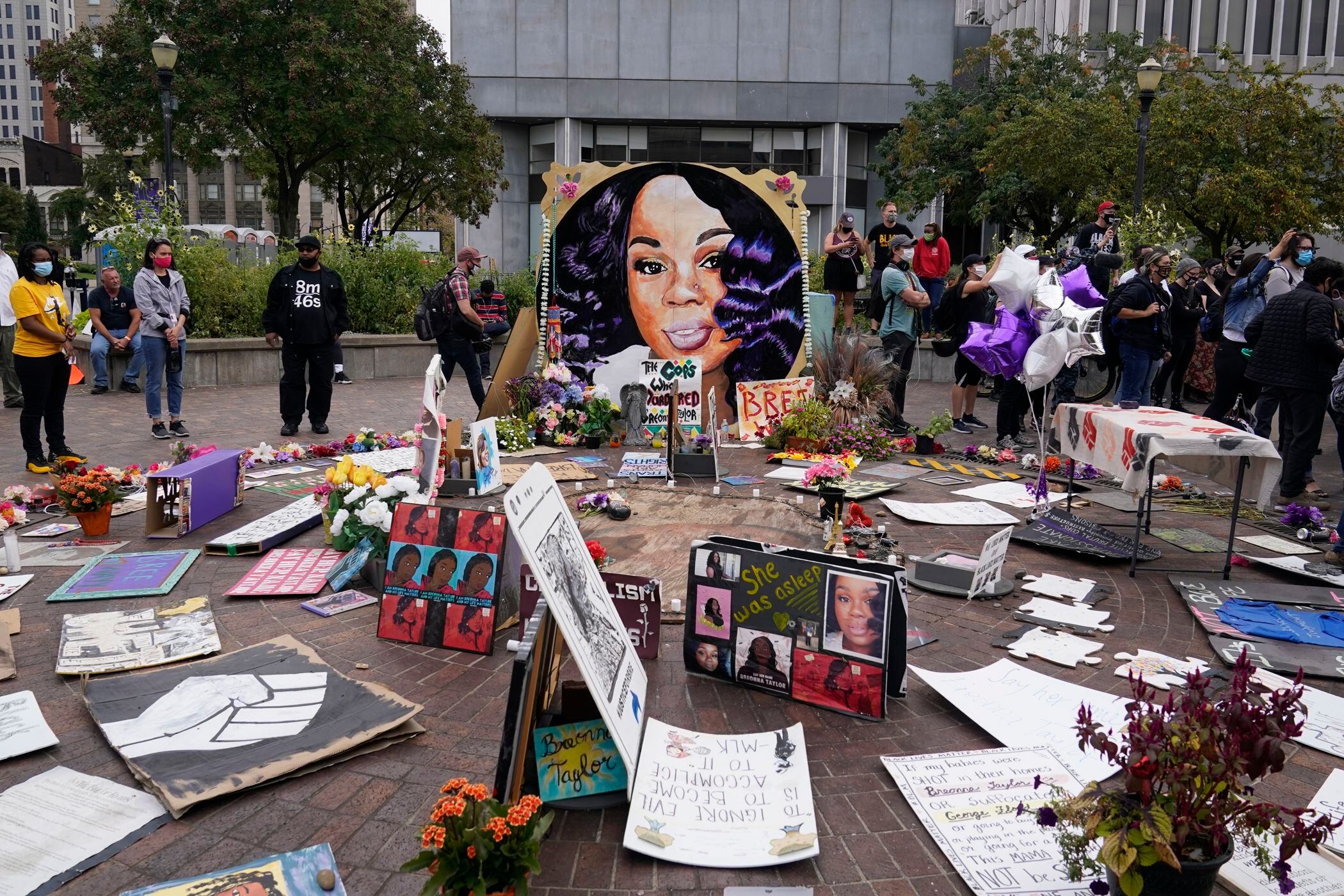
At Jefferson Square Park, where protesters outraged over Taylor's death have gathered for months, a small group gathered in a mood far more subdued than the outcry that followed the grand jury's decision.
On the March night in question, police arrived after midnight at Taylor's apartment with a narcotics warrant to search the home. She and her boyfriend were in bed. Within minutes, she had been shot five times.
Though police had a “no-knock” warrant that would have allowed them to burst in unannounced, they agreed it was better to “give them a chance to answer the door,” said Louisville police Lt. Shawn Hoover. Detective Myles Cosgrove said the officers had been told to “use our maturity as investigators get into this house.”
In a police interview played for the grand jury, Hoover said the officers announced themselves as police and knocked three times. He estimated they waited 45 seconds to a minute before going through the door.
Another officer said they waited as much as two minutes.
Walker said he heard knocking, but that police did not respond to his and Taylor's repeated requests that whoever was at the door identify themselves. He told police that he grabbed his gun, and they both got up and walked toward the door.
“She’s yelling at the top of her lungs, and I am too at this point. No answer. No response. No nothing,” said Walker.
Police said they used a battering ram to enter the apartment, hitting the door three times before getting inside. Detective Michael Nobles said officers made so much noise that an upstairs neighbor came outside.
Walker, who has said he thought the police were intruders, fired once, hitting detective Jonathan Mattingly in the leg as soon as he leaned inside the apartment.
Mattingly said in testimony, some of which was previously released, that he fired his gun while falling on his backside.
Cosgrove came through the door and saw Mattingly on the ground. In his interview with investigators, he spoke to the confusion of the confrontation. He told investigators that he thought he fired four or fewer shots, but the evidence showed he fired 16 rounds, including the bullet that killed Taylor.
Officer Brett Hankison, who has since been fired, told investigators that he saw flashes from a gun coming from inside the apartment and feared his fellow officers were “sitting ducks.” Hankinson said he began shooting, and when gunfire inside the apartment continued, moved to fire through a window. He fired 10 bullets.
Hankinson was the only officer indicted by the grand jury, which charged him with wanton endangerment for shooting into another home with people inside. He has pleaded not guilty.
“What I saw at the time was a figure in a shooting stance, and it looked as if he was holding, he or she was holding, an AR-15 or a long gun, a rifle,” said Hankison.
Walker was, in fact, using a handgun. He said he and Taylor both dropped to the ground when the officers returned fire.
“I’m scared to death,” Walker said, before it dawned on him that it was the police.
Walker said he then looked at Taylor, who was bleeding. Seeking help he called his mother, 911, and then Taylor's mother. Walker told a 911 dispatcher: “Somebody kicked in the door and shot my girlfriend.”
While Walker told police he did not hear officers identify themselves, he also said he doubted he could have, considering the couple was at the opposite end of a long hallway.
“If we knew who it was, that would have never happened,” Walker said.
But Hoover, the police lieutenant, said he believed Walker and Taylor “ambushed” the officers.
“They knew we were there. I mean, hell, the neighbors knew we were there,” he said.
Police interviews with Taylor’s neighbors, however, didn’t clear up the confusion. Two neighbors said they didn’t hear the police knocking. One of them also said he was certain he didn’t hear police identify themselves. Another man gave three differing accounts — in two of them saying he heard officers identify themselves.
After the burst of gunshots, the officers focused on the wounded Mattingly. No one else entered Taylor's apartment until a SWAT team arrived — even as she lay bleeding.
A neighbor, Summer Dickerson, told investigators she was jolted out of bed by the gunshots. Outside the apartment, she said, an officer she recognized told her that “some drug-dealing girl shot at the police.”
Walker initially told police that Taylor was the one who shot at them. He later said he was the one who fired the gun.
One law enforcement officer testified that no drugs were found in the apartment but that police ultimately never executed the search warrant.
___
Associated Press writers from around the country contributed to this report.