By Matthew Lee
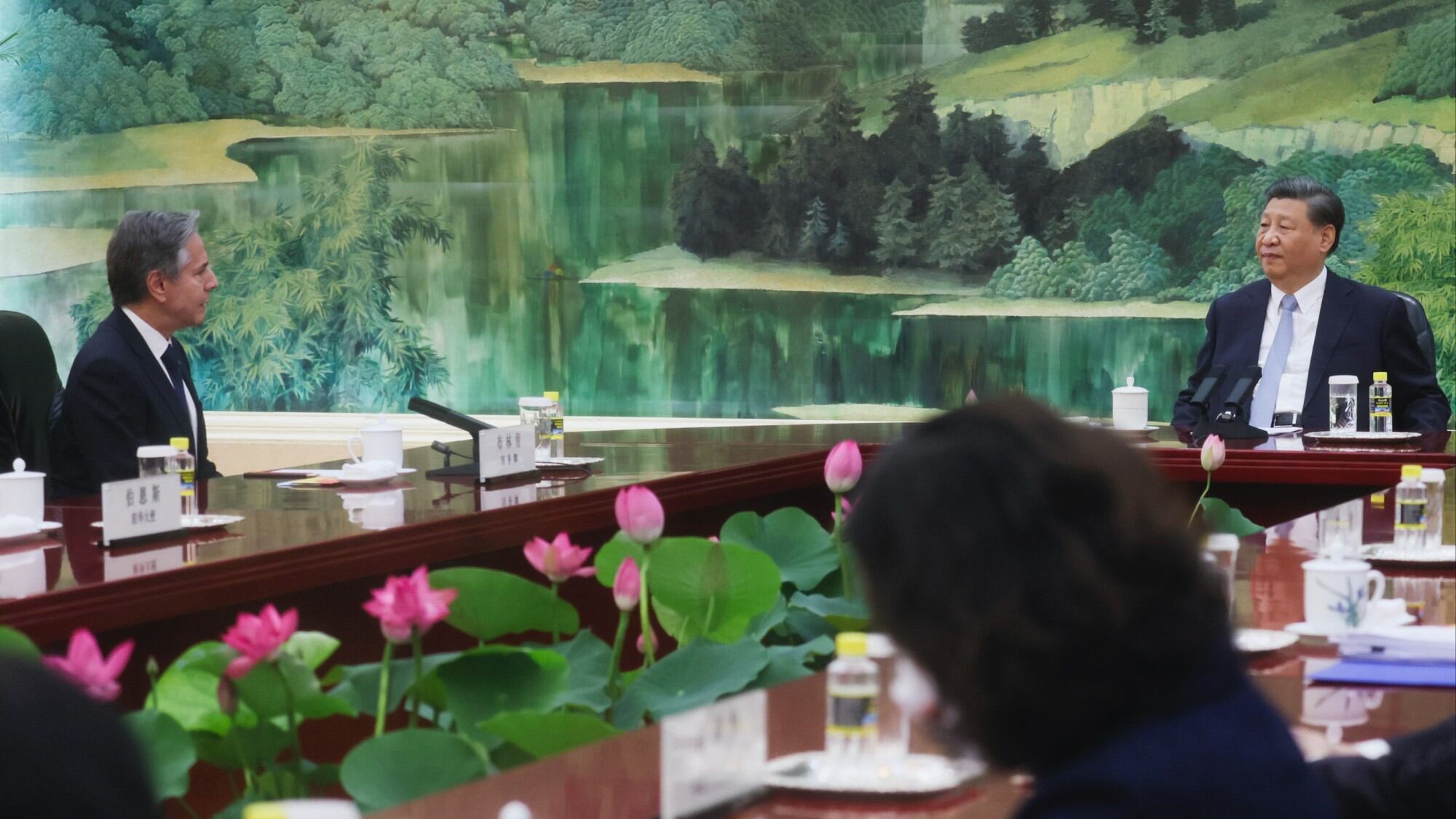
U.S. Secretary of State Antony Blinken met on Monday with Chinese President Xi Jinping and said they agreed to “stabilize” badly deteriorated U.S.-China ties, but America’s top diplomat left Beijing with his biggest ask rebuffed: better communications between their militaries.
After meeting Xi, Blinken said China is not ready to resume military-to-military contacts, something the U.S. considers crucial to avoid miscalculation and conflict, particularly over Taiwan.
Still, China's main diplomat for the Western Hemisphere, Yang Tao, said he thought Blinken's visit to China “marks a new beginning.”
“The U.S. side is surely aware of why there is difficulty in military-to-military exchanges,” he said, blaming the issue squarely on U.S. sanctions, which Blinken said revolved entirely around threats to American security.
Yet Blinken and Xi pronounced themselves satisfied with progress made during the two days of talks, without pointing to specific areas of agreement beyond a mutual decision to return to a broad agenda for cooperation and competition endorsed last year year by Xi and President Joe Biden at a summit in Bali.
And, it remained unclear if those understandings can resolve their most important disagreements, many of which have international implications. Still, both men said they were pleased with the outcome of the highest-level U.S. visit to China in five years.
The two sides expressed a willingness to hold more talks, but there was little indication that either is prepared to bend from positions on issues including trade, Taiwan, human rights conditions in China and Hong Kong, Chinese military assertiveness in the South China Sea, and Russia’s war in Ukraine.
Blinken said later that the U.S. set limited objectives for the trip and achieved them. He told reporters before leaving for a Ukraine reconstruction conference in London that he had raised the issue of military to military communications “repeatedly."
“It is absolutely vital that we have these kinds of communications,” he said. “This is something we’re going to keep working on.”
The U.S. has said that, since 2021, China has declined or failed to respond to over a dozen requests from the Department of Defense for top-level dialogues.
According to a transcript of the meeting with Blinken, Xi said he was pleased with the outcome of Blinken's earlier meetings with top Chinese diplomats and said restarting the Bali agenda were of great importance.
“The Chinese side has made our position clear, and the two sides have agreed to follow through the common understandings President Biden and I had reached in Bali,” Xi said.
That agenda had been thrown into jeopardy in recent months, notably after the U.S. shot down a Chinese surveillance balloon over its airspace in February, and amid escalated military activity in the Taiwan Strait and the South China Sea. Combined with other disputes over human rights, trade and opiate production, the list of problem areas is daunting.
But also Xi suggested the worst could be over.
“The two sides have also made progress and reached agreement on some specific issues,” Xi said without elaborating, according to a transcript of the remarks released by the State Department. “This is very good.”
In his remarks to Xi during the 35-minute session at the Great Hall of the People, a meeting that was expected but not announced until an hour before it started, Blinken said “the United States and China have an obligation and responsibility to manage our relationship.”
“The United States is committed to doing that,” Blinken said. “It’s in the interest of the United States, in the interests of China, and in the interest of the world.”
Blinken described his earlier discussions with senior Chinese officials as “candid and constructive.”
Despite the symbolism of his presence in China, Blinken and other U.S. officials had played down the prospects for any significant breakthroughs on the most vexing issues facing the planet’s two largest economies.
Instead, these officials have emphasized the importance of the two countries establishing and maintaining better lines of communication.
Thus, China's refusal to resume the military-to-military contacts was a hitch.
“Progress is hard,” Blinken told reporters. "It takes time, it takes more than one visit.”
Blinken's trip is expected to herald a new round of visits by senior U.S. and Chinese officials to each other's countries, possibly including a meeting between Xi and Biden in India or the U.S in the coming months.
Before meeting with Xi, Blinken met earlier Monday with China’s top diplomat Wang Yi for about three hours, an encounter that produced a harsh assessment of the talks.
China’s foreign ministry said "it is necessary to make a choice between dialogue or confrontation, cooperation or conflict.” It blamed the “U.S. side’s erroneous perception of China, leading to incorrect policies towards China” for the current “low point” in relations.
And, it said the U.S. bore responsibility for halting “the spiraling decline of China-U.S. relations to push it back to a healthy and stable track." It added that Wang had "demanded that the U.S. stop hyping up the ‘China threat theory,’ lift illegal unilateral sanctions against China, abandon suppression of China’s technological development, and refrain from arbitrary interference in China’s internal affairs.”
In it's readout of the meeting, the State Department said Blinken “underscored the importance of responsibly managing the competition between the United States and the PRC through open channels of communication to ensure competition does not veer into conflict," using the acronym for the People's Republic of China.
In the first round of talks on Sunday, Blinken met for nearly six hours with Chinese Foreign Minister Qin Gang, after which both countries said they had agreed to continue high-level discussions.
Both the U.S. and China said Qin had accepted an invitation from Blinken to visit Washington but Beijing made clear that “the China-U.S. relationship is at the lowest point since its establishment.” That sentiment is widely shared by U.S. officials.
Blinken's visit came after his initial plans to travel to China were postponed in February after the shootdown of a Chinese surveillance balloon over the U.S.
In his meetings, Blinken also pressed the Chinese to release detained American citizens and to take steps to curb the production and export of fentanyl precursors that are fueling the opioid crisis in the United States.
Since the cancellation of Blinken’s trip in February, there have been some high-level engagements. CIA chief William Burns traveled to China in May, while China’s commerce minister traveled to the U.S. And Biden’s national security adviser Jake Sullivan met with senior Chinese foreign policy adviser Wang Yi in Vienna in May.
But those have been punctuated by bursts of angry rhetoric from both countries over the Taiwan Strait, their broader intentions in the Indo-Pacific, China’s refusal to condemn Russia for its war against Ukraine, and U.S. allegations from Washington that Beijing is attempting to boost its worldwide surveillance capabilities, including in Cuba.
And, earlier this month, China’s defense minister rebuffed a request from U.S. Defense Secretary Lloyd Austin for a meeting on the sidelines of a security symposium in Singapore, a sign of continuing discontent.
AP writer Emily Wang contributed.
Updated with latest details.