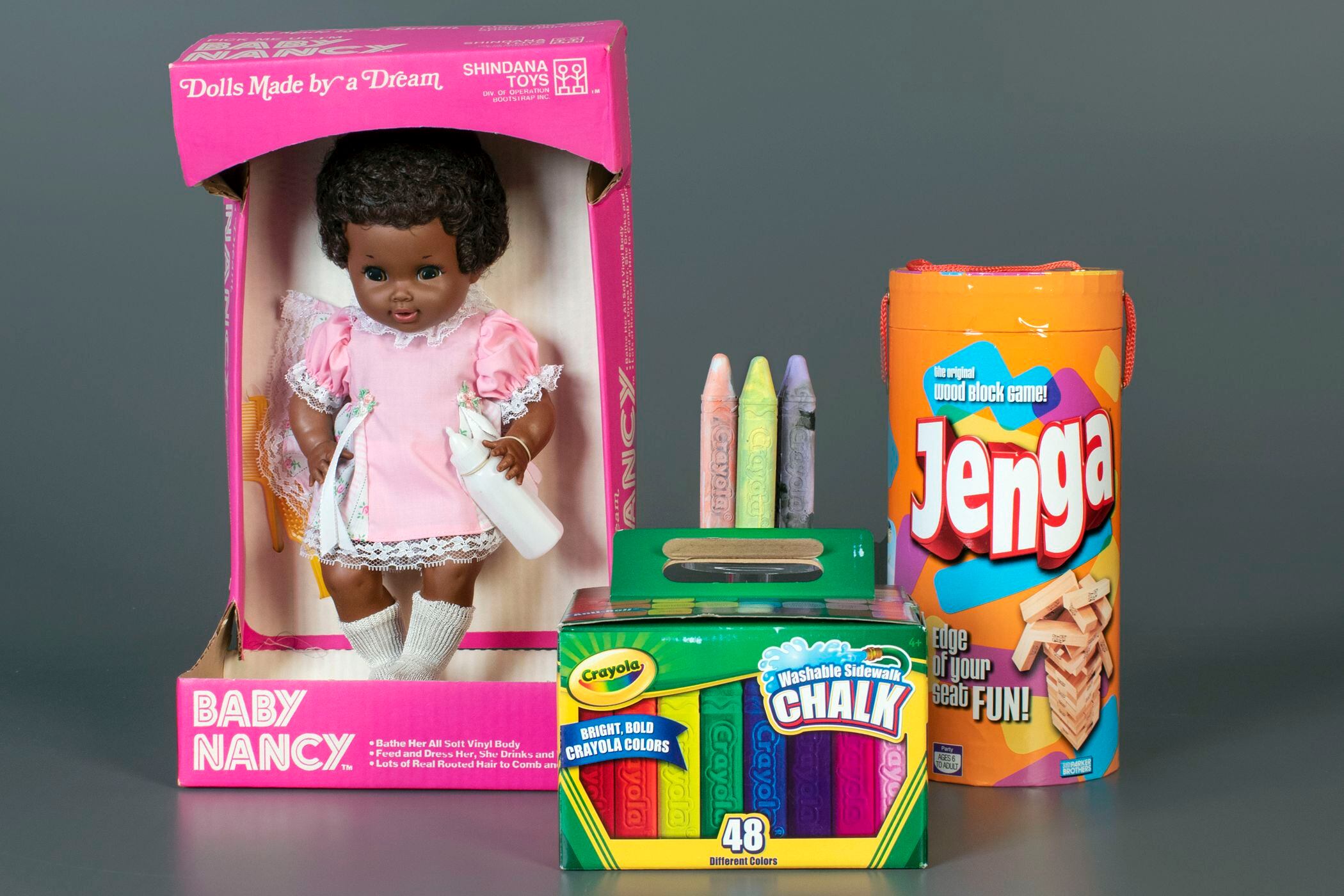
This photo, provided by the National Toy Hall of Fame, shows Baby Nancy, by Shindana Toys; Sidewalk Chalk, by Crayola; and Jenga, by Parker Brothers, left to right, that were inducted into the National Toy Hall of Fame on Thursday, Nov, 5, 2020. The honorees were chosen by a panel of experts from among 12 finalists and will be on permanent display inside The Strong National Museum of Play, in Rochester, New York. (Victoria Gray/National Toy Hall of Fame via AP)
Baby Nancy, the first Black baby doll to have an Afro and other authentic features, was inducted into the National Toy Hall of Fame on Thursday, along with sidewalk chalk and the wooden block game Jenga.
The 2020 honorees were recognized for their creativity and popularity over time.
They were chosen by a panel of experts from among 12 finalists that also included bingo, Breyer Horses, Lite-Brite, Masters of the Universe, My Little Pony, Risk, Sorry!, Tamagotchi, and Yahtzee.
Baby Nancy was the inaugural doll for Shindana Toys, a California company launched in 1968 by Operation Bootstrap Inc., the not-for-profit Black community self-help organization that emerged in the aftermath of the Watts riots in Los Angeles.
By Thanksgiving, Baby Nancy was the bestselling Black doll in Los Angeles, and before Christmas, she was selling nationwide. The toy exposed a long-standing demand for ethnically correct Black dolls, according to the National Toy Hall of Fame, located in The Strong museum in Rochester, New York.
Shindana Toys folded amid financial problems in 1983, but Baby Nancy “still stands as a landmark doll that made commercial and cultural breakthroughs,” curator Michelle Parnett-Dwyer said in a news release.
Another inductee, sidewalk chalk, traces its roots all the way back to Paleolithic cave art found throughout the world, hall officials said.
“There are few limits to what kids can do with chalk. Every sidewalk square, patio, and driveway holds the potential for a work of art, a winning game of strategy and cleverness, or a demonstration of physical agility, poise, and balance," chief curator Christopher Bensch said.
Jenga, the creation of Englishwoman Leslie Scott, was honored for its simplicity and ability to be played by almost anyone. Players take turns removing wooden blocks from a rectangular tower until it collapses. Its name comes from the Swahili verb, kujenga, which means to build.
"It is one of the rare games that’s equally fun for two people or a bigger crowd. It’s perfect for a game party with a group or something more intimate, but either way, it’s always sure to make instant memories,” curator Nicolas Ricketts said.
The three new inductees will be on permanent display at the National Toy Hall of Fame, alongside previous winners that include Barbie and the Hula Hoop. The hall takes nominations from anyone year-round and has inducted a new class each year since 1998.
Marvel's "Spiderman: No Way Home" is the third highest-grossing film of the year and could be the only one to reach the $1 billion mark of 2021 with ticket sales already surpassing $750 million.
Although still early in development, blockchain technology, Web3, also known as Web 3.0 has been getting a lot of attention from some top tech names lately. Web3 is based on blockchain technology, which powers NFT’s and cryptocurrencies such as bitcoin. With Web3, users would ideally control their own data, rather than have it be controlled by a few large companies. But, Tesla CEO Elon musk isn't buying into Web3 just yet, tweeting over the weekend that the decentralized iteration of the internet seems more like a marketing "buzzword" right now than reality. Twitter co-founder Jack Dorsey also chiming in to the conversation, expressing doubt over whether or not Web3 would actually be decentralized if ownership still belonged to venture capital firms. Parker McCurley, co-founder & CEO of Decent Labs explains the significance of Web3 catching the eye of the tech giants, and what Web3 could mean for the future of the internet.
Carlo and Baker cover the heartening news on the Covid front ahead of the holiday, plus President Biden punting student loan repayments again, a new space telescope and Love, Hate, Ate: Christmas Eve Eve Edition!
This year's worldwide semiconductor shortage limited the supply of everything from new cars to smartphones; and now, many in the chip industry expect the shortage to continue deep into 2022, and maybe even 2023. Semiconductor senior research analyst for Robert W. Baird & Co., Tristan Gerra, joins Cheddar News' Closing Bell to discuss.
Pavel Bains, the Executive Producer of MixMob and CEO of Bluzelle, joins Cheddar News' Closing Bell to elaborate on an opinion piece he wrote for CoinDesk in which he compares the cultural significance of crypto to hip hop in the 1990s.
Direct health care company Nomi Health recently raised $110 million in a Series A round. Nomi Health lets public and private organizations directly purchase healthcare at reduced costs, and pay providers in real-time. It also delivers healthcare directly to under-served communities via its fleet of mobile care units, which the company says is the largest in the country. Nomi Health says its mission is to improve the health care experience for all Americans. Nomi Health CEO Mark Newman joined Cheddar News' Closing Bell to discuss.
Darby Fox, child and adolescent family therapist, joins Cheddar News to discuss how parents can navigate their child's mental wellness during the holidays.
A new series is looking to advance Black founders who have disruptive ideas and companies. 'Bet on Black' is a new series that allows black entrepreneurs to pitch their businesses in the hopes of securing $200,000 in funding. Revolt TV and Target teamed up to create the show. Detavio Samuels, CEO of Revolt, joins Cheddar News to discuss.