A group of bipartisan lawmakers are working to celebrate the centennial anniversary of women's suffrage next year with the founding of a new museum dedicated entirely to the accomplishments of women in the U.S.
"It is difficult to empower women, if you don't even recognize them," said Rep. Carolyn Maloney (D-N.Y.), the author of the pending Smithsonian Women's History Museum Act.
"What better way of inspiring young women — and men — than by knowing the contributions of those that went ahead."
If passed, the bill will establish a new national museum that showcases and honors women's historical achievements in a variety of fields including art, science, and the military, among others. The legislation currently has 293 co-sponsors in the House.
"Women's contributions to the development of our nation and society are immense," Rep. Brian Fitzpatrick (R-Pa.) said in a statement. "As the first museum in the United States dedicated to the full story of women's history, this museum will tell the diverse story of the women who helped shape America."
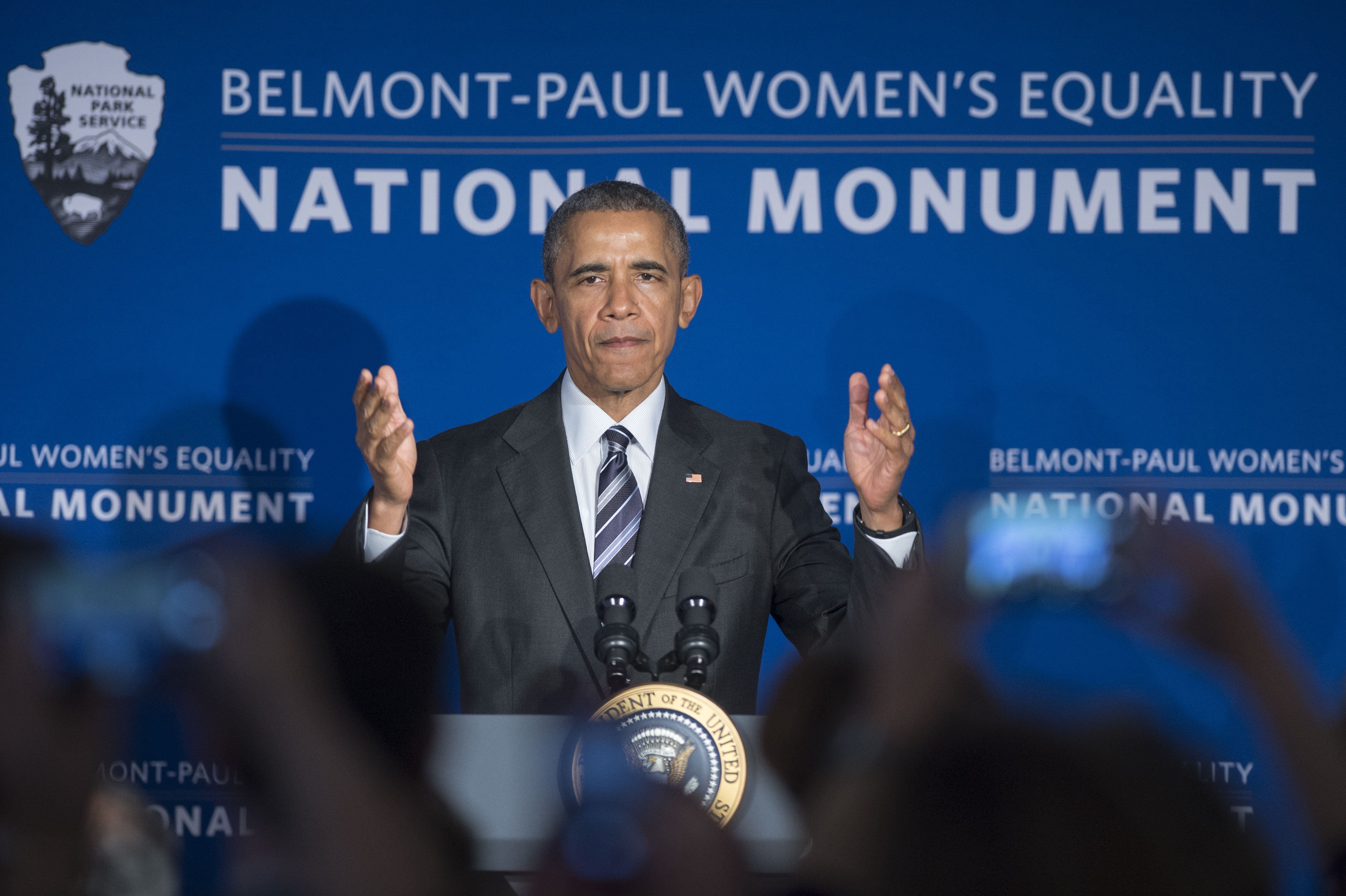
The lawmakers stress that the museum is vital for accurately depicting U.S. history, which is dominated by the achievements of men and ignores those of women. The legislation notes, for instance, that only 9 out of 91 statues in the U.S. Capitol's National Statuary Hall are of women and cites a study that found only 10 percent of American history textbooks detail the contributions of women. The bill also mentions how only one out of the National Park Service's 44 national monuments honor women: the Belmont-Paul Women's Equality National Monument, which President Obama designated in 2016.
"The American people need and deserve a museum dedicated to telling the story of American women," Jane Abraham, the chair of the American Museum of Women's History Congressional Commission, said in a statement. "Women's history is as rich as it is vast and to truly learn about and celebrate our country's history, women's contributions must be showcased in a dedicated museum."
<i>President Obama at the inauguration of the Belmont-Paul Women's Equality National Monument in 2016. The historic house was designated to honor National Woman's Party benefactor Alva Belmont and founder Alice Paul. Photo Credit: Shutterstock</i>
The House bill was also accompanied by a Senate version that was co-sponsored by Sens. Susan Collins (R-Maine) and Dianne Feinstein (D-Calif.). Both bills were introduced in March to coincide with Women's History Month
"American women have made invaluable contributions to our country in every field, such as government, business, medicine, law, literature, sports, entertainment, the arts, and the military," Collins said in a statement. "A museum dedicated to women's history would help ensure that future generations understand what we owe to those American women who have helped build, sustain, and advance our society."
Sen. Feinstein added that a Smithsonian museum "would be a fitting and long-overdue way to properly recognize women's contributions to our nation's narrative."
Neither bill is scheduled for a vote in Congress, yet supporters aim to pass the legislation by the end of 2020 to honor the passing of the 19th Amendment, which granted women the right to vote in the U.S.
Marvel's "Spiderman: No Way Home" is the third highest-grossing film of the year and could be the only one to reach the $1 billion mark of 2021 with ticket sales already surpassing $750 million.
Although still early in development, blockchain technology, Web3, also known as Web 3.0 has been getting a lot of attention from some top tech names lately. Web3 is based on blockchain technology, which powers NFT’s and cryptocurrencies such as bitcoin. With Web3, users would ideally control their own data, rather than have it be controlled by a few large companies. But, Tesla CEO Elon musk isn't buying into Web3 just yet, tweeting over the weekend that the decentralized iteration of the internet seems more like a marketing "buzzword" right now than reality. Twitter co-founder Jack Dorsey also chiming in to the conversation, expressing doubt over whether or not Web3 would actually be decentralized if ownership still belonged to venture capital firms. Parker McCurley, co-founder & CEO of Decent Labs explains the significance of Web3 catching the eye of the tech giants, and what Web3 could mean for the future of the internet.
Carlo and Baker cover the heartening news on the Covid front ahead of the holiday, plus President Biden punting student loan repayments again, a new space telescope and Love, Hate, Ate: Christmas Eve Eve Edition!
This year's worldwide semiconductor shortage limited the supply of everything from new cars to smartphones; and now, many in the chip industry expect the shortage to continue deep into 2022, and maybe even 2023. Semiconductor senior research analyst for Robert W. Baird & Co., Tristan Gerra, joins Cheddar News' Closing Bell to discuss.
Pavel Bains, the Executive Producer of MixMob and CEO of Bluzelle, joins Cheddar News' Closing Bell to elaborate on an opinion piece he wrote for CoinDesk in which he compares the cultural significance of crypto to hip hop in the 1990s.
Direct health care company Nomi Health recently raised $110 million in a Series A round. Nomi Health lets public and private organizations directly purchase healthcare at reduced costs, and pay providers in real-time. It also delivers healthcare directly to under-served communities via its fleet of mobile care units, which the company says is the largest in the country. Nomi Health says its mission is to improve the health care experience for all Americans. Nomi Health CEO Mark Newman joined Cheddar News' Closing Bell to discuss.
Darby Fox, child and adolescent family therapist, joins Cheddar News to discuss how parents can navigate their child's mental wellness during the holidays.
A new series is looking to advance Black founders who have disruptive ideas and companies. 'Bet on Black' is a new series that allows black entrepreneurs to pitch their businesses in the hopes of securing $200,000 in funding. Revolt TV and Target teamed up to create the show. Detavio Samuels, CEO of Revolt, joins Cheddar News to discuss.