A group of bipartisan lawmakers are working to celebrate the centennial anniversary of women's suffrage next year with the founding of a new museum dedicated entirely to the accomplishments of women in the U.S.
"It is difficult to empower women, if you don't even recognize them," said Rep. Carolyn Maloney (D-N.Y.), the author of the pending Smithsonian Women's History Museum Act.
"What better way of inspiring young women — and men — than by knowing the contributions of those that went ahead."
If passed, the bill will establish a new national museum that showcases and honors women's historical achievements in a variety of fields including art, science, and the military, among others. The legislation currently has 293 co-sponsors in the House.
"Women's contributions to the development of our nation and society are immense," Rep. Brian Fitzpatrick (R-Pa.) said in a statement. "As the first museum in the United States dedicated to the full story of women's history, this museum will tell the diverse story of the women who helped shape America."
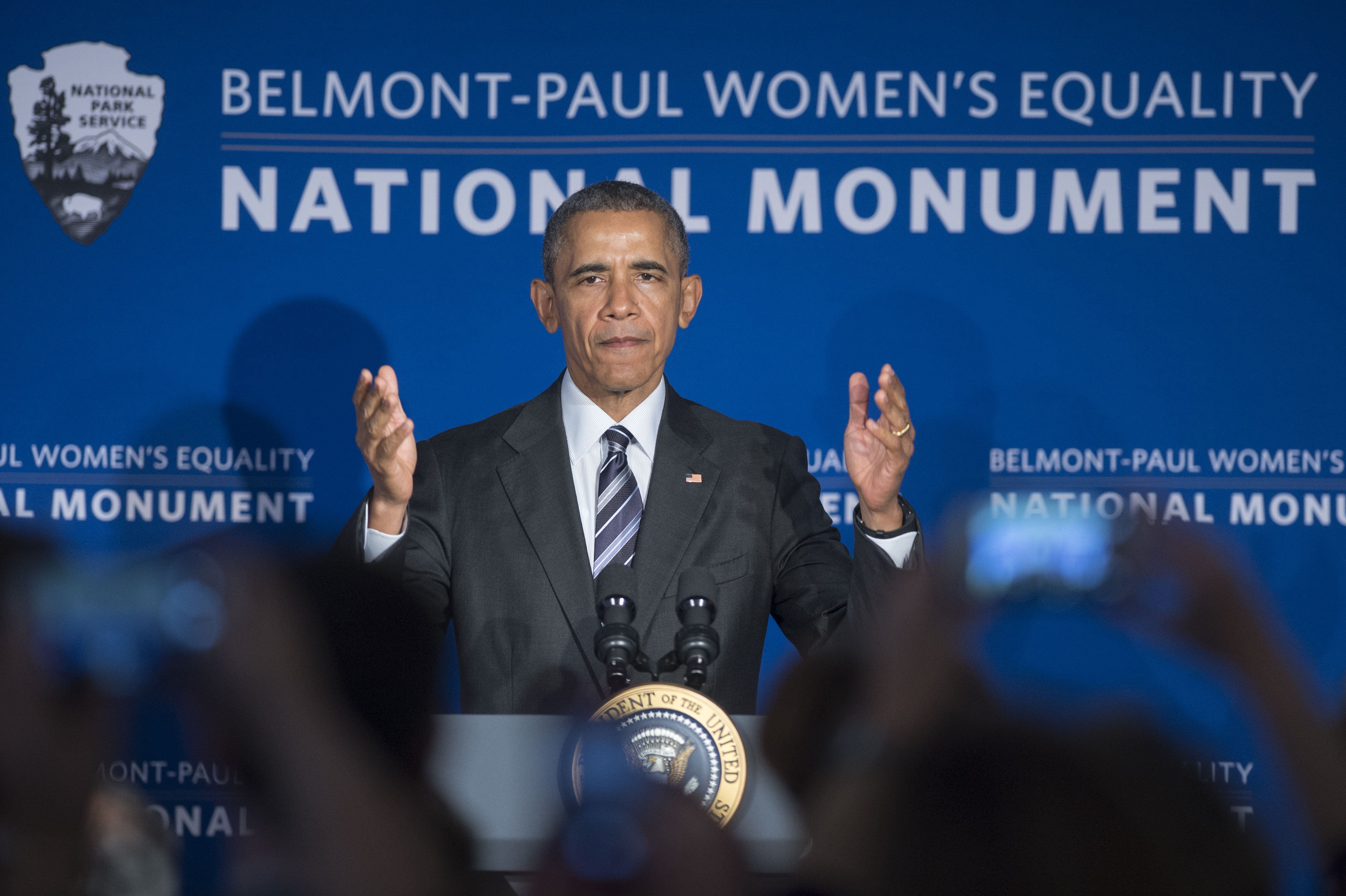
The lawmakers stress that the museum is vital for accurately depicting U.S. history, which is dominated by the achievements of men and ignores those of women. The legislation notes, for instance, that only 9 out of 91 statues in the U.S. Capitol's National Statuary Hall are of women and cites a study that found only 10 percent of American history textbooks detail the contributions of women. The bill also mentions how only one out of the National Park Service's 44 national monuments honor women: the Belmont-Paul Women's Equality National Monument, which President Obama designated in 2016.
"The American people need and deserve a museum dedicated to telling the story of American women," Jane Abraham, the chair of the American Museum of Women's History Congressional Commission, said in a statement. "Women's history is as rich as it is vast and to truly learn about and celebrate our country's history, women's contributions must be showcased in a dedicated museum."
<i>President Obama at the inauguration of the Belmont-Paul Women's Equality National Monument in 2016. The historic house was designated to honor National Woman's Party benefactor Alva Belmont and founder Alice Paul. Photo Credit: Shutterstock</i>
The House bill was also accompanied by a Senate version that was co-sponsored by Sens. Susan Collins (R-Maine) and Dianne Feinstein (D-Calif.). Both bills were introduced in March to coincide with Women's History Month
"American women have made invaluable contributions to our country in every field, such as government, business, medicine, law, literature, sports, entertainment, the arts, and the military," Collins said in a statement. "A museum dedicated to women's history would help ensure that future generations understand what we owe to those American women who have helped build, sustain, and advance our society."
Sen. Feinstein added that a Smithsonian museum "would be a fitting and long-overdue way to properly recognize women's contributions to our nation's narrative."
Neither bill is scheduled for a vote in Congress, yet supporters aim to pass the legislation by the end of 2020 to honor the passing of the 19th Amendment, which granted women the right to vote in the U.S.
Daniel Loría, SVP content strategy and editorial director at Boxoffice Media, joins Cheddar News to discuss what helped 'Scream' score number one at the box office and what it means for the horror genre.
Dave Levinthal, deputy Washington Bureau chief at Insider, joins Cheddar News to discuss Gallup's new survey that reveals more Americans leaned Republican by the end of 2021.
L’Oréal is doubling down on its investment in tech. The French beauty giant unveiled two new high-tech products ahead of CES 2022, aimed at simplifying the hair coloring process. Guive Balooch, global vice president of L’Oréal Technology Incubator, joined Cheddar's Opening Bell to discuss the company's innovations for hair coloring, including the Colorsonic application device and the Coloright AI diagnostic tool.
After meeting by chance in an airport, legendary actor Bill Murray and world-renowned cellist Jan Vogler joined forces to put out an album of poetry and music, go on a European concert tour, and release a feature documentary. Murray and Vogler joined Cheddar to dish about the experiences taking their “New Worlds: The Cradle of Civilization" on the road and filming the documentary that followed the pair, along with Mira Wang on violin and Vanessa Perez on piano, at their final show in Greece. "When this opportunity to play with Jan and Mira and Vanessa came along, I thought, well how bad can I be with these people behind me," Murray self-deprecatingly noted about his own musical talents.
On this episode of Cheddar Reveals: Director of Programs at Alpine Ascents breaks down how to mentally and physically prepare for climbing Mount Everest; American Himalayan Foundation's Vice President discusses Sherpa culture and ethos, and why they are so critical to the climb; A look at Curiosity Stream's 'History by the Numbers.'
All around the world, speed limits are placed on public roads to promote car safety and save lives. In that same world, car manufacturers have continued to look for ways to build faster and faster cars. Despite the dangers of speeding, many drivers are guilty of pushing the pedal from time to time. With cars being such a prevalent culture in everyday life, especially in the US, it’s worth wondering what it would take for car companies to once and for all settle the argument of safety versus freedom.
A recent study by MSI uncovers a vast racial divide in influencer marketing. The research found a 35% racial pay gap between white and black influencers. This gap is extremely wider than the gap in other industries such as education, business, and finance. The research also suggests that brands and agencies have the power to close this gap. Tiffany Hardin, founder and CEO of Gild Creative Group, joins Cheddar News to discuss.
Student loan collection company Navient agreed to cancel $1.7 billion in debt and paid more than $140 million in other penalties to settle a lawsuit over abusive lending practices. Josh Shapiro, the attorney general of Pennsylvania who led negotiations in the settlement, joined Cheddar to go over the details of the company's predatory lending. "What Navient would do is charge [borrowers] these exorbitantly high rates, even though they knew people couldn't pay them or they would likely default on them," he explained.