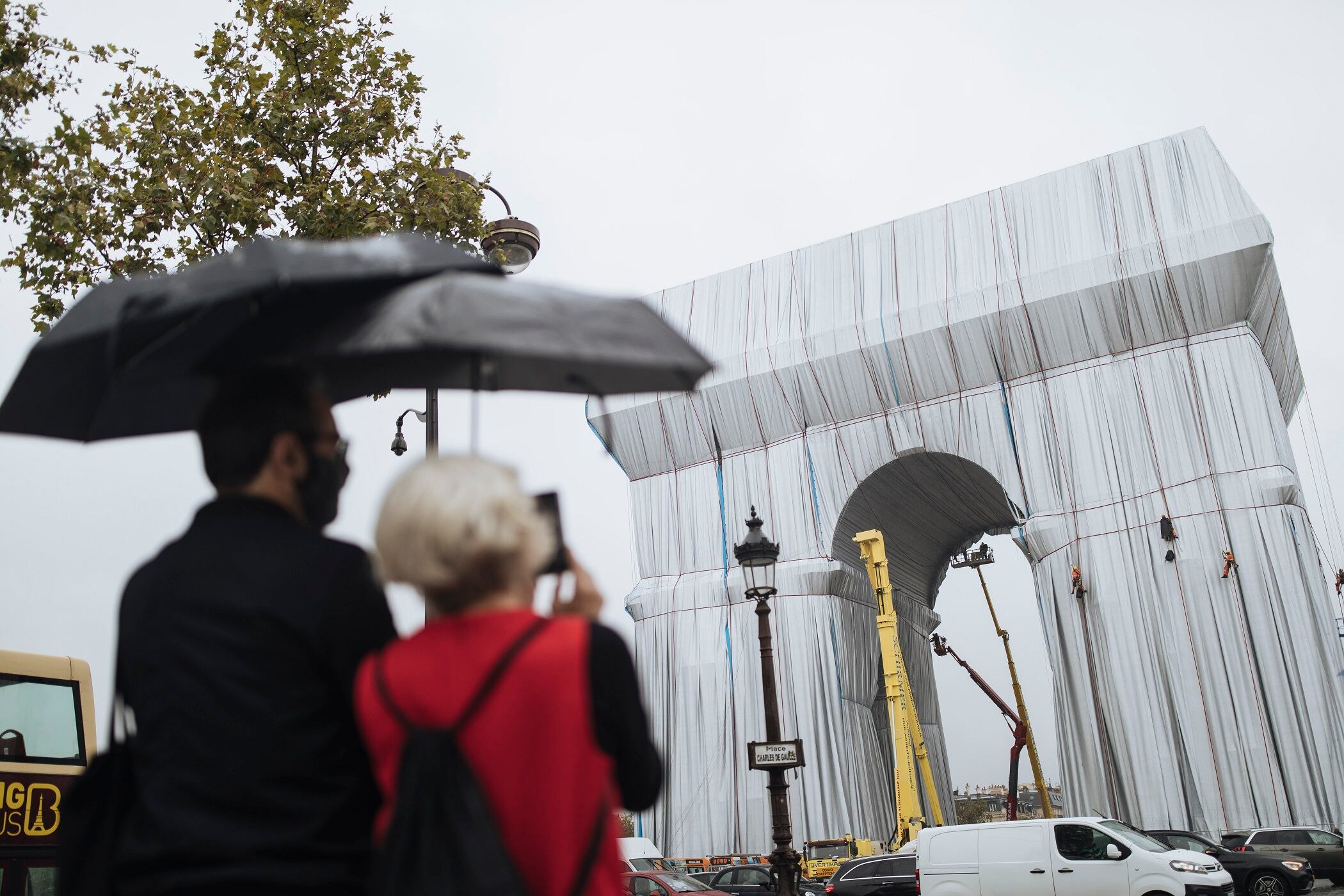
People watch workers wrapping the Arc de Triomphe monument, Wednesday, Sept. 15, 2021 in Paris. The "L'Arc de Triomphe, Wrapped" project by late artist Christo and Jeanne-Claude will be on view from, Sept. 18 to Oct. 3. The famed Paris monument will be wrapped in 25,000 square meters of fabric in silvery blue, and with 3,000 meters of red rope. (AP Photo/Lewis Joly)
By Arno Pedram
The city of Paris is unveiling a monumental artwork built around an actual monument: the Arc de Triomphe completely wrapped in silver and blue fabric.
The installation by late artist couple Christo and Jeanne-Claude, who conceived the project in 1961, will open on Saturday. Visits will take place for almost three weeks. At weekends, the Arc de Triomphe’s traffic-heavy roundabout will be entirely pedestrianized.
Visitors to the famous Napoleonic arch, which dominates the Champs-Elysees Avenue, will not only be able to see the gleaming fabric, but to touch it too — as the artists had intended.
Those climbing the 50 meters (164 feet) to the top will step on it when they reach the roof terrace.
At a press conference on the project entitled “Arc de Triomphe, Wrapped,” France’s Culture Minister Roselyne Bachelot called it “a formidable gift offered to Parisians, the French and beyond, to all art lovers.”
Bachelot added that it was “a posthumous testimony of artistic genius.”
Bulgarian-born Christo Vladimirov Javacheff met Jeanne-Claude Denat de Guillebon in Paris in 1958 and they later became lovers. The idea for the artwork was born in the early '60s, when they lived in Paris. Jeanne-Claude died in 2009, and Christo in May last year. The monument was to be wrapped last fall, but the COVID-19 pandemic delayed it.
Christo "wanted to complete this project. He made us promise him that we will do it,” the couple’s nephew, Vladimir Yavachev, told The Associated Press.
The 14 million-euro ($16.4 million) project is being financed through the sale of Christo’s preparatory studies, drawings, scale models, and other pieces of work, Yavachev said.
Passersby on Thursday looked up in awe. “It makes me think of a big gray elephant placed in Paris on the Champs-Elysee" said 47-year-old Thomas Thevenoud, who works nearby.
“You really rediscover the beauty of the form," said 39-year-old Parisian Agnieszka Wojel. “I couldn’t stop taking pictures because it’s extraordinary... We are very lucky.”
The artists were known for elaborate, temporary creations that involved blanketing familiar public places with fabric, including Berlin’s Reichstag and Paris’ Pont Neuf bridge, and creating giant site-specific installations, such as a series of 7,503 gates in New York City’s Central Park and the 24.5-mile “Running Fence” in California.
Yavachev said he plans to complete another one of their unfinished projects: a 150-meter-tall (492 feet) pyramid-like mastaba in Abu Dhabi.
“We have the blueprints, we just have to do it,” he said.
___
Masha Macpherson and Alex Turnbull in Paris contributed
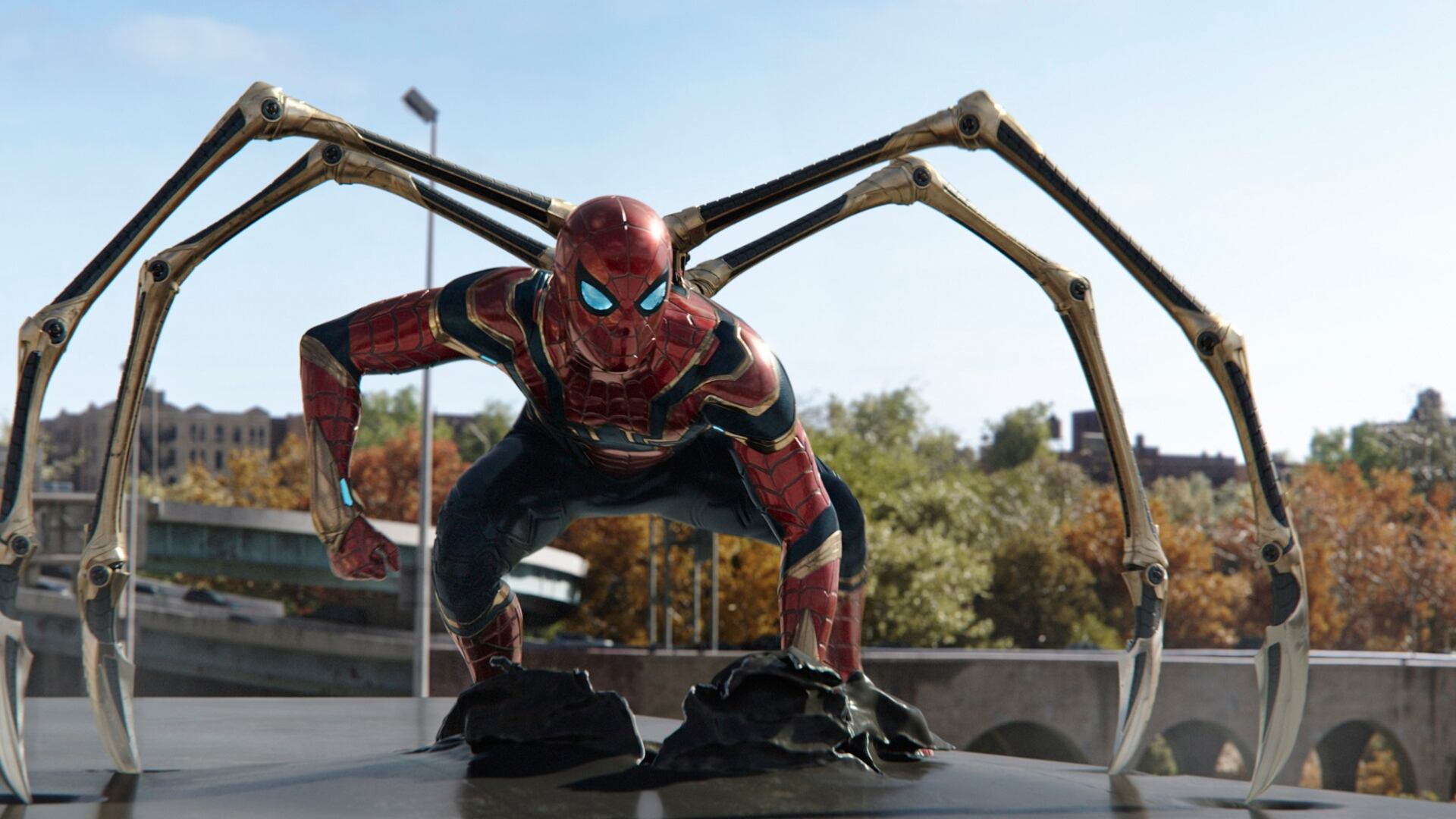
Marvel's "Spiderman: No Way Home" is the third highest-grossing film of the year and could be the only one to reach the $1 billion mark of 2021 with ticket sales already surpassing $750 million.
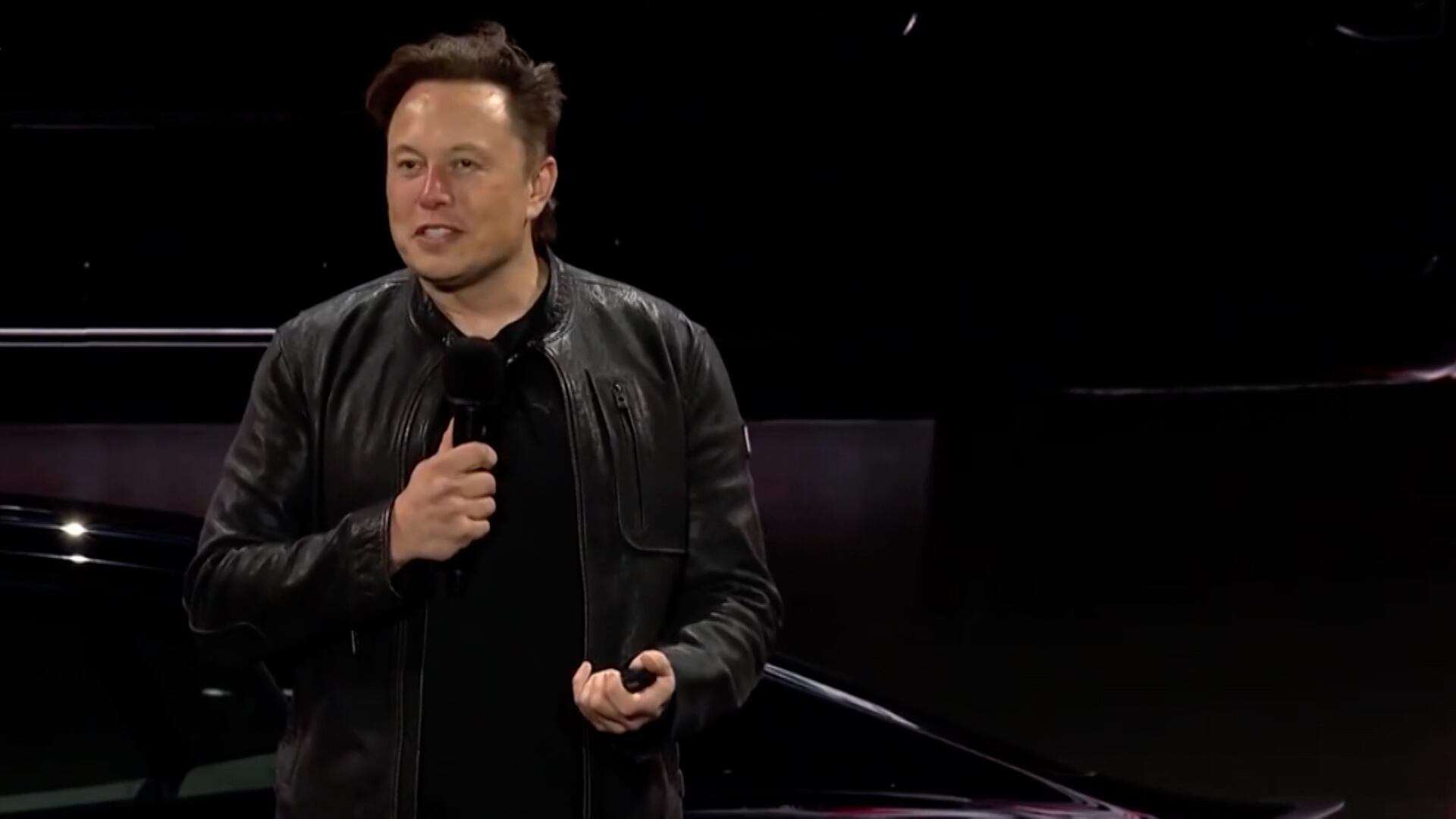
Although still early in development, blockchain technology, Web3, also known as Web 3.0 has been getting a lot of attention from some top tech names lately. Web3 is based on blockchain technology, which powers NFT’s and cryptocurrencies such as bitcoin. With Web3, users would ideally control their own data, rather than have it be controlled by a few large companies. But, Tesla CEO Elon musk isn't buying into Web3 just yet, tweeting over the weekend that the decentralized iteration of the internet seems more like a marketing "buzzword" right now than reality. Twitter co-founder Jack Dorsey also chiming in to the conversation, expressing doubt over whether or not Web3 would actually be decentralized if ownership still belonged to venture capital firms. Parker McCurley, co-founder & CEO of Decent Labs explains the significance of Web3 catching the eye of the tech giants, and what Web3 could mean for the future of the internet.
Carlo and Baker cover the heartening news on the Covid front ahead of the holiday, plus President Biden punting student loan repayments again, a new space telescope and Love, Hate, Ate: Christmas Eve Eve Edition!
This year's worldwide semiconductor shortage limited the supply of everything from new cars to smartphones; and now, many in the chip industry expect the shortage to continue deep into 2022, and maybe even 2023. Semiconductor senior research analyst for Robert W. Baird & Co., Tristan Gerra, joins Cheddar News' Closing Bell to discuss.
Pavel Bains, the Executive Producer of MixMob and CEO of Bluzelle, joins Cheddar News' Closing Bell to elaborate on an opinion piece he wrote for CoinDesk in which he compares the cultural significance of crypto to hip hop in the 1990s.
Direct health care company Nomi Health recently raised $110 million in a Series A round. Nomi Health lets public and private organizations directly purchase healthcare at reduced costs, and pay providers in real-time. It also delivers healthcare directly to under-served communities via its fleet of mobile care units, which the company says is the largest in the country. Nomi Health says its mission is to improve the health care experience for all Americans. Nomi Health CEO Mark Newman joined Cheddar News' Closing Bell to discuss.
Darby Fox, child and adolescent family therapist, joins Cheddar News to discuss how parents can navigate their child's mental wellness during the holidays.
A new series is looking to advance Black founders who have disruptive ideas and companies. 'Bet on Black' is a new series that allows black entrepreneurs to pitch their businesses in the hopes of securing $200,000 in funding. Revolt TV and Target teamed up to create the show. Detavio Samuels, CEO of Revolt, joins Cheddar News to discuss.